Tag Archives: Valdosta

HB 397 sunshine bill is now law: open government forecast partly cloudy

It’s a cloudy sunrise for open government in Georgia with HB 387 now law. Will anyone enforce it? Will local governments comply? Will the legislature extend this law into a sunshiny day in Georgia?

Aaron Gould Sheinin and Bill Rankin wrote for the AJC yesterday, Governor signs Open Records rewrite into law,

House Bill 397, which took effect upon Deal’s signature, is the first major rewrite of Georgia’s sunshine laws in more than a decade. New provisions in the open records and meetings laws increase fines for offenders. The maximum penalty of $500 is now $1,000, and offenders who commit repeat violations within a year face fines of up to $2,500.

Previously, the sunshine laws allowed only criminal complaints to be filed against suspected violators, meaning a prosecutor would have to prove the case beyond a reasonable doubt. The rewrite now allows the filing of civil complaints, which have a lower burden of proof.

That could be interesting if anyone actually files a complaint.

The rewrite also would provide new exemptions for some gatherings of governing bodies, such as allowing a quorum of members to attend the same civic function, receive training or visit government agencies — provided no official business is discussed or transpires.

So the various elected boards meeting together at the end of last month was probably OK, since they weren’t making decisions, merely educating each other. But the Lowndes County Commission repeatedly hiding from the public while discussing solid waste disposal, among other issues, does not seem to fit that exception.

It also reduces the cost of most documents disclosed under the Open Records Act from 25 cents to 10 cents per page.

That means the price of the Industrial Authority’s old minutes just went down, Continue reading

Parks and Rec Board meets Thursday

According to their website, the Valdosta-Lowndes County Parks & Recreation Authority (VLPRA) board meets Thursday:

Date: Thursday, April 19, 2012
Time: 4:30 P.M.
Location: VLPRA Office 1901 N. Forrest Street, Valdosta

I don’t have a detailed agenda, but their website says they’ll vote on rental rates, and they include links to: Continue reading

Importing illegal immigrants into private Georgia prisons

Ocilla, about an hour north of here, took the private prison gamble, and now is scrambling to import enough prisoners to fill it.

Jim Galloway wrote for the AJC 11 April 2012, Importing illegal immigrants — into private Georgia prisons quoting Hannah Rappleye and Lisa Riordan Seville in The Nation 10 April 2012, How One Georgia Town Gambled Its Future on Immigration Detention,

Deportations have reached record levels under President Barack Obama, and demand for detention facilities has increased. Starting in 2002, ICE had funding for 19,444 beds per year, according to an ICE report. Today, ICE spends about $2 billion per year on almost twice the number of beds.

ICE’s reliance on facilities like the Irwin County Detention Center has put small rural towns at the center of one of today’s most contentious policy arguments—how to enforce immigration law. A yearlong investigation by The Nation shows how much politics has come to rule detention policy. Even as Georgia and Alabama passed harsh new immigration laws last year designed to keep out undocumented immigrants, documents obtained through the Freedom of Information Act reveal that politicians from both states were lobbying hard to bring immigrant detainees in. ICE succumbed to the pressure, sending hundreds of detainees to the financially unstable facility in Georgia that promised to detain immigrants cheaply. That promise came at the expense of the health, welfare and rights to due process of some 350 immigrants detained daily in Ocilla.

Marvelous. Pass a low to eject illegal immigrants, except it really locks up a bunch of them, but not enough to keep Ocilla’s private prison full, so import a bunch of them back in as prisoners.

Aren’t you glad we didn’t accept a private prison in Lowndes County, Georgia?

Ocilla and Irwin County didn’t just make that bad bet once, they doubled down on it:

Continue reading

Videos @ VLCIA 2012 03 20

Likely new industry, private prison really cancelled, strategic planning, and trees in the median!

Here are videos of the entire March regular meeting of the Valdosta-Lowndes County Industrial Authority (VLCIA). Here’s the agenda.

It’s good that they approve minutes after emailing them to each other. Maybe someday we the taxpayers will get to see those minutes.

Did you know they had two executive sessions on 23 February 2012, at 10AM and 2:25 PM in addition to their retreat and regular meeting of that same day? If they’re having all these executive sessions, presumably all the material about personnel and real estate that needs to be kept confidential is in there, and the minutes of the regular meetings shouldn’t contain anything the public should not see.

For example, Continue reading

Videos @ Joint Governments 2012 03 29

Here are videos of the entire “first annual Valdosta-Lowndes Governmental Leadership Meeting” that was held 6:30 PM 29 March 2012 in the Lowndes High School Lecture Hall. Here’s the announcement.

The meeting was introduced by Dr. Steve Smith, Superintendent, Lowndes County Schools. Lowndes County Schools had a written position statement, with everything from a broad variety of test scores and other metrics to specific examples of existing collaborations such as loaning busses to the Valdosta School System for away sporting events.

Dr. Smith clarified that:

This is not a community forum, it is not an open dialogue.
He told me before the meeting started that he was concerned that if they opened it up to questions from the audience it would take all night and it had been hard enough to get the various elected officials to show up at all without expecting them to stay for that. I didn’t see but maybe a dozen non-elected audience members, so I wonder whether that really would have happened, but I applaud the various governments for collaborating at all. He did say if you had a question you could write it down and hand it to a member of your elected government or school board. He also indicated that committees might form, not that evening, but perhaps growing out of that evening’s meeting. He reiterated this meeting was for brainstorming among the elected officials.

The elected officials included Valdosta Schools Superintendent and many VBOE members, Lowndes School Superintendent and Superintendent-elect and many LCBOE members, Valdosta Mayor, City Manager, and many city council members, and Lowndes County Manager, Clerk, and voting commissioners, but not the Chairman.

Wes Taylor, Lowndes High School Principal & Lowndes County Schools Superintendent Elect talked about finances.

Valdosta Mayor John Gayle said we’re regional now (regional hospital, regional university, etc.). He talked about how Troup County went about landing the Kia plant, which had to do with each governmental entity taking a role and collaborating. (It had nothing to do with school consolidation.)

VBOE member Vanassa Flucas said they try to put everything related to their schools on their website, in an effort of transparency for parents and students. Plus:

We noticed that since we put our strategic plan on our website approximately three years ago, it was very well received. It was very heartening; people could find the information that they wanted.
Imagine that! Continue reading

They come to school hungry; they come to school homeless — Bill Cason @ Joint Governments 2012 03 29

Breaking from the agenda of the first annual Valdosta-Lowndes Governmental Leadership Meeting, Valdosta School Superintendent Bill Cason rose above tactics and talked about vision and the root of the matter: poverty.

Supt. Cason started talking about teenage pregnancy and drug use, and then got to the heart of the matter:

They come to school hungry; they come to school homeless. Last year we identified more than 200 homeless kids in our school district. We can talk about all of these other things, but until we can address those as a group, every public entity in this room, is willing to get together as a team and address those issues, we forgot the most important thing we deal with, that is our students.

[applause]

They will be the future leaders of this community. And if you want to see Valdosta take a backwards slide, then let this problem run as it is and you will see. I’ve seen it before in other communities, and I’m seeing it here now. This is not something we can wait on; it has to be done now. So if we want to really be serious about what we’re talking about tonight, educating our children, having a viable community, having a good community, having recreational facilities everybody can use, then you need to begin to address these problems not only with our mouths, but with our money and with our resources. And until you do this, then we’re going backwards.

Poverty is the root of the matter. It’s great that the local goverments and school boards are talking, and they can tinker around the edges all they want, but until they get serious about poverty in our community, educational improvements and the future of the community will be severely limited.

-jsq


Videos of Rally for HOPE @ LCDP 2012 03 24

Rain kept the numbers down, but the enthusiasm was strong in Lakeland at the Rally for HOPE, 24 March 2012.

The announcement said:

This will be a Rally for the Hope Scholarship and a Voter Registration. Everyone concerned about HOPE is invited. We will have guest speakers and will hear from those students and families affected by the current status of HOPE.

The featured speaker was Janice Barrocas of HOPE for Georgia, which is running a three year nonpartisan campaign to save HOPE scholarships.

Bikram Mohanty explained that there will be a shortfall of $270 million for the HOPE scholarships in 2012. Janice Barrocas pointed out there were really two HOPEs now: the other one being the Zell Miller scholarships. Bikram showed a map that illustrates that very few Zell Miller Scholarships go to south Georgia.

Janice Barrocas and Bikram Mohanty discussed that HOPE is funded by a lottery, and lottery funds are down in the recession. The blue line on the chart is deposits from the lottery into the HOPE program, the red line is expenditures, and the green line, dropping rapidly, is reserves at the end of the year.

Janice Barrocas noted that

The end users of this program were not at the table

when the recent HOPE changes were passed. Especially students mostly found out when they got stuck with bigger bills they had to pay. Students and their families may still be too polite to mention they have financial troubles, but it’s time to break the culture of silence when it’s a choice between the family eating or the student going to school. Betty Marini pointed out students loans add up to $1 trillion dollars, which is a huge drag on the economy.

Matt Flumerfelt observed that there is a push for divestiture and privatization these days, and he wondered if the silence around the quick passage of the recent HOPE changes wasn’t because it was a money grab for the lottery funds.

Tech school HOPE is grants, and most tech school students get them. If HOPE went away, the lottery would Continue reading

Industrial Authority board meets Tuesday @ VLCIA 2012 04 17

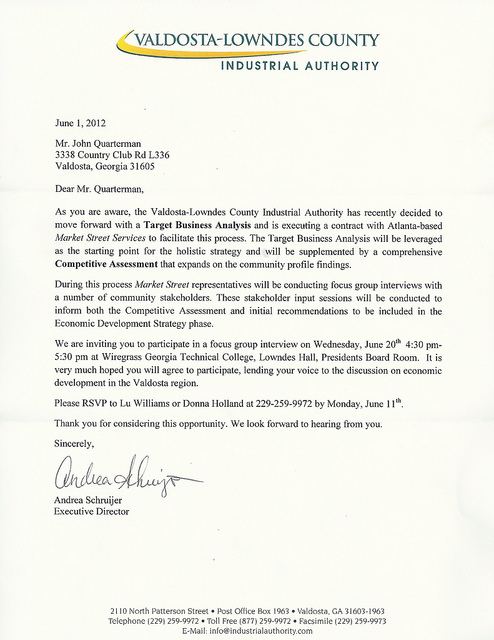
Industrial Authority board meets about something or other Tuesday; hard to tell what. Maybe this will reveal some sort of strategy:

  • Target Market Study Update

VLCIA’s website is restored enough to say:

The Valdosta-Lowndes County Industrial Authority will hold a Regular Board Meeting on Tuesday, April 17, 2012 at 5:30pm in the Industrial Authority Conference room.
They’ve also posted a notice on their facebook page.

The agenda doesn’t say much. I guess that one time they put a lot of information in it was a one-shot. And if you want to see any old agendas, you’ll need to wait until they finish fixing their website. Or look in the LAKE blog….

Now, let’s see, where are those minutes?

Here’s the agenda.

-jsq

Valdosta-Lowndes County Industrial Authority
Agenda
Tuesday, April 17, 2012 5:30 p.m.
Industrial Authority Conference Room
2110 N. Patterson Street
Continue reading

Underfunded ethics commission makes mistakes

Underfunding of Georgia’s ethics commission has led to numerous inappropriate fines, some of which are still being straightened out after many months. Maybe the legislature should fund the ethics commission to a working level and make it independent of the legislature.

David Rodock wrote for the VDT 29 September 2011, Transparency Confusion: New campaign contributions system leads to officials owing fines,

The Georgia Government Transparency and Campaign Commission posted a seven-page list online earlier this week ethics.ga.gov of local government officials who have supposedly failed to submit their campaign contribution information this year.

According to the state organization’s website, each late filer owes fines of different amounts.

Various elected officials were quoted in that article saying the fines were inappropriate. Many of those fines had already been removed from the list by the time that article was written.

There have been calls to properly fund that agency and to make it independent of the legislature. The Columbus Ledger-Inquirer wrote 25 January 2012, Ethics panel needs funding and independence,

Continue reading

Even George Will is calling for drug legalization

We can’t afford this anymore:
A $200 transaction can cost society $100,000 for a three-year sentence.
It’s time to legalize, regulate, and tax drugs, taking tax money away from private prisons and police militarization, and freeing it up for education, health care, and rehabilitation.

George F. Will wrote 11 April 2012, Should the U.S. legalize hard drugs?

Amelioration of today’s drug problem requires Americans to understand the significance of the 80-20 ratio. Twenty percent of American drinkers consume 80 percent of the alcohol sold here. The same 80-20 split obtains among users of illicit drugs.

About 3 million people — less than 1 percent of America’s population — consume 80 percent of illegal hard drugs. Drug-trafficking organizations can be most efficiently injured by changing the behavior of the 20 percent of heavy users, and we are learning how to do so. Reducing consumption by the 80 percent of casual users will not substantially reduce the northward flow of drugs or the southward flow of money.

Will-like, he ignores the real reasons we’re locking up so many people (corporate greed), but he does get at the consequences: Continue reading