Tag Archives: Lake Park

Communities watching boards

Susan Hall Hardy says that in most places industrial authority executives don’t interact with their communities. Well, paraphrasing what Yakov Smirnoff used to say, in Lowndes County, community interact with officials!

Here is her comment from 15 March 2011 on this blog:

Not to be rude, although honesty is very often perceived that way these days, but, the industrial authority executives rarely thank their communities. In the six states I’m most familiar with, these fellows see themselves as beholden only to their employers. After all, they work with their directors, elected officials, a few bankers and city/county department heads. Rarely do they come in direct contact with the average voter, employee or homeowner, although all those people often pay a large part of their salaries and office operating expenses. Despite the public funding, these groups are usually tight lipped about how they do business and rarely provide the public with records or audits. We’ve all put up with that manner of doing business for so long we now see it as just that — the way you do business. We’d never accept that from a nonprofit organization, a charity group or most elected officials. Shame on us all.
Susan, you’re helping by reading, and you’re helping more by posting. Many local officials have noticed LAKE and this blog because they know people read it.

Anyone who wants to help still more, you, too, can go to a meeting. The Industrial Authority is a good one to attend, but I hear the Tree Commission isn’t trying as hard to enforce things, and does anybody know anything the Hospital Authority does? The Airport Authority? Continue reading

G. Robert Carter (1924-2011)

Update 13 Feb 2011: A very nice biography and tribute in the VDT today. His birth year is corrected in the title of this post.
According to the VDT today [12 Feb 2011]:
At approximately 11 a.m. Saturday morning, emergency personnel responded to the residence of G. Robert Carter, former Lowndes County Commissioner and Sheriff. Carter, who was recently hospitalized for an unnkown illness, has reportedly passed today.
Two weeks ago he spoke as he was being honored at the Lake Park Chamber of Commerce Annual Dinner:


G. Robert Carter, former Lowndes County Commissioner District 3, former Sheriff,
speaking at the Lake Park Chamber of Commerce annual dinner,
Lake Park, Lowndes County, Georgia, 28 January 2011.
Video by Gretchen Quarterman for LAKE, the Lowndes Area Knowledge Exchange.
I’ve lived long enough to appreciate the Greatest Generation, but also to appreciate the younger ones coming along to take our place.

I’m not totally out of business; I might be able to help you somewhere down the line. As I told Crawford, don’t wait until you get in trouble. Come to see me before you get in trouble.

Here are videos of all the tributes to Sheriff Carter that evening. Continue reading

Why “jobs, jobs, jobs” isn’t good enough for the public good and the general welfare –John S. Quarterman

Sure, everyone wants jobs for the people right now and jobs so the children don’t have to go somewhere else to find one. But what good is that if those jobs suck up all the water those children need to drink?

This is the problem:

“What I believe the three most important things are, not only for our community, and our state, and our country, but for our country, thats jobs number 1, jobs number 2, and jobs.”


Brad Lofton, Executive Director, Valdosta-Lowndes County Industrial Authority (VLCIA),
speaking at the Lake Park Chamber of Commerce annual dinner,
Lake Park, Lowndes County, Georgia, 28 January 2011.
Video by Gretchen Quarterman for LAKE, the Lowndes Area Knowledge Exchange.

I shook Brad Lofton’s hand after that speech and told him I liked it, because I did: in general it was a positive speech about real accomplishments. I’ve also pointed out I had a few nits with that speech. This one is more than a nit. This one is basic philosophy and policy.

Now one would expect an executive director of an industrial authority to be all about jobs. And that would be OK, if Continue reading

What was missing from Brad Lofton’s speech?

Seems like there’s something from Brad Lofton’s speech at the Lake Park Chamber of Commerce on 28 January 2011. Right at the end he mentioned:
a project we’ve been working on


Brad Lofton, Executive Director, Valdosta-Lowndes COunty Industrial Authority,
speaking at the Lake Park Chamber of Commerce annual dinner,
Lake Park, Lowndes County, Georgia, 28 January 2011.
Videos by Gretchen Quarterman for LAKE, the Lowndes Area Knowledge Exchange.

What could that project be?

Right at the beginning Lofton said:

Ben Copeland beat me slap silly
Maybe that’s a clue. What did Ben Copeland say about Brad Lofton?
Brad Lofton was going to talk after me, and he’d talk about biomass. [laughter]
Continue reading

Brad Lofton’s memory fails him again, and again….

Speaking at the Lake Park Chamber of Commerce 28 January 2011, Industrial Authority Executive Director Brad Lofton remarked about:
The largest solar panel array that we are aware of today in the state of Georgia. That’s 350 kW solar panel array that you’ll be seeing coming out of the ground February first.


Brad Lofton, Executive Director of the Valdosta-Lowndes County Industrial Authority (VLCIA),
speaking at the Lake Park Chamber of Commerce annual dinner,
Lake Park, Lowndes County, Georgia, 28 January 2011.
Videos by Gretchen Quarterman for LAKE, the Lowndes Area Knowledge Exchange.

That’s funny, because as readers of this blog may recall, on 18 January 2011 I pointed out to Lofton that: Continue reading

Brad Lofton asks for your ideas

In a generally congenial and well-received speech to the Lake Park Chamber of Commerce (LPCoC), Industrial Authority (VLCIA) executive director Brad Lofton gave an update on various projects and concluded by asking for input. “Economic development is a team sport,” he said, and “Give us ideas” and “There’s one of us and hundreds of you.”

Lofton was introduced by LPCoC chairman Dan Bremer who said that Lofton and VLCIA brought a plant to Lake Park with 400 workers.

In his speech, Lofton lauded the LPCoC as a great incubator of local businesses.

It’s going to come from all of you.
He talked about expanding local industries, especially PCA at length, asking David Carmon of PCA to stand up, saying PCA made a $230 million expansion in 2010, and noting “We had to compete for the PCA project.” Continue reading

Biomass water usage as a problem. –Ben Copeland

Ben Copeland, who is on the Suwannee-Satilla regional water council, has learned something about rivers:
“One of the things that keeps some of these rivers going is the treated effluent that goes into them.

Now Brad Lofton wants to use some of that up in a biomass plant. We have a problem there.”

It’s at the end of this video:


Video of Ben Copeland, Past Chairman of the Board, Wiregrass Technical College,
speaking at the Lake Park Chamber of Commerce annual dinner,
Lake Park, Lowndes County, Georgia, 28 January 2011.
by Gretchen Quarterman for LAKE, the Lowndes Area Knowledge Exchange.

Matthew Richard brought up a similar point in his LTE in the VDT of yesterday: Continue reading

Ben Copeland on water and growth in south Georgia

Ben Copeland asked the big question: “How much growth do we want?” He related it to regional water in the aquifer, rivers, growth, and planning, speaking at the Lake Park Chamber of Commerce annual dinner, 28 January 2011.

Copeland is Past Chairman of the Board, Wiregrass Technical College. He serves on the regional water planning council. He said those councils were started due to worries about Atlanta not having a reliable water supply. He said the councils were planning for water and wastewater to 2050. The local regional council is the Suwannee-Satilla regional water council. He described the extent of the water planning region (see map). He expects finalization of the water plan by May. He talked about the Floridian aquifer, and how he’s worried not so much about Atlanta taking our water as about Orlando, Jacksonville, and Tallahassee. “Because they all have their straws in that same aquifer.”

Finally, Ben Copeland asked the big question: “How much growth do we want?”

“Do we want to be Jacksonville? Do we want to be Tallahassee? Do we want to be a large metropolitan region?

Folks are going to move to south Georgia, I can tell you that, because of all the resources that we have. I’m a great believer in the free enterprise system. How much do we try to limit that?

Continue reading

Parks and Rec. Appointment, Lowndes County, Georgia

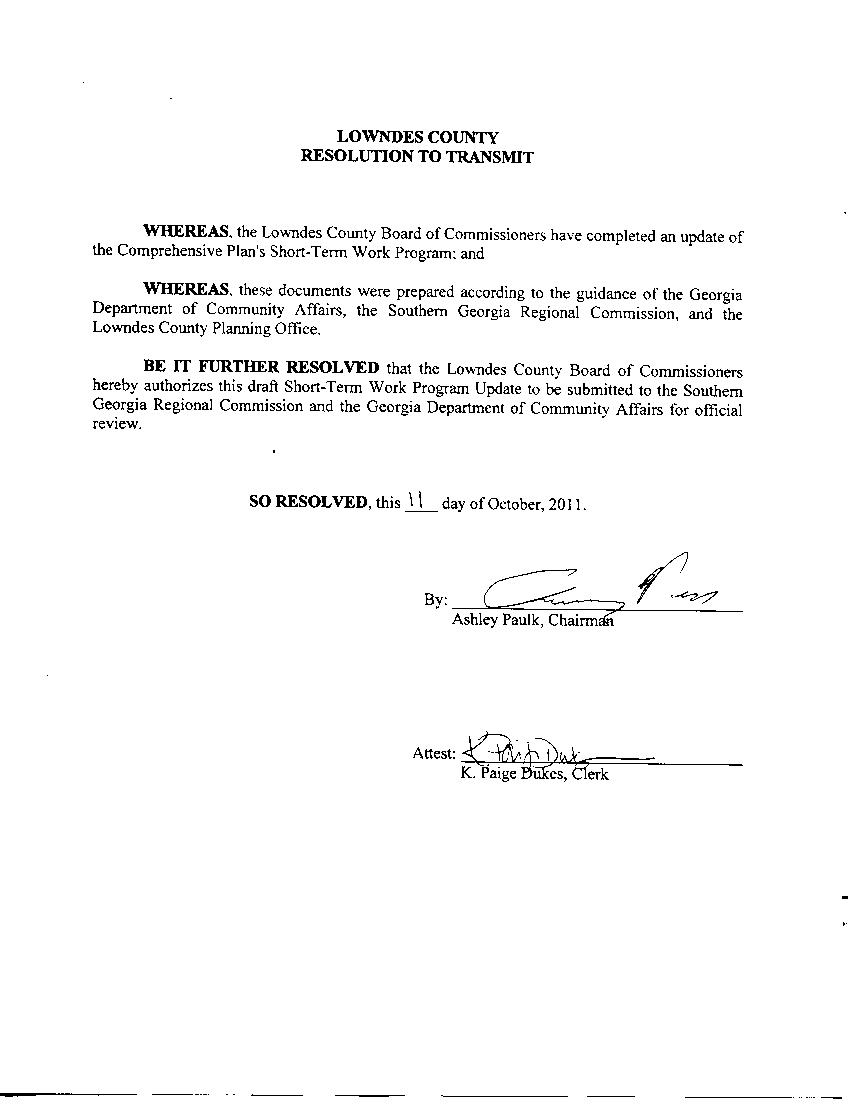
Previously, the Valdosta City Council appointed City Council member Robert Yost to the Valdosta-Lowndes County Parks & Recreation Authority (VLPRA). The Lowndes County Board of Commissioners debated appointing a Commissioner to the VLPRA at their June 8 meeting:

They decided to appoint their chairman, Ashley Paulk, to the VLPRA. Chairman Paulk said he would serve, but as a private citizen. I wonder then what the point was of appointing him, rather than someone else.

When Valdosta appointed Yost, Ashley Paulk provided this statement to the VDT: Continue reading

DoJ Rejects Lowndes County Redistricting

The Valdosta Daily Times seems to have a reading comprehension problem:
In denying the Lowndes County Commission the right to expand under the current proposed “superdistrict” plan, the DOJ stated in its opinion, “Our analysis of the evidence precludes a determination that the county has met its burden of showing that the proposed plan was not adopted, at least in part, with the purpose of making minority voters worse off.” In addition to stating that the plan was done deliberately to disenfranchise black voters, the letter of explanation that the DOJ sent to the county Tuesday regarding its denial of the petition states that the proposed plan was not in compliance with the Voting Rights Act regarding discrimination.
Saying the county has not shown that it has not done something is not the same as saying the county deliberately did that thing.

The commission chairman seems to be forgetting his history:

Paulk said he is certain that the map met all of the criteria in the Voting Rights Act. The initiative was approved by the state’s General Assembly and voters approved the plan on Nov. 4, 2009.

In denying the proposal, Paulk says the DOJ is denying the right of the people to vote on a plan of their choosing, noting that it passed overwhelmingly in the majority minority districts.

“We had a democracy when we drew those maps, not the socialist government we have now,” Paulk said.

The county districts currently in use were required in 1984 as part of a court settlement under that well-known socialist, Ronald Reagan.

That’s a good point about the plan passing overwhelmingly in the majority minority districts, but it also passed when nothing else was on the ballot for the county (everything else was for the various cities in the county), so few people outside Valdosta, Hahira, and Dasher voted on it. This problem was noted beforehand by state representative Ellis Black:

“My concern is about the inequity where it’s a special election in the unincorporated areas but it’s a regular city election,” Black said. “I’m concerned about the impact on the turn out as there will be a greater emphasis on city voters more so than the unincorporated voters.”
The VDT quoted Ashley Paulk as saying he didn’t want to spend the money to hold a special election: “$40,880 minimum.” This from a county government that just spent $15 million for a bridge that few people use and $1.5 million to pave a road the majority of whose residents didn’t want paved. Is the will of the people in the unincorporated areas so unimportant? In any case, it looks like the county will now need to pay for developing another redistricting plan.

The VDT quotes Joe Pritchard, County Manager:

“We are satisfied that we did everything we possibly could to create a plan that met all of the criteria,” he said.
If so, apparently all they could do was not enough. Also, the plan the county government proposed was not the only possible plan.

Back in 1997 a plan was proposed that would have put two commissioners in each of the two districts. The voters voted it down, and for that one the VDT wondered if the voters got it right, because the SPLOST tax was the big issue at the time, not commission expansion.

Another way would be to split the current districts lengthwise, creating two out of each of them. I don’t think that possibility was ever seriously entertained by the current commissioners. Why not is mysterious.

The DoJ was aware of the possibility of splitting at least the existing minority district, and said so:

Moreover, the evidence establishes that this retrogression was avoidable. Several alternatives exist that meet the county’s stated criteria and do not have a prohibited retrogressive effect. For example, it is possible to create an illustrative plan that follows the county’s 3-2 configuration, but which, unlike the county’s proposed plan, creates a second district in which census data show that the African American community would be able to elect a candidate of choice. The most recent data indicate that African Americans constitute 53 percent of the registered voters in this illustrative district. Although the county’s contention that the 2000 Census data understate this district’s current African American population percentage appears to be correct, it does not alter our conclusion, based on an analysis of voter registration data from October 2009, that the district would not afford black voters the ability to elect candidates of choice to office.
That’s the paragraph in the DoJ letter immediately before the passage the VDT quoted. Neither the VDT nor the county government has chosen to put a copy of the DoJ letter on the web, but fortunately the DoJ did, so we don’t have to go by what we’re told to think; we can read the letter for ourselves.

The VDT article about redistricting history neglects to mention that another plan was put to a vote around 1983 that would have expanded the county commission to 9 members, if I recall the number correctly from the VDT article of that period I saw in the county museum. That plan was only narrowly defeated by the people of the county. Perhaps a similar plan, better prepared and presented, might fare better today. Thomas County, with about half the population of Lowndes County, has eight commissioners.

Current commissioners are aware of that mid-1980s plan, and at least one of them objects to it because it would have created a district entirely within Valdosta, which is already represented by the Valdosta City Council. This makes me wonder if all the voters in the current county commission districts who happen to live inside Valdosta (or Hahira, or Remerton, or Dasher, or Lake Park) don’t count? That would be ironic, since they’re the ones who just voted for the plan these same commissioners favored.

The county government also did everything it thought it possibly could to create a new county waste disposal plan last year, but external reality intervened in that case, too. The county couldn’t get bids for its plan at the minimum it required. This was just as well, since there were strenuous objections to the county’s plan, voiced by hundreds of people at the meetings the county held not to get early input, rather to tell the people what the county government had decided.

The incoming chairman, Ashley Paulk, came up with a new, simpler plan that addressed most of the objections of the old waste disposal plan and that’s the one now working fine. The current waste plan was sort of an emergency solution arrived at without much external input.

Here’s a chance for the new chairman to once again demonstrate the adaptability of the county government. Given that circumstances have repeatedly indicated that the county government’s solution to a problem isn’t necessarily correct just because the county government believes it is, perhaps this time a transparent process for citizen participation could be used so that the people and the DoJ could be convinced that a solution is correct.