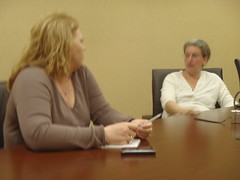
Norman Bennett, VLCIA board member and former chairman of the Lowndes County Commmission,
asked Corey Hull:
Can you explain that again for me about the penalties if the voters don’t pass the tax?
If the county’s got a project, then they’ve got to put up ten percent
or whatever the percentage is?
What’s this about yet another sales tax decided on by
regional transportation boards and GDOT?
Corey Hull of the Valdosta-Lowndes County Metropolitan Planning Organization
(VLMPO)
explained T-SPLOST
at the regular monthly meeting,
Valdosta-Lowndes County Industrial Authority (VLCIA).
Georgia HB 277, which was passed by the legislature and signed into law
last year,
calls for a 1% regional sales tax (T-SPLOST) to fund
transportation projects.
Valid points and a great question to ponder. You may recall my quote
from Benjamin Franklin: “Waste not, want not”.
Add to that a quote from the Sierra Club: “Energy use should be
minimized through conservation and efficiency. In the near future,
efficiency is the only “energy source” which does not incur some
environmental damage and which is available immediately in generous
supply. Sophisticated building construction, efficient appliances,
recycling, modernized industrial
processes, programmable thermostats, public transit supplemented by
fuel-efficient cars, and many other innovative technologies can reduce
energy use tremendously, while saving money.”
In other words, we are wasting enormous amounts of energy and money
I thought you all might find this power point article interesting. It
was sent to me by a group representing local small farmers who are
looking into growing bio-crops for economic opportunities to feed their
families. The information below is from the power point presentation.
After he gave his
goodbye speech,
I
wished him happiness in Myrtle Beach
and thought maybe he’d make a graceful exit.
Nope, he’s still cranking the Edison phonograph on the same old
scratched wax cylinder.
Here he is last week responding to James Wright
and dozens of other people in the same thread
to which I later posted
It’s an opportunity.
In Lofton’s case, he’s still fixated on the losing proposition of biomass fuels.
-jsq
Thanks so much for sharing this and for your continued strong support of our
client’s green renewable energy project. In addition to assisting the
country in reducing our consumption of middle eastern fuel and improving the
environment, this project will provide a much needed economic impact for
landowners of every race, and the Industrial Authority will assist in the
efforts underway to assist local farmers. Google “benefits of biomass
electricity,”
We’ve rotated around the north end of Lowndes County;
time to rotate down to the west of Valdosta.
Monthly LAKE Meeting
When: 5:30 PM, Tuesday 5 April 2011
Where: Heidi’s Brooklyn Deli
1407 W Hill Ave Ste 1
Valdosta, GA 31601
(229) 241-9944
That’s on Hill Ave just east of St. Augustine Road.
They’re open until 9PM, and they’d be happy to push a few tables
together for us.
Restaurant review and source of the picture.
Help cover food, water, transportation, incarceration, solar energy,
biomass, and regular local government meetings: you never know when
news will be made!
If you follow the LAKE blog,
On the LAKE Front,
which you can also see through the
LAKE facebook page,
you know what we cover, from protesters to private prisons to gardening,
all of which turn out to be related.
What else do you want to investigate?
You can be LAKE, too!
Continue reading →
Protestors wearing respirator masks held signs reading “Biomass? No!”
in front of the Valdosta City Hall building on Thursday. Members of
the Wiregrass Activists for Clean Energy, the VSU student organization
Students Against Violating the Environment, and other concerned Valdosta
citizens showed up to protest the construction of the Wiregrass Power:
Biomass Electric Generating Plant.
“We already have solar power resources in place that we could be using
and I feel like money should be directed towards that,” Ivey Roubique,
vice-president of the Student Geological Society, said. “It wouldn’t
be good for the community and even though I’m in college here it
still matters.”
The Spectator article quotes from two speakers for whom LAKE
happens to have video, linked below.
Continue reading →
When public officials ignore objections for long enough, eventually
people start speculating as to their motives, in this case about the proposed biomass plant.
Here’s
the video:
Regular meeting of the Valdosta City Council, 24 February 2011.
Videos by Gretchen Quarterman for LAKE, the Lowndes Area Knowledge Exchange.
Erin Hurley provided the very model of how to give a speech:
I’m the president of
Students Against Violating the Environment at VSU.
I’m here representing
200+ members of SAVE, that consists of students, faculty, community members.
We are deeply concerned with environmental issues and
we are networking together to make this city a more humane and
sustainable community
for future generations.
As a student, I feel I have the right to be able to breathe clean air
at the college I attend.
With this biomass plant possibly being built here,
the future for generations to come are in jeopardy, and we want to protect our fellow and future students’ health.
Please take into consideration the future health of this university
and its community,
and don’t sell grey water to the proposed biomass plant.
Erin Hurley, President of
SAVE, Students Against Violating the Environment, speaking at
Regular meeting of the Valdosta City Council, 24 March 2011,
Valdosta, Lowndes County, Georgia.
Videos by Gretchen Quarterman for LAKE, the Lowndes Area Knowledge Exchange.
She said who she was, who she represented, how many, what they were for, what they wanted, quickly enough that attention didn’t waver, slowly and loudly enough to be heard, and briefly enough to transcribe, with pathos, logic, and politic. Even the mayor looked up at “As a student….”
Such publicly owned networks can offer services that incumbents don’t,
such as the 1Gbps fiber network in Chattanooga, Tennessee, run by the
government-owned electric power board. And they sometimes have more
incentive to reach every resident, even in surrounding rural areas,
in ways that might not make sense for a profit-focused company.
According to this map of
Community Broadband Networks
by the Institute for Local Self-Reliance,
quite a few small cities in south Georgia have municipal cable networks: