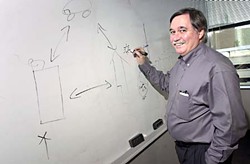
“Renewable (energy sources are) going to have a sliver,”
Bowers said of fuels to create electricity. “Is it going to be
2 or 4 percent? That’s yet to be determined. Economics will drive
that. But you always remember (that renewable energy is) an
intermittent resource. It’s not one you can depend on 100 percent of
the time.”
One time you can depend on it is hot summer days when everybody is
air conditioning, which is why
Austin Energy flipped in one year
from spouting such nonsense to deploying the most aggressive solar rooftop
rebate program in the country.
Austin Energy did the math and found those rebates would cost
about the same as a coal plant and would generate as much energy.
And when it is needed most, unlike the fossilized baseload grid,
which
left millions without power in the U.S. in June
and
hundreds of millions without power in India in July.
Pushers of the charter school amendment must be desperate!
Blurring the line between public officials and private
citizens, state Attorney General Sam Olens wrote:
Local school boards do not have the legal authority to expend funds
or other resources to advocate or oppose the ratification of a
constitutional amendment by the voters. They may not do this
directly or indirectly through associations to which they may
belong….
That means organizations like the Georgia School Boards Association,
and perhaps, the Georgia School Superintendents Association, would
be barred from speaking out against the proposed constitutional
amendment.
Olens’ letter would apply to what
the VDT said was in the VBOE and LCBOE joint resolution,
at least the part about “The resolution explicitly states that the boards
are asking voters to not support the Constitutional Amendment relative
to state charter schools.”
But what does Olens mean, duly elected local school boards don’t
have authority to express opinions about educational matters
that would directly affect the people who elected them?
Will he next be telling the Valdosta City Council it can’t
pass a resolution opposing a referendum?
What exactly is the difference between that elected body and
an elected school board as far as expressing such an opinion?
And all of those resolutions were non-binding opinions.
The Valdosta Board of Education, followed by the
Lowndes County Board of Education, adopted a
“Charter School Amendment Resolution” or a
“Joint Resolution in Support of Quality Public Education”,
depending on which ones minutes you go by.
What does the resolution actually say?
“The Lowndes County and Valdosta City Boards of Education
request that the Governor and State Legislators commit their support
to adequately fund a first-class K-12 public education for students
in Lowndes County and Valdosta City and across the state of
Georgia,” the resolution states.
The resolution explicitly states that the boards are asking voters
to not support the Constitutional Amendment relative to state
charter schools.
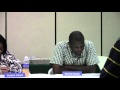
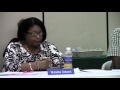
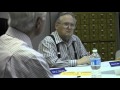
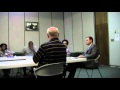
The library board heard citizens at length about a problem that was
apparently news to the board,
later considered the problem at length,
came up with an interim solution,
and formed a committee to examine it longterm.
Citizen concerns about rules against after hours library use
Concerns were raised about hours at the southside library at the monthly meeting
of the South Georgia Library Board, 18 September 2012.
Apparently rules have recently been changed for
all library branches
so that meetings can no longer be held after library hours.
This is a problem for volunteer groups composed of working people.
It was unclear what the latest version of the rules is.
And the library board appeared
unfamiliar with the hours of its own libraries.
However, they did at the end of their meeting
extensively consider the issue
and apparently come to an interim solution with
a path to a more general solution.
The rules change may have been due to
one incident at one branch
(not the southside branch)
for which the library board knew the sponsoring organization.
Questions were raised as to why a blanket rules change ensued.
One citizen pointed out that
taxpayers pay for the library buildings
so it’s not clear why they should be prevented from using them;
school buildings, too.
Another consideration was
elderly parent care, because it’s hard to get help for that
any time other than during the day.
Kay Harris wanted to be sure everyone who wanted to speak had spoken.
At least one citizen left
a written statement for the record,
which is always a good idea.
Then all the citizens who had spoken left the meeting,
apparently uninterested in anything else the library board was doing.
Interestingly,
a southside library support group
was in one of the regular report items.
Transparency
After the other citizens left, one of the library board (his nameplate
said Ray Devery)
asked whether Gretchen could stay.
Kay Harris without hesitation said yes and moved on to approval of the minutes.
Congratulations to Kay Harris on knowing the open meetings law
and sticking to it!
Speaking of the minutes, where are they so the taxpaying public can see them?
Regarding the planned Five Points library, Kay Harris clarified
that staff are not supposed to help promote that
“in any way, shape, or form.”
During paid hours.
After hours is different.
South Georgia Library Board
southside library hours,
Monthly Meeting, South Georgia Library Board (SGLB),
Video by Gretchen Quarterman for Lowndes Area Knowledge Exchange (LAKE),
Valdosta, Lowndes County, Georgia, 18 September 2012.
The Valdosta-Lowndes County Chamber will host a Meet the Candidates
event on Tues. Oct. 2 from 5-7 p.m. at the VSU Continuing Education
Building located on 903 N. Patterson Street.
The event is an opportunity for the public to meet and hear from
contested candidates running in the Nov. 6 general election.
Attendees can speak one-on-one with candidates and candidates will
be given three minutes to discuss his or her main initiatives.
“The election is quickly approaching and it is important to
know who i s on the ballot and their stance on key issues. This
event provides a way for the public to have personal interaction
with the future decision-makers of our community,” said Chair
of the Chamber’s Government Affairs Council, Ron Borders (Real
Living Realty Advisors).
Attendees should look forward to meeting the following candidates:
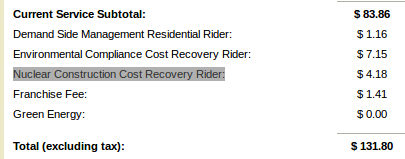
A captive Public Service Commission that
rubber-stamps costs for Plant Vogtle.
In case there was any doubt as to the PSC’s role in legitimizing those new nukes,
the very next day Fitch reaffirmed Southern Company’s bond ratings.
Southern Company’s regulated utility subsidiaries derive predictable
cash flows from low-risk utility businesses, enjoy relatively
favorable regulatory framework in their service territories, and
exhibit limited commodity price risks due to the ability to recover
fuel and purchased power through separate cost trackers.
A pressure group for privatizing schools is the origin of the jargon
in the charter school referendum on the November Georgia ballot.
And yes, it’s tied to ALEC.
Provides for improving student achievement and parental
involvement through more public charter school options.
Where else is that wording found?
Combinations of the three phrases “student achievement”, “parental involvement”,
and “charter school” actually are not very common, according to google.
But the Parent Trigger wrote in
Empowering Parents,
Policy initiatives that empower parents are likely to increase
parental involvement and satisfaction and raise student achievement
by inviting parents into the process.
What process?
The designers of the California Parent Trigger made a grave mistake
by leaving tepid reform modules in the bill and allowing districts
to override the parents’ reform choice.
The Georgia constitutional amendment wouldn’t leave school districts
any ability to decide anything.
To get a decent deal on streetlights, a small Georgia city may have
to help change the Georgia Public Service Commission.
Or, an energy concern in Hahira happened to coincide with
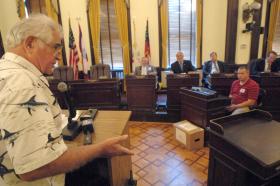
a visit by PSC candidate Steve Oppenheimer.
Ralph Clendenin, City Council member, is looking into converting
Hahira's streetlights to LEDs or maybe solar.
He has discussed that with Georgia Power, which will do it for
$250,000 up front.
At a savings of $1,000 a month, that would take quite a while to pay back:
more than 20 years.
Just like you're looking at options the city might do for better choices for lighting
in terms of serving the people and meeting your budget, as Georgians we need that, too.
He indicated that there are more solutions than we're being told.
To me what's improtant are homeowners rights,
and we get control over the power rates,
because our residential rates and small business rates have gone up about 31% in five years.
What it comes down to is people like you in this room in the small communities
figuring out what pieces do we put together to make our community better for tomorrow.
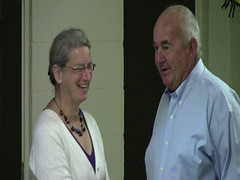
Afterwards in the entranceway,
Ralph Clendenin showed Steve Oppenheimer how
he'd figured out that Georgia Power was charging about 73% maintenance
above the electricity cost of the streetlights.
Oppenheimer said there were many options.
Clendenin suggested one:
The option I see right now is, the Commission somehow, has got to change the rules
on how Georgia Power… structures payments.
Oppenheimer suggested a way to get there:
We need a commission with some new leadership,
with some separation from industry, that doesn't have the
apparent conflicts of interest.
Ralph summed it up pithily:
Ralph Clendenin: 73% is that forever payment to Georgia Power.
Steve Oppenheimer: It's a great deal, if you're on the right end of it.
[laughter]
What say we change the end of the stick we the taxpayers are getting from the PSC?
Work Session, Hahira City Council, Hahira, Lowndes County, Georgia, 1 October 2012.
Videos by John S. Quarterman for Lowndes Area Knowledge Exchange (LAKE).
Apparently
WCTV’s “at the South Georgia Medical Center Parking Garage”>
meant actually in the nearby parking lot, because that’s where we found
some city and county employees and a few volunteers
standing in the shade of a Valdosta Police van.
An invocation and six speeches from five speakers ensued,
all in support of SPLOST VII,
the Special Local Option Sales Tax on the November ballot.
Several of the speakers were not so positive off the podium about the
library and auditorium projects, and nobody from the library board spoke.
The major theme of the event was a firm reminder that SPLOST VII is
not a new tax, just a continuation of a penny sales tax that has
been in place since 1987.
Fair enough.
However, Sam Allen’s second talk summed up what’s wrong with SPLOST VII:
Continue reading →
“Renewable (energy sources are) going to have a sliver,” Bowers said of fuels to create electricity. “Is it going to be 2 or 4 percent? That’s yet to be determined. Economics will drive that. But you always remember (that renewable energy is) an intermittent resource. It’s not one you can depend on 100 percent of the time.”
 Austin Energy flipped in one year
from spouting such nonsense to deploying the most aggressive solar rooftop
rebate program in the country.
Austin Energy did the math and found those rebates would cost
about the same as a coal plant and would generate as much energy.
And when it is needed most, unlike the fossilized baseload grid,
which
left millions without power in the U.S. in June
and
hundreds of millions without power in India in July.
Austin Energy flipped in one year
from spouting such nonsense to deploying the most aggressive solar rooftop
rebate program in the country.
Austin Energy did the math and found those rebates would cost
about the same as a coal plant and would generate as much energy.
And when it is needed most, unlike the fossilized baseload grid,
which
left millions without power in the U.S. in June
and
hundreds of millions without power in India in July.




 The
The