Lest you think fracking is something that happens only in faraway
places like
Alberta
or Pennsylvania,
look at
this map of North American shale gas basins,
extending right through the Appalachians from Pennsylvania through
West Virginia, Virginia, Tennessee, and North Carolina into Georgia, Alabama,
and Mississippi.
How long before Georgia Power or Southern Company decide natural
gas would be even cheaper if they fracked in Georgia or Alabama or Mississippi?
How long until
unavoidable human error
starts fracking polluting our local groundwater and rivers?
For that matter, isn’t it bad enough already that other people’s
water is fracked for cheap gas in Georgia?
After
Kendra Ulrich of Friends of the Earth asked
about some licensee documents related to last week’s
NRC hearing in faraway Maryland on restarting California’s
San Onofre nuclear reactor,
NRC’s
David Beaulieu expanded on NRC’s refusal to divulge the documents.
Video by Myla Reson at NRC, Maryland, 18 December 2012.
You can hear him say it’s “never been a practice” to let the public
see licensee documents. But if they’re being used in making a license
decision, why doesn’t that make them public documents accessible by the
public? Oh, right “it’s very complex” but “it’s a yes or no question”
and “I will assess”, he says. It’s good to be king!
I wonder if the public had some assurance of
transparency maybe the NRC wouldn’t get
so many FOIA requests?
City of Valdosta Clerk Teresa Bolden has earned the designation of
Certified Municipal Clerk (CMC), awarded by the International
Institute of Municipal Clerks (IIMC), Inc. IIMC grants the CMC
designation exclusively to municipal clerks who complete the
demanding education requirements and who have a record of
significant contributions to their local government, their community
and state.
“In light of the speed and drastic nature of change these days,
lifelong learning is not only desirable, it is necessary for all in
local government to keep pace with growing demands and changing
needs of the citizens we serve,” said City Manager Larry Hanson.
“Teresa performs her duties with the highest degree of
professionalism and integrity and is a great credit to our city and
to her profession. We are fortunate to benefit from her talent and
ability.”
What do you get in a solar spill?
A sunny day.
What do you get in a fracking spill?
Polluted groundwater and drinking water.
When do you get it?
Whenever somebody makes a mistake, which turns out to be frequently.
“There is no amount of regulation that can overcome human error,”
said Alberta’s Energy Resources Conservation Board (ERCB) spokesman
Darin Barter. ERCB released an investigation report that cites
inadequate management of risks as one of the main causes of a
September 2011 accident that contaminated groundwater with toxic
hydraulic fracturing chemicals, including the cancer causing agent
known as BTEX (benzene, toulene, ethylbenzene, and xylene).
At least the company involved in this particular incident did something about it:
Personnel from Crew Energy told the Calgary Herald the company is
“embarrassed” about the accident. Rob Morgan, chief operating
officer for Crew said, “there’s no question of our appreciation of
the severity of this,” adding, “pretty much all of the personnel who
were involved in this particular circumstance are no longer with the
company.”
But the groundwater is still contaminated.
And where will they find replacement personnel who will never make mistakes?
Many people are unfamiliar with Moore’s Law, and
how it affects solar power.
Moore’s Law doesn’t occur
in many technologies or industries,
but it’s there in solar photovoltaic (PV).
For those of us whose whole working lives have been
affected by Moore’s Law, seeing it turn up in another field
is like a flashing neon sign pointing to the future.
A future of distributed solar power sunrise
over the crumbling industrial relics of coal, nuclear, and natural gas plants.
A future with much less control by monopoly utilities,
which is why they fight it.
If they even see it coming; Bill Gates didn’t, back in the day,
but Jeff Bezos of Amazon did.
They both surfed that tide,
and Moore’s Law made both of them among the richest humans on the planet
while changing the world for all of us.
Steve Jobs even used it to put a computer in your pocket
more powerful than big companies could buy a few decades ago.
What does Moore’s Law for solar power mean for electric power?
This chart shows the telltale symptom of Moore’s Law in solar electricity:
65% compound annual growth rate in solar power plants
deployed for the past 5 years:
That 17 GW installed in 2010 is the equivalent of 17 nuclear power
plants — manufactured, shipped and installed in one year. It
can take decades just to install a nuclear plant. Think about that.
I heard Bill Gates recently call solar “cute.” Well,
that’s 17 GW of “cute” adding up at an astonishing pace.
Bill Gates should recall that Moore’s Law made formerly “cute” PCs with his
“cute” operating system Windows expand into every company in the world
and made him the second richest human on the planet.
Growth of computer software markets,
like for the U.S. as shown in the graph on the right,
is a symptom of the original Moore’s Law.
Software runs on hardware, and these hardware market curves
are driven more directly by Moore’s Law:
Georgia Power’s idea of “distributed” is 2 to 20 Megawatt solar farms
doled out over several years.
Bangladesh reminds us how distributed is really done.
In one of the poorest countries on earth, a renewable energy
company, Grameen Shakti, is busy installing nearly 1,000 solar home
systems each day. It turns out all that small-scale solar has
achieved something quite big.
In November, Grameen Shakti hit one million Solar Home Systems
installed. The company’s milestone reinforces a lesson that is
increasingly clear: Whether it’s Germany, the U.S., or even China,
distributed solar installations are driving the solar revolution.
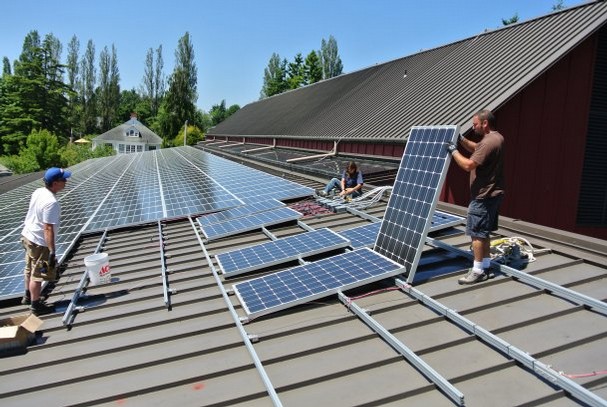
City Hall’s array of 297 rooftop solar panels is expected to produce
the equivalent of 20 percent of the building’s energy needs,
according to Joe Deets, executive director of Community Energy
Solutions, the Bainbridge nonprofit group that spearheaded the
privately-funded project.
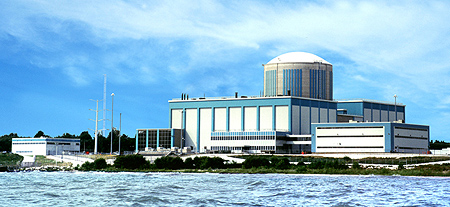
Dominion Power is shutting down a nuke because it can’t compete economically.
Why are we letting Georgia Power charge us up front and load us up with
debt to build a nuke we already know can’t compete economically?
After all, if it could, it wouldn’t need
three-legged nuclear regulatory-capture stool
that we the rate-payers and taxpayers are already paying on, instead of getting on with
solar and wind power.
Dominion (NYSE: D) today said it plans to close and decommission its Kewaunee Power Station in Carlton, Wis., after the company was unable to find a buyer for the 556-megawatt nuclear facility.
According to Dominion:
Kewaunee, Dominion’s fourth nuclear station, generates 556 megawatts
of electricity from its single unit. That’s enough to meet the needs
of 140,000 homes.
The pharmaceutical giant Pfizer (PFE) has confirmed that it will no
longer support the Heartland Institute, a political advocacy group
that questions the science of climate change and tobacco smoking.
Forecast the Facts, which is leading the
campaign calling on
corporations to drop Heartland, was informed of the decision by
Pfizer's Corporate Secretary Matthew Lepore. Pfizer was a major
donor to Heartland, giving $45,000 in 2012 alone.
Pfizer's decision means that there are no longer any pharmaceutical
companies known to support the Heartland Institute.
Pfizer's last contribution to Heartland was in 2012. Pfizer's
decision follows a groundswell of public outrage over the corporate
support for the Heartland Institute's toxic behavior, including a
billboard campaign that equated believers in climate change with
serial killers such as the Unabomber. Over 150,000 people have
signed petitions to corporate leaders to drop Heartland. Pfizer is
the 21st company to end its support for Joseph Bast's organization,
joining its competitors Amgen (AMGN), Eli Lilly (LLY), Bayer
(BAYRY), and GlaxoSmithKline (GSK), as well as major companies like
General Motors (GM), State Farm, and PepsiCo (PEP).
That’s the best you’ve got for support, PSC, and you’re pretending continuing
to let Southern Company and Georgia Power run up a bill of $billions is in the
best interests of the people of Georgia?
Kendra Ulrich of Friends of the Earth asked the NRC some simple questions
that stumped the Commissioners and staff.
She wondered when the public could expect to see a
a 50-59 analysis California Edison had done about
restarting San Onofre.
Dave Beaulieu, NRC Generic Communications Branch,
said it was a “licensee document, licensee documents are not made public.”
He did say NRC would release its own inspection results.
She asked again, and Rick Daniel, NRC meeting facilitator
suggested she submit written questions.
Beauleiu summarized:
“At the end of the day, licensee documents are not made public;
that’s the answer.”
So what would be the point of her submitting questions when
she was just told they won’t make the answers public?
Ulrich continued by asking why NRC was considering going ahead
on the basis of experimental data that has never been used before
and that has not been made public.
Remember this is about a nuclear reactor that was shut down because
it was leaking.
That question sure caused some passing of the buck and pretending
not to understand the question by everybody in the room
who should have been able to answer the question.