Tag Archives: Georgia

Corporate McDonalds Please Don’t Build A Store In My Front Yard While I’m Deployed To Afghanistan

Here’s a letter Vince Schneider sent on Thursday 9 September to Vivian Valdivia, Development Director, Atlanta Region, McDonalds, copied to Kay Harris of the VDT, Fox News, MSNBC on the Internet, and NBC News:
Vivian Valdivia, et al.

Corporate McDonalds=2C please don’t build a store in my front yard while I’m deployed to Afghanistan. And please continue this policy after my return. Since 30 June 2010 when I first learned of Corporate McDonalds’ plan to build a store in my front yard this Fall=2C I believe I’ve done everything that I could to stop it. My local and state governments refuse to help by simply saying that there is nothing they can do. I guess I shouldn’t have expected anything else from an elected official. This is my last appeal to Corporate McDonalds to not build a store in my front yard this Fall.

I am deploying next Friday to Afghanistan to help secure the rights and liberties of the Afghan peoples. Because of this 6 month deployment I will not be able to prosecute any more actions in the attempt to dissuade Corporate McDonalds from building a store in my front yard. Now, because of Corporate McDonalds’ greed, it’s only a wish that I could enjoy some of the same rights and liberties that I am helping to secure for the Afghanis, at my home upon my return. Rights and liberties that Corporate McDonalds is effectively taking from me to name a few include the right to peace, prosperity, and the pursuit of happiness.

Continue reading

Video of Biomass Air Quality Hearing, Valdosta, 27 April 2010

A video of a hearing about the biomass plant Wiregrass Power LLC proposes to build in Lowndes County just outside of Valdosta was held in Valdosta on 27 April 2010 by the Air Protection Branch (APD) of the Environmental Protection Division (EPD) of the Georgia Department of Natural Resources (DNR).

Eric Cornwell of APD explains location, process flow, and specific items covered by the permit (soot, SO2, NOX, CO, VOC, HCL, etc., but not CO2). He remarks that Wiregrass Power LLC is building a small plant with a “lower emission limit in order to avoid some of the red tape” by getting a minor permit instead of a major permit. The first half hour concludes with Bob Turner, the plant manager, presenting similar material, ending with:

“No new carbon is added to the atmosphere when burning woody byproducts.”
I beg to differ on that: in the time it takes trees to grow back, there is indeed new carbon dioxide added to the atmosphere. More from Dr. William Sammons on that.

Back to the video of the hearing. Questions start at 00:29:44. Here are some time markers and very brief summaries of Q and A; see the video for the full questions and answers. Continue reading

jsq VDT LTE pro Solar GA

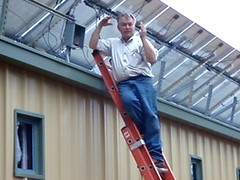
The VDT printed my LTE today. It doesn’t seem to be online yet. Appended is what I submitted, annotated with some links and pictures. The last picture shows the solar panels on my farm workshop.

-jsq


Re: Forester R. Wayne Bell’s points of May 20, 2010. (Hi Wayne; I’ll get those dibbles back to you soon.)

Where does Georgia Power say Albany’s biomass plant will reduce carbon dioxide emissions by 95 percent? Biomass proponents usually say what Forester Bell says: trees are carbon neutral. That ignores the time gap between clearcutting and new growth. That gap from 15 to 100 years or more can produce a lot of CO2.

As a tree farmer myself, I know the pulpwood market is down in Georgia due to the recession and foreign competition. I’d like to be convinced that biomass is the new market we need, but the more I look into it, the more obfuscation I encounter.

Forester Bell seeks a study showing solar will work in Georgia. Georgia Power’s web pages (renewable energy -> solar -> solar potential)
http://www.georgiapower.com/spotlightsolar/solar_potential.asp
include a map of Georgia’s Solar Potential, Continue reading

First Friday, Valdosta, 3 Sep 2010

Downtown Valdosta was bustling Friday night:

That’s Albert in the hat bending my ear.

There was food, there was blown glass and much other artwork, and bands. As previously mentioned, SAVE was educating people about the problems with biomass. More pictures in the flickr set.

First Friday, Valdosta, Lowndes County, Georgia, 3 September 2010, Pictures and videos by Gretchen Quarterman for LAKE, the Lowndes Area Knowledge Exchange.

-jsq

SAVE educates about biomass at First Friday

Students Against Violence Against the Environment (SAVE) educate people about the proposed Wiregrass Power LLC biomass plant in Lowndes County just outside of Valdosta.

On the right, Natasha Fast is explaining it to somebody.

First Friday, Valdosta, Lowndes County, Georgia, 3 September 2010, Pictures and videos by Gretchen Quarterman.

-jsq

Where the biomass plants are

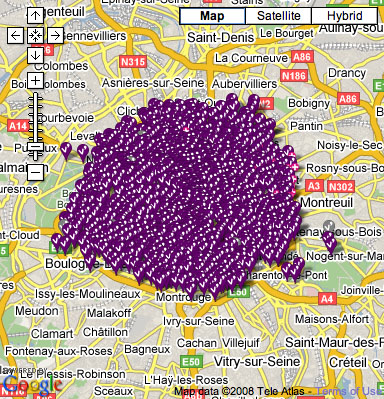
For months I’ve been asking who at least knows where all the biomass plants in Georgia are proposed to be. Valdosta Lowndes County Industrial Authority (VLCIA) doesn’t know. National Geographic knows some, but not all. The State of Georgia maybe knows, but isn’t telling where they all are.

Who does know?

Energy Justice Network!

We are mapping all of the existing, proposed, closed and defeated dirty energy and waste facilities in the United States. We are building a network of community groups to fight the facilities and the corporations behind them.
The detail map shown includes the Wiregrass Power LLC proposed plant (the orange oval I just south of Valdosta), two plants in Hamilton County, Florida Continue reading

Biomass plant air quality permit approved, but is that final?

Georgia EPD approved the air quality permit for the Wiregrass Power LLC biomass plant on Perimeter Road just outside Valdosta in Lowndes County, with an effective date of July 19, 2010 (PDF, Word). Somebody may want to do the exercise of comparing the approved permit with the application to see if the process was entirely rubberstamp or whether any changes at all were made after the many questions people asked at the public hearing.

Meanwhile, is that it? Will the plant be built? Not necessarily: Continue reading

Water Planning

In 2004 the state of Georgia adopted a water planning system, and in 2008 adopted a water plan, with regional councils appointed in 2009 by the governor, lieutenant governor, and Speaker of the House. While I wonder why this organizational setup inserted a regional layer of government that is unaccountable to the people in the region, it’s good somebody is doing some water planning.
In the event “gaps” between available water and future (or current) demands are identified, the Council will determine which water and land use management practices should be employed to ensure there is sufficient water and assimilative capacity to meet future needs. EPD will use computer models to test the ability of the recommended practices to close any identified “gaps.”
If you remember Atlanta running out of water a few years ago Continue reading

On behalf of local workers

From: George Boston Rhynes
Date: Sat, 14 Aug 2010 16:21:27 -0400
Subject: Citizens To Be Heard At Valdosta City Council Meetings, Mr. Roy Taylor on behalf of local workers!

August 13, 2010

George Boston Rhynes (229-251-8645) Valdosta, Georgia 31605

TO: All Editors and Beyond

The Valdosta Daily Times Article on Aug 11 that read; “Order in the Court, a look at the Lowndes County Court House.” It highlighted the history and benefits of the old 1905 Lowndes County Court House but did not address diversity, gender, and who mostly benefited through employment from building this new facility. That is except for the employers and immigrants from Mexico. Continue reading

Proposed Solar Plants

OK, let’s look at “solar” in the online interactive map from Joel Achenbach’s story about The 21st Century Grid in the July 2010 National Geographic. It’s easy to count the proposed solar power plants in Georgia: zero. Yet there’s one in Virginia, one in Maryland, and at least three in Florida, adding to the currently largest solar plant in the country near De Soto, Florida. The map legend repeats the GEFA canard that
The Southwest is a solar-power hotbed. To supplement fossil fuel plants, long-distance transmission lines stretch from the Mojave Destert, which has plenty of sun.
Yes, that’s true, but what about this. At least three solar plants are proposed around San Antonio and Austin, which are not in the area of the southwest the map blurb is referring to. In fact, the largest solar plant in the country is proposed for Austin. Austin is one degree of latitude south of Valdosta, and has been leading the country in solar deployment for many years now. Texas in general almost doubled renewable energy generation between 2004 and 2006 while Georgia did nothing. Texas hasn’t stopped. When will Georgia start?

The Austin solar solution doesn’t require massive new power lines, either. It’s mostly been accomplished with solar panels on houses and business roofs; panels that wouldn’t show up on National Geographic’s map because they’re small and distributed. Which is the point: they generate power where it’s needed, and at peak times when it’s needed, namely when it’s hot and sunny out and air conditioners are running on max. There’s no reason Georgia can’t do the same.

I would continue this series by showing wind generation proposed for Georgia, but there isn’t any of that, either. There could be, off the coast.

Which makes more sense: polluting our air with more coal and biomass plants, or getting a move on with solar and wind?

-jsq