Tag Archives: Georgia

Proposed Biomass Plants

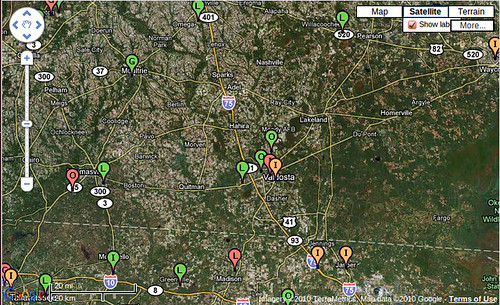
Let’s select “other” in the online interactive map from Joel Achenbach’s story about The 21st Century Grid in the July 2010 National Geographic. This map clearly shows the proposed Wiregrass LLC plant in Valdosta, as well as two plants proposed just to the south for Hamilton County, Florida, and one in Echols County, Georgia, which presumably would be the Oglethorpe Power alternative site. Several of the other plants shown are probably the other proposed Oglethorpe Power plants. Missing is Georgia Power’s Plant Mitchell in Albany, which is supposed to convert from coal to biomass. (Also if you select “nuclear”, the two Georgia Power proposed nuclear plants on the Savannah River are missing.) Apparently National Geographic edoesn’t have a complete list of proposed biomass plants. I wonder who does, if anybody?

Nonetheless, take this map of proposed biomass plants and combine it with the map of proposed new coal plants, plus the existing coal plants in Juliette, Georgia (dirtiest in the country) and Albany, and south Georgia is slated to become even more infested with polluting energy sources.

Does that seem like a good idea to you?

Next: proposed solar plants.

-jsq

Proposed Coal Plants

In the July 2010 National Geographic, Joel Achenbach writes about The 21st Century Grid. It’s mostly about how we need a smart grid and additional power lines to redistribute power better, but it does get into proposed power plants to generate new power.
Although everyone acknowledges the need for a better, smarter, cleaner grid, the paramount goal of the utility industry continues to be cheap electricity. In the U.S. about half of it comes from burning coal. Coal-powered generators produce a third of the mercury emissions in America, a third of our smog, two-thirds of our sulfur dioxide, and nearly a third of our planet-warming carbon dioxide—around 2.5 billion metric tons a year, by the most recent estimate.
Then it talks about how it’s hard to get stodgy electric utilities to invest in anything else. However, there is at least one way:
A California law requires utilities to generate at least 20 percent of their electricity from renewable sources as of this year.
OK, so what new energy plant are proposed for Georgia? The online interactive map lets you select different energy types. The map above shows four proposed new coal plants in Georgia, surrounding south Georgia (plus something nonrenewable in Florida near Tampa). I recognize the one in far southwest Georgia as the one proposed for Early County and fortunately still tied up in litigation. All four are in addition to the existing Plant Scherer at Juliett, GA, near Macon, the dirtiest coal plant in the country, and the one that generates 2/3 of our power for south Georgia (as well as selling a lot of power to Florida). Adding still more dirty coal plants does not look like progress.

Continued in next blog entry.

-jsq

Valdosta in bottom 10 metro areas for wages

Richard Florida writes about The Geography of High-Paying Jobs, including this map based on Bureau of Labor Staistics (BLS) data:

The Valdosta Metropolitan Statistical Area (MSA) comes in the bottom 10 nationwide. That’s for overall average wages.

It doesn’t look quite as bad for specific classes of jobs (creative, service, and working class), but that’s mostly because there are almost no MSAs in the lowest pay tier. However, for service jobs, Valdosta is not as good as Tallahassee, and makes it into the bottom 10: Continue reading

Local Food for Economic Benefit in Georgia

The UGA Center for Agribusiness and Economic Development has quantified the economic effects of eating local food in Georgia, in this report: The Local Food Impact: What if Georgians Ate Georgia Produce? Prepared by: Sharon P. Kane, Kent Wolfe, Marcia Jones, and John McKissick Center Report: CR-10-03 May 2010
If Georgians produced all of the fruits and vegetables that they consumed, it could provide a way to close this utilization gap (the difference between state-wide production and consumption) of over $780 million per year. Even if this level can’t be achieved, simply closing the gap in one commodity­lettuce, for example­could mean an additional $83.6 million of direct revenue to local producers.

What is the lettuce gap? The Cordele Dispatch explains it: Continue reading

Candidates, Lowndes County Commission, District 2, at LCDP BBQ

Every year the Lowndes County Democratic Party (LCDP) has a barbecue to which it invites candidates for public office. These include local candidates. Here we have the two Democrats running for Lowndes County Commission in District 2, in alphabetical order: Debra M. Franklin and John S. Quarterman. Notice the two candidates dining amicably side by side.

Debra M. Franklin: Continue reading

Polling Places, Lowndes County, Georgia

There’s an election going on, with the primary this Tuesday, July 20th. Here’s a google map of Lowndes County Polling Places:


View Lowndes County Polling Places in a larger map

To find out where you should go vote, go to the Georgia Secretary of State My Voter Page. It will be one of these places: Continue reading

Biomass Town Hall Part 2

This is part 2 about the July 8th town Hall meeting about the biomass plant proposed for Valdosta.

First let’s hear George Rhynes explain that it’s never too late to reregulate our minds:

Here I’ve selected videos of local County Commission candidates: Continue reading

Biomass Town Hall, 8 July 2010

On July 8th there was a town Hall meeting about the biomass plant proposed for Valdosta.

Pastor Angela Manning of New Life Ministries sums up why she called this Town Hall meeting:

Speakers included: Continue reading

Foxborough Anti-McDonalds Banner

The VDT writes about Foxborough two days in a row:
Several dozen residents of the Foxborough subdivision came to the Lowndes County Commission meeting Tuesday to again express their dismay at the possibility of having a McDonald’s fast food restaurant located by the neighborhood’s entrance.

Resident Pete Candelaria said he has been living in Foxborough for six years and was speaking on behalf of the residents.

Candelario (I believe that’s the actual spelling of his name) provided a list of suggestions to the Commission, which Chairman Paulk addressed, including: Continue reading