Tag Archives: Georgia Power

Transparency for power companies?

Danny Orrock writes an op-ed in the AJC, Pro & Con: Do Georgia’s electric co-ops need better oversight?
Fundamental determinations like power rates and capital expenditures should not be made in the dark — if Georgia Power customers can participate, there’s no reason EMC customers shouldn’t have the same opportunity. Transparency benefits members and the utility. The situation at Cobb EMC would likely not be so contentious if members had been allowed to meaningfully engage with the board and management several years ago.
Sounds like a good idea, especially considering Cobb EMC is the one that wants to build a coal plant in Ben Hill County.

On the same page, Paul Wood argues that Continue reading

Michael Noll: “enough is enough”

Here is a followup to the VDT story in the previous post.

-jsq

Dear Lowndes County Commissioners.

My sincere thanks for letting me present my concerns at yesterday’s meeting. It is very much appreciated.

Please understand that what I presented is based on facts. I have worked for ten years at VSU as an educator, and my students and colleagues know me as a straightforward person. I may ruffle some feathers at times, but I clearly was brought up in a no-nonsense household.

If Mr. Lofton would not continue to ignore our concerns (as he again did at the BOE meeting), to misrepresent organizations such as the Sierra Club (an organization I happen to support), or to keep bringing up names of those who endorse the biomass plant (yet conveniently overlooks a conflict of interest), I  probably would have never brought this up. However, during these past couple weeks, and particularly with his behavior at the BOE meeting, Mr. Lofton has added insult to injury, and enough is enough.

To substantiate the comments I made yesterday,

Continue reading

Let’s Think About This!

Michael Noll has offered this letter to anyone who wants to publish it:
This is an open letter with a few questions for the Industrial Authority on the proposed biomass incinerator. Simple answers will do, as we have heard enough confusing verbiage by now:

1. Isn’t it correct that annually the proposed biomass incinerator will emit 247 tons of sulfur dioxide (SO2), 247 tons of nitrogen oxide (NOx), 247 tons of carbon monoxide (CO), 135 tons of particulate matter (PM), 113 tons of PM10, 87 tons of PM2.5, 60 tons of volatile organic compounds (VOCs), and 14 tons of hazardous air pollutants (HAPs)?

2. Isn’t it true that the American Lung Association states that pollutants such as NOx, SO2, and PM can have “severe impacts on the health of children, older adults, and people with lung disease”?

3. Isn’t it correct that the “baghouse filtration technology” in connection with the proposed incinerator cannot capture PM10 (particulate matter smaller than 10 microns) much less PM2.5 (particulate matter smaller than 2.5 microns)?

Continue reading

jsq VDT LTE pro Solar GA

The VDT printed my LTE today. It doesn’t seem to be online yet. Appended is what I submitted, annotated with some links and pictures. The last picture shows the solar panels on my farm workshop.

-jsq


Re: Forester R. Wayne Bell’s points of May 20, 2010. (Hi Wayne; I’ll get those dibbles back to you soon.)

Where does Georgia Power say Albany’s biomass plant will reduce carbon dioxide emissions by 95 percent? Biomass proponents usually say what Forester Bell says: trees are carbon neutral. That ignores the time gap between clearcutting and new growth. That gap from 15 to 100 years or more can produce a lot of CO2.

As a tree farmer myself, I know the pulpwood market is down in Georgia due to the recession and foreign competition. I’d like to be convinced that biomass is the new market we need, but the more I look into it, the more obfuscation I encounter.

Forester Bell seeks a study showing solar will work in Georgia. Georgia Power’s web pages (renewable energy -> solar -> solar potential)
http://www.georgiapower.com/spotlightsolar/solar_potential.asp
include a map of Georgia’s Solar Potential, Continue reading

Georgia Power Away from Coal?

Walter Jones writes about how Georgia Power aims to rely less on coal:
For years, solar and wind were described as unsuited for the South’s weather conditions and geography, although Georgia Power is now taking another look at them in this year’s version of it’s integrated-resource plan, a document it updates every three years.
I suppose late is better than never. However, Georgia Power is turning more to nuclear and natural gas.

But why is it turning away from coal at all?

Stricter environmental regulations are also changing the economics of coal. Even without a “carbon tax” or “cap and trade” passing in Congress, the federal government is stepping up its existing authority over power plants. And an ongoing court case related to a proposed power plant owned by an independent company, Longleaf, could open the door in Georgia to regulation of carbon dioxide emissions. Any combination of those factors could lead regulators to force Georgia Power to shut down more of its older coal plants.

“The financial outlook for coal is grim,” Thompson said.

People are finally wising up that coal is bad for us, and the company sees that affecting its bottom line.

-jsq

Solar Power and Georgia Power

As we’ve seen, the Center of Innovation – Energy defines solar as a southwestern energy source (see slide 9). That slide uses a version of this map:

I found that map on Georgia Power’s web pages. Meanwhile, here are Georgia Power Solar Projects. Hm, “a rooftop solar demonstration program”, “plans to install solar panels at schools in each of the company’s regions”, “showcase its technology”. Where’s the actual rapid deployment?

Meanwhile, Texas almost doubled its renewable energy generation between 2004 and 2006 and hasn’t stopped since. Continue reading

State Energy Strategy of Georgia

Among the questions local citizens asked the Valdosta-Lowndes County Industrial Authority (VLCIA) was where is the south Georgia, state, or southeast U.S. renewable energy strategy? VLCIA Project Manager Allan Ricketts looked, and he couldn’t find it, either. He did find this list of “renewable energy strategy” hits from a GEFA search. At least one of those links points us to http://www.georgiaenergyplan.org/, which now gets us
Are you interested in buying this domain name?
The state has apparently abandoned that domain. Is that an indication of how seriously Georgia takes renewable energy?

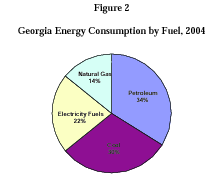
Here’s something that looks promising: State Energy Strategy for Georgia (SESG), December 14, 2006, Governor’s Energy Policy Council, GEFA. It says it’s an energy strategy, but it’s mostly about transportation of existing fuels such as natural gas. Towards the end of the document in Figure 2 (shown above) the SESG illustrates the pit we’re in: about a third of Georgia’s energy comes from coal, another third from petroleum, a sixth from natural gas, and so little from renewable sources they apparently weren’t worth putting on the pie chart.

The SESG does contain this: Continue reading