Videos of 9 Jan 2012 LCC Work Session
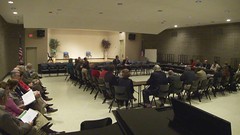
Work Session, Lowndes County Commission (LCC),
Valdosta, Lowndes County, Georgia, 9 January 2012.
Videos by Gretchen Quarterman for LAKE, the Lowndes Area Knowledge Exchange.
CCA inadvertently rehabilitated former prisoner Alex Friedmann
and gave him a new career, lobbying against prison privatization.
He says:
In my view, the worst thing
is that they have normalized the notion of incarcerating people for profit.
Basically commodifying people, seeing them
as nothing more than a revenue stream….
If you incarcerate more people and you put more people in
your private prisons you make more money.
Which provides perverse incentives against reforming our justice system.
And increasing the number of people we’re putting in prison,
whether they need to be there or not, just to generate corporate profit.
I think that’s incredibly immoral and unethical,
I think that’s the worst aspect of our private prison industry.
1.) In 2010 permission was given by Bullard to Allgreen, the mayor’s
employer, to store Allgreen equipment on city property, 6571 Union Road
Dumpsite, without bringing the issue before the City Council.
HEC decided that while he shouldn’t have done it, the Hahira City Council
already met on that subject and he already agreed not to do it again,
so there was nothing more for the ethics commission to do on that complaint,
although the City Council could take it up again if it wanted to.
If you like blogs, YouTube, facebook, and other social media,
you won’t like SOPA and PIPA if they become law, because they
will enable big copyright holders such as movie studios to
force websites to remove links to entire domains on suspicion
of copyright violation.
In a refreshing changes from “jobs, jobs, jobs” as everything,
Andrea Schruijer,
Executive Director of the Valdosta-Lowndes County Industrial Authority (VLCIA),
told the Lowndes County Democratic Party meeting, 5 December 2011,
that it wasn’t her job to create jobs, jobs, jobs; it was her job
to create an environment that let jobs be created.
Towards that end, she announced several new jobs at VLCIA,
including a PR and marketing position.
VLCIA Chairman Roy Copeland also spoke and helped answer questions
from the audience, including about
wages,
workers, and
green industries.
Perhaps not shown is her answer to my question about what does
VLCIA do to promote new local industry.
I believe she said VLCIA looks to the Chamber of Commerce for incubation,
and helps once local businesses are established.
My job: create environment for jobs —Andrea Schruijer of VLCIA @ LCDP 5 Dec 2011
Andrea Schruijer Executive Director of VLCIA,
Monthly Meeting, Lowndes County Democratic Party (LCDP),
Valdosta, Lowndes County, Georgia, 5 December 2011.
Videos by John S. Quarterman.
I’ve made these same comments before. It’s just part of the attitude that
is popular with some elected & appointed officials “We’ve been chosen. Now
go away & don’t ask any questions about what we are doing until it’s time
to vote again.” I don’t think all the individuals share the attitude,
but some do & over time it has become standard procedure. Hopefully,
as more citizens pay attention & ask for more insight procedure will
adjust. There is a reason for open meetings & sunshine laws & it’s not
so citizens can listen to or read about decisions based on information
they are not allowed to hear or observe.
Today is the third Tuesday of the month, so the Valdosta-Lowndes County
Industrial Authority Board of Directors
meets tonight.
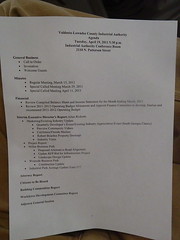
A list of specific projects, a PR position, and a strategic planning presentation
are on their agenda.
I see they held a special called meeting 16 December 2011,
but at least they listed it on their web page.
Maybe they’ve got control of their
technical glitches.
Appended is the schedule for 2012,
and the agenda for tonight’s meeting.
All Meetings will be held at 5:30pm in the Industrial Authority Conference
Room, 2110 N. Patterson Street, unless otherwise notified.
Special Called Meeting
**December 16, 2011**
Meeting Schedule for 2012
January 17, 2012
February 21, 2012
March 20, 2012
April 17, 2012
May 15, 2012
June 19, 2012
July 17, 2012
August 21, 2012
September 18, 2012
October 16, 2012
November 20, 2012
December 18, 2012
issue another Executive Order and STOP the jail deaths in the Valdosta,
Lowndes County Jail. (30 Jail deaths from 1994-2009) Today the general
public is told that the public does not have a right to know under
the law.
In
this video
George goes into many years of evidence regarding jail violations.
Requesting such a hearing before January 24 would give the opportunity
to have all this information presented and for questions to be asked
and answered.
Except that’s not the way it works around here.
Public hearing locally means the chairman or mayor or whoever says
“Who wants to speak for?”
and maybe somebody speaks.
And then “Who wants to speak against?”
and maybe somebody speaks.
It doesn’t mean that the Commission or the Council or the Authority
presents anything for the public to consider.
Witness the
hearing the Lowndes County Commission
held in December on the documents related to the Comprehensive Plan.
The only reason the public knew anything about what was in those documents
was that Gretchen got them from somewhere else after the Commission
refused to supply them in response to an open records request.
The Commission never distributed any of the relevant documents
to the public.
Only one citizen spoke, perhaps because nobody else knew what
to speak about.
Almost none of the local municipalities or boards or authorities
routinely present to the public the information that is in the
packets they see before the discuss or vote.
There are rare exceptions, such as the VLMPO
and other organizations or projects administered by the
Southern Georgia Regional Commission (SGRC).
SGRC is a state agency, not a local agency.
Why does Lowndes County and all its municipalities and boards
avoid transparency?
Why can’t you, the public, see what’s in a rezoning request before
Continue reading →
When you call a company or government agency for help, there’s a
good chance the person on the other end of the line is a prison
inmate.
The federal government calls it “the best-kept secret in
outsourcing” — providing inmates to staff call centers and
other services in both the private and public sectors.
The U.S. government, through a 75-year-old program called Federal
Prison Industries, makes about $750 million a year providing prison
labor, federal records show. The great majority of those contracts
are with other federal agencies for services as diverse as laundry,
construction, data conversion and manufacture of emergency
equipment.
But the program also markets itself to businesses under a different
name, Unicor, providing commercial market and product-related
services. Unicor made about $10 million from “other agencies and
customers” in the first six months of fiscal year 2011 (the most
recent period for which official figures are available), according
to an msnbc.com analysis of its sales records.
The Justice Department and the U.S. Bureau of Prisons don’t