The member who hardly ever speaks at board meetings makes a strong case for openness.
Tom Call
called me back about the biomass plant,
and we talked about a number of other matters.
He remarked that he was not an appointed spokesperson for the Industrial
Authority, so this is just him talking.
Yesterday I wrote that we were left with hearsay through Ashley Paulk
and people he talked to about what the Industrial Authority is up to,
and I had
left telephone messages with all five VLCIA board members.
So far, three out of five have called me back.
Roy Copeland referred me to VLCIA Chairman Jerry Jennett
for an update about the present status of the biomass plant.
He also had many good things to say about the activism in the community,
including this:
Because people in the community are concerned, that makes us better.
And sometimes there are good things that come out of disagreement.
I don’t like to publish hearsay, but since the Industrial Authority
won’t talk, that’s what I’ve got.
According to Leigh Touchton, Ashley Paulk told her Tuesday night:
He said that Jerry Jennett took the biomass vote off the agenda at last
Industrial Authority meeting (April 19) even though Mary Gooding and
Roy Copeland wanted the vote to be taken ( a vote that was to oppose an
extension of the biomass contract since the biomass incinerator had not
met timeline benchmarks like having a buyer, etc). He said that Allan
Ricketts, Industrial Authority attorney Steve Gupton, and Jerry Jennett
went up to Atlanta to meet with Wiregrass officials and that’s when he
(Chairman Paulk) got a call telling him all this and he said he wouldn’t
keep quiet about it. He said the three men asked Wiregrass LLC officials
to rescind their letter asking VLCIA for an extension on their contract
and to substitute a new letter saying they were withdrawing their request
for extension (or not going forward to ask for extension).
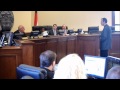
This is in addition to what you can see him
on video saying during the meeting.
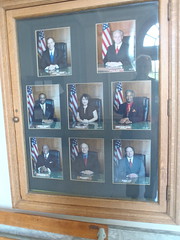
More after this picture of the cast of characters:
Continue reading →
Thank you for posting this, Mr. Quarterman. The NAACP is one of the
groups boycotting Arizona over its anti-Hispanic “immigration” law
(which really does nothing except racially profile American citizens
who happen to have brown skin.)
More on the NAACP boycott of Arizona can be found here.
“We are joining this lawsuit because the Arizona law is out of step with
American values of fairness and equality,” said Benjamin Todd Jealous,
President and Chief Executive Officer of the NAACP. “It encourages
racial profiling and is unconstitutional. African Americans know all
too well the insidious effects of racial profiling.”
Ashley Paulk agrees with my mother about
what the Industrial Authority should do.
At the Lowndes County Commission meeting last night, Chairman Paulk
discussed the biomass plant with Dr. Noll, and said:
Certain people won’t share it with you, and I don’t think it’s fair.
We were approached … almost three weeks ago by the Industrial Authority
and we were asked to … ask them not to extend the contract.
Well, it’s not our contract; we could do that, but … we didn’t.
And then last week the Tuesday of their meeting, I received a call
… on my way back fromm Atlanta and they had gone up
there to talk to Wiregrass Power,
because they’d written a letter asking for an extension.
My understanding was that they asked Wiregrass to write another letter
to remove that extension request.
These are things, I think should be public knowledge.
Regular meeting of the Lowndes County Commission, Lowndes County, Georgia, 26 April 2011
Video by Alex Rowell for LAKE, the Lowndes Area Knowledge Exchange.
He told me several weeks ago about the commission being asked to vote not to extend.
Continue reading →
Over the past four years, I have had a significant number of citizens
contact me. Some with complaints, some with questions and yes…even some
with compliments. I have never refused to meet with anyone. Some want
to know what my position is on an issue. As a rule, especially on items
that may come before council for a vote – I do not state a position. I
choose to wait for the public hearing at which time all final arguements
both for and against an item are stated and on the record.
Mrs. Noll contacted me directly this past week and we met and discussed
How much does it cost to pave 3.5 miles of dirt road?
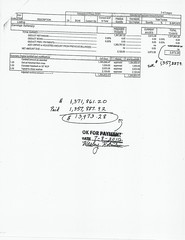
Apparently $1,413,097.92, or around a million dollars a mile,
when the county insists on paving it like a state highway
at the expense of safety:
How Much
To Whom
From
For What
$7,200.00
Lovell Engineering Associates
Valdosta
Design of Culvert
$48,010.00
Doyle Hancock & Sons Construc.
Doerun
Clearing and Grubbing
$1,357,887.92
The Scruggs Company
Valdosta
Paving
$1,413,097.92
All contractors
Total
This financial information comes from an open records request
filed by Carolyn Selby more than a year ago
and finally fulfilled 17 March 2011.
Copies of all the pages received are
in the flickr set.
How many other roads could have been paved for $1.4 million?
If this road had been paved like a local rural road,
instead of like a state highway (literally according to
state highway standards) it would not have cost nearly
as much and probably another shorter road could have been paved, too.
And if other roads were paved like local roads instead of state
highways, how many more of them could be paved?
They still wait while this one got paved to the tune of $1.4 million.
This came in Sunday as a blog post on
To Speak or Not to Speak.
As a contrast, Lowndes County Commissioners do usually talk to people before and after
their meetings, and sometimes they use that time to answer questions citizens asked during the meeting. -jsq
Yost engaged Dr. Noll (and was unpleasant about it) at one meeting that I attended, Mayor Fretti engages people sometimes, Attorney Talley engaged J. Smith last Thursday, and sometimes others at other meetings, myself included, and Vickers talks pretty much to whomever he wants whenever he wants. The whole CTBH policy is a smokescreen. The Council Comments period ought to be followed by adjournment and then the Councilmembers making their remarks from the dais during Council Comments ought to have to walk out into the audience and deal with the voters’ concerns directly.
When Jimmy Rainwater was Mayor, I may not always have agreed with him, or he with me, but he always came out into the audience and talked to us.
This Council is not responsive to the concerns of its citizens,