Some local councils don’t even have open records request forms,
and many don’t have them posted online.
But that doesn’t have to stop you!
As mentioned,
there are plenty of open records requests still to be filed.
If you want suggestions, inquire at
information at l-a-k-e.org (the dashes are part of the address).
For how, see the previous post on the
Open Records Act.
Send LAKE the results of your request and we may publish them.
If you want your name mentioned in a LAKE post as the open records requestor,
please say so.
Also remember that any communications you may receive from
an elected
Continue reading →
Valid points and a great question to ponder. You may recall my quote
from Benjamin Franklin: “Waste not, want not”.
Add to that a quote from the Sierra Club: “Energy use should be
minimized through conservation and efficiency. In the near future,
efficiency is the only “energy source” which does not incur some
environmental damage and which is available immediately in generous
supply. Sophisticated building construction, efficient appliances,
recycling, modernized industrial
processes, programmable thermostats, public transit supplemented by
fuel-efficient cars, and many other innovative technologies can reduce
energy use tremendously, while saving money.”
In other words, we are wasting enormous amounts of energy and money
I thought you all might find this power point article interesting. It
was sent to me by a group representing local small farmers who are
looking into growing bio-crops for economic opportunities to feed their
families. The information below is from the power point presentation.
We’ve rotated around the north end of Lowndes County;
time to rotate down to the west of Valdosta.
Monthly LAKE Meeting
When: 5:30 PM, Tuesday 5 April 2011
Where: Heidi’s Brooklyn Deli
1407 W Hill Ave Ste 1
Valdosta, GA 31601
(229) 241-9944
That’s on Hill Ave just east of St. Augustine Road.
They’re open until 9PM, and they’d be happy to push a few tables
together for us.
Restaurant review and source of the picture.
Help cover food, water, transportation, incarceration, solar energy,
biomass, and regular local government meetings: you never know when
news will be made!
If you follow the LAKE blog,
On the LAKE Front,
which you can also see through the
LAKE facebook page,
you know what we cover, from protesters to private prisons to gardening,
all of which turn out to be related.
What else do you want to investigate?
You can be LAKE, too!
Continue reading →
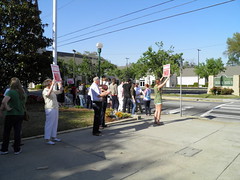
Protestors wearing respirator masks held signs reading “Biomass? No!”
in front of the Valdosta City Hall building on Thursday. Members of
the Wiregrass Activists for Clean Energy, the VSU student organization
Students Against Violating the Environment, and other concerned Valdosta
citizens showed up to protest the construction of the Wiregrass Power:
Biomass Electric Generating Plant.
“We already have solar power resources in place that we could be using
and I feel like money should be directed towards that,” Ivey Roubique,
vice-president of the Student Geological Society, said. “It wouldn’t
be good for the community and even though I’m in college here it
still matters.”
The Spectator article quotes from two speakers for whom LAKE
happens to have video, linked below.
Continue reading →
When public officials ignore objections for long enough, eventually
people start speculating as to their motives, in this case about the proposed biomass plant.
Here’s
the video:
Regular meeting of the Valdosta City Council, 24 February 2011.
Videos by Gretchen Quarterman for LAKE, the Lowndes Area Knowledge Exchange.
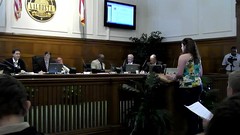
Erin Hurley provided the very model of how to give a speech:
I’m the president of
Students Against Violating the Environment at VSU.
I’m here representing
200+ members of SAVE, that consists of students, faculty, community members.
We are deeply concerned with environmental issues and
we are networking together to make this city a more humane and
sustainable community
for future generations.
As a student, I feel I have the right to be able to breathe clean air
at the college I attend.
With this biomass plant possibly being built here,
the future for generations to come are in jeopardy, and we want to protect our fellow and future students’ health.
Please take into consideration the future health of this university
and its community,
and don’t sell grey water to the proposed biomass plant.
Erin Hurley, President of
SAVE, Students Against Violating the Environment, speaking at
Regular meeting of the Valdosta City Council, 24 March 2011,
Valdosta, Lowndes County, Georgia.
Videos by Gretchen Quarterman for LAKE, the Lowndes Area Knowledge Exchange.
She said who she was, who she represented, how many, what they were for, what they wanted, quickly enough that attention didn’t waver, slowly and loudly enough to be heard, and briefly enough to transcribe, with pathos, logic, and politic. Even the mayor looked up at “As a student….”
The center “will educate a person to work in an advanced manufacturing
plant,” Gilley says, just the kind of plants that are coming to Troup
County over the next year or so. Using industry-standard equipment,
students will be educated to meet the manufacturing community’s
workforce needs.
In fact, the manufacturing community already is calling on the
center. DaeLim, a supplier to Kia and Hyundai (the latter has a plant
nearby in Alabama), expressed interest in students doing prototyping of
plastic parts once the center, which opened June 1, is up and running.
“We’ve left a good platform on which to build. We have good faculty,
good staff. I think we have good community relations,” Gilley says of
his time at West Georgia. Then he looks to the future and what he’ll
miss most about his job. “We offer programs that allow people to get
better paying jobs. I’ll miss having the power to make decisions that
change people’s lives.”
Hm, so the locals think the technical college has more to do with
industry than the K-12 schools.
It seemed like a good idea at the time when the west Texas farming
town of Littlefield borrowed $10 million and built the Bill Clayton
Detention Center in a cotton field south of town in 2000. The charmless
steel-and-cement-block buildings ringed with razor wire would provide
jobs to keep young people from moving to Lubbock or Dallas.
For eight years, the prison was a good employer. Idaho and Wyoming paid
for prisoners to serve time there. But two years ago, Idaho pulled out
all of its contract inmates because of a budget crunch at home. There
was also a scandal surrounding the suicide of an inmate.
Shortly afterward, the for-profit operator, GEO Group, gave notice that
it was leaving, too. One hundred prison jobs disappeared. The facility
has been empty ever since.
Such publicly owned networks can offer services that incumbents don’t,
such as the 1Gbps fiber network in Chattanooga, Tennessee, run by the
government-owned electric power board. And they sometimes have more
incentive to reach every resident, even in surrounding rural areas,
in ways that might not make sense for a profit-focused company.
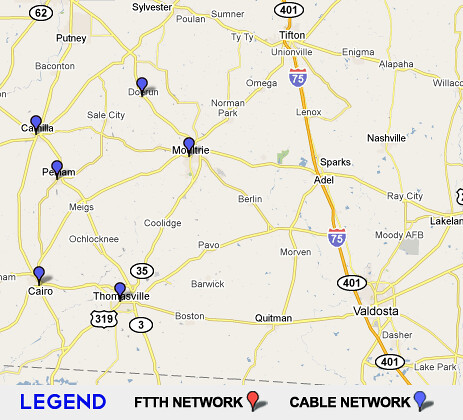
According to this map of
Community Broadband Networks
by the Institute for Local Self-Reliance,
quite a few small cities in south Georgia have municipal cable networks:
 Some local councils don’t even have open records request forms,
and many don’t have them posted online.
But that doesn’t have to stop you!
Some local councils don’t even have open records request forms,
and many don’t have them posted online.
But that doesn’t have to stop you!