Tag Archives: debate

We tend to promote free speech —VSU President Levy


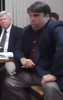
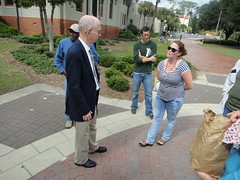
Henry Calhoun found VSU Interim President Dr. Louis Levy,
who came over to the Occupy Valdosta meeting 27 October.
Erin Hurley invited him to come to the

mid-November
Teach-In.
He replied:

…as long as it’s legal and non-obstructive
in terms of people getting in and out of buildings.
We tend to promote free speech.
And if we don’t, we’ll pay the price for it later.


We actually encourage free discussion and debate.
Besides, I’m a sociologist.
We can take what everyone knows and put them into
four different kinds of perspectives and lenses
just to do battle with each other.
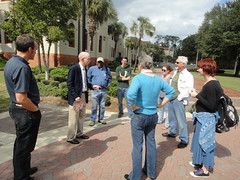
He thanked Erin for the invitation.

VSU students, staff, and faculty who want their next president
to hold positions like that on free speech might want to

get involved with selection of the next VSU president.

Here’s

the video:


We tend to promote free speech.

Information and Organization,

General Assembly, Occupy Valdosta (OV),

Valdosta, Lowndes County, Georgia, 27 October 2011.

Videos by John S. Quarterman for LAKE, the Lowndes Area Knowledge Exchange.

-jsq

Real discussion for real education: Shanghai

Here’s how they do it in the best education system in the world:


Shanghai’s education system is distinctive and superior—and not
just globally, but also nationally. Hong Kong, Beijing, and ten Chinese
provinces participated in the 2009 PISA, but their results reflected
education systems that were still the same-old knowledge acquisition
models, whereas Shanghai had progressed to equipping students with
the ability to interpret and extrapolate information from text and
apply it to real world situations—what we would normally refer to
as ‘creativity.’ Twenty-six percent of Shanghai 15 year-olds could
demonstrate advanced problem-solving skills, whereas the OECD average
is 3 percent.

I do mean that literally, the best in the world:

Every three years, the Organisation for Economic Co-operation and
Development (OECD) administers its worldwide
Programme for International Student Assessment
(PISA) to measure how well a nation’s education
system has been preparing its students for the global knowledge
economy. Nations such as South Korea, Finland, and Singapore have
traditionally topped the rankings, but, apparently, even they are no
match for Shanghai, which shoved the others into lower positions in its
very first year of participation in the programme, in 2009.

That’s according to
Jiang Xueqin writing in the Diplomat 1 August 2011,

How Shanghai Schools Beat Them All
.

So, how did they do it?

Continue reading

“Debate is not allowed.” Well, why not?

The real problem with education around here is the adults who refuse
to hold a civil discussion.

I hear this all the time around here:


“We’re not going to get into debate.”


“We will not, however, debate you over e-mail.”


“There’s been enough debate.”


“one more public meeting with 15 minutes of pros and cons and
then hopefully that will be the end of discussion.”


“I’m not going to debate you about that.”


“Debate is not allowed.”

Well, why not?
When did “debate” become a dirty word?
What if we call it a civil discussion, will that make it sound better?
Nobody seems to know how to do that, either.

And that, my friends, is the real failure of the local education system.

Next:
how they do it in the best education system in the world.

-jsq

A real education dialog @ LCDP 2 May 2011

The only real public dialog about unification or education that


I’ve heard of
was at the May 2011 Lowndes County Democratic Party (LCDP) meeting,
organized by LCDP Chair Gretchen Quarterman.
You can see it either of two ways:

  1. Through the LCDP 2 May 2011 LAKE blog topic,
    which has all the relevant posts, newest first.

  2. Through the YouTube video

    playlist.

    Each video has a link to the relevant blog post.


    School unification dialog at Lowndes County Democratic Party (LCDP)

    Videos by John S. Quarterman, Jim Parker, Gretchen Quarterman, 2 May 2011.

At that LCDP meeting I pointed out
that the CUEE education committee was not scheduled to report back
until after the proposed referendum vote, and nobody had any rebuttal.

-jsq

dialogue on consolidation was a forbidden zone —Barbara Stratton

Received yesterday on

Videos of CUEE’s idea of a “public dialog”
. -jsq


In their minds
every name signed as attending is part of their consensus, which is why
I never sign in. It is also why they keep trying to say
Sam Allen is for
consolidation even though
he chairs the group against consolidation.

I went to the June & July CUEE meetings just to see what they were
doing & to dialogue about consolidation. At both meetings dialogue on
consolidation was a forbidden zone. I keep telling you their game plan is
textbook UN Agenda 21. Debate is not allowed. They manipulate everything
to create what they misname “consensus” which means per their numbers &
statistics everyone who does not speak out against their agenda is for
their aganda including anyone who never shows up at all. In their minds
every name signed as attending is part of their consensus, which is why
I never sign in. It is also why they keep trying to say
Sam Allen is for
consolidation even though


he chairs the group against consolidation.
They
made sure they got photos of him at the July meeting to further their
consensus game.

If you live in the city or the county & you want to hear
real dialogue about consolidation

Continue reading

Andrea Schruijer’s Opportunity —John S. Quarterman

Here’s my op-ed in the VDT today. -jsq

Welcome

Andrea Shuijer Schruijer
to a great opportunity as the new Executive
Director of the Valdosta-Lowndes County Industrial Authority (VLCIA)!


For a year I’ve been asking for a list of jobs attracted by the
Authority. We welcome your marketing expertise so we’ll know
the Authority’s successes!

We welcome your communications expertise to inform the community
affected by the process of bringing new jobs. VLCIA could publish
its agendas, minutes, and videos of its meetings, events, and
new jobs on its web pages, and facebook, maybe even twitter.

We welcome your stewardship of the Authority’s $3 million/year in taxes.
Maybe some

Continue reading

Quakers and others organized private prison hearings in Tucscon

Churches don’t always sit quietly on their hands when there is injustice
impending for their communities.
Sometimes they help organize hearings in which pro and con are discussed
and recorded, as the American Friends Service Committee did in Tucson
last year.

According to
Mari Herreras in

Tucson Weekly, 26 October 2010
,


The American Friends Service Committee, Private Corrections Working
Group, UA Latino Law Students Association, and St. Francis in the
Foothills United Methodist Church have organized a series of private
prison hearings across the state that kick off tomorrow in Tucson at
Pima Community College, Downtown Campus at 1255 N. Stone Ave., in the
Amethyst Room from 6 to 8 p.m., moderated by yours truly, Mari Herreras.

The public is invited to present testimony, but the AFSC has also invited
representatives from the Arizona Department of Corrections, Corrections
Corporation of America (expected to build a new prison in Tucson) and
Management and Training Corporation (which manages the Marana Community
Correctional Treatment Facility). Word is no one has responded from those
organizations, but AFSC organizers know the following presenters will
be there to provide critical information on the private prison industry:
Stephen Nathan, editor of Prison Privatization Report International; Joe
Glen, spokesman for Maricopa and Pima Juvenile Corrections Associations;
Brent White, UA law professor; Jim Sanders, real estate appraiser; Susan
Maurer, retired corrections commissioner from New Jersey; and Victoria
Lopez, from ACLU of Arizona.

The hearing will include the following community leaders who will hear
testimony and ask questions: Pima County Supervisor Richard Elias;
Tucson City Councilman Steve Kozachik; Assistant Tucson City Manager
Richard Miranda; Representative Phil Lopes; and Mark Kimble, former
associate editor of the Tucson Citizen.

They even made sure both the basic positions and the actual
debate would be recorded:

Continue reading

Drug war fail: devastating consequences —Global Commission on Drug Policy

Stop locking up drug users who harm no others,
legalize drugs starting with marijuana,
switch to health and treatment,
stop harrassing farmers,
abandon zero tolerance and invest instead in youth activities,
focus on reducing harm,
and do it now, so says a commission of business moguls, former heads of state,
financial professionals, writers, and activists.

Writes Douglas Stanglin today in USA TODAY,


“The global war on drugs has failed, with devastating consequences for
individuals and societies around the world,” says the Report of the
Global Commission on Drug Policy in its opening statement. “Fifty years
after the initiation of the U.N. Single Convention on Narcotic Drugs,
and 40 years after President Nixon launched the U.S. government’s war on
drugs, fundamental reforms in national and global drug control policies
are urgently needed.”

According to whom?

The 19-member commission, a private venture chaired by ex-Brazilian
president Fernando Henrique Cardoso, includes George Schultz, President
Reagan’s Secretary of State; Richard Branson, founder of the Virgin
Group; former U.N. Secretary General Koffi Anna; George Papandreou,
prime minister of Greece; Paul Volcker, former chairman of the Federal
Reserve, and Javier Solana,former EU foreign minister.

Here’s their full report.

What do they recommend?

Continue reading

Everyone agrees there’s a problem with education — pro and con CUEE @ LCDP 2 May 2011

Pretty much everyone agrees there are problems with the two local
school systems in this county, those of Lowndes and Valdosta.

Proponents and opponents of school unification even agree on many
of the details.
They just don’t agree on the solution.
CUEE believes that unification will somehow lead to solutions to all this,
and

believe is the word they use,

because they have no evidence.
Opponents such as me

don’t see any plan to get to better education
, and some think that unification
will cause problems that CUEE is not even considering,

just like integration did in 1969.

Here’s a pair of pie charts from 2008 from

Who’s losing in Winnersville?

a project unification opponent Dr. Mark George was involved in:


And here is a similar comparison

from CUEE using data from 2009-2010.
:

Continue reading

Where are the students in this decision? —Karen Noll

This comment by Karen Noll came in last night on
“I don’t see a separation”. -jsq

I completely agree with Alex Rowell. What is the purpose of
consolidation/’unification’? Is the purpose to desegregate the two school
districts? If so, how will the new school district deal with the issues
that Leigh Touchton brings up with regard to education not serving black
male students. How will a larger school district better meet the needs of
a much more diverse student body? Furthermore, What do the parents in the
county think about desegregation of their distict? (Because if they don’t
want it, there is no doubt that ‘unification’ will be a disaster for ALL)

OR is the purpose to reduce cost by reducing administrators in the head
office? If that is the purpose where are the students in this decision.

-Karen Noll

CUEE’s

own study
says unification wouldn’t save money and

CUEE’s own expert consultant
said:

“If you believe in the end that running one system is cheaper than
running two school systems. If in the end you are going to cast a vote
for a single system because you think it would save money, I wouldn’t
cast my vote. I do not think it will save money.”

And, indeed, where are the students in this decision?

-jsq