Category Archives: Law

Save money by streamlining the state penal code

Even the Bainbridge and Decatur County Post-Searchlight publishes news about their very own state legislator explaining one of the biggest reasont why prisons are a bad bet for a local economy: because we can’t afford to lock up so many people anymore.

Brennan Leathers wrote 6 January 2012, Georgia legislature going back to work State Senator John Bulloch (R-Ochlocknee):

“We’re still struggling to find revenue to pay for operation of the state government and its services,” Bulloch said. “We’re going to have to fill holes that we filled during worse economic times using federal stimulus money and other temporary money.”

Bulloch said he also understands Georgia Gov. Nathan Deal has instructed Georgia’s department heads to include 2-percent cuts in their budget requests for this year.

One way in which legislators might opt to save money is by streamlining its criminal penal code. According to Bulloch, Georgia has a very high number of people serving supervised probation or parole.

“A lot of those people who are in prison or under close supervision by state officers are serving sentences for non-violent offenses or minor felonies,” Bulloch said. “We may look at alternative means for dealing with them, such as creating drug courts or setting up drug-testing centers that would monitor drug offenders without imprisoning them.”

Which would mean fewer people in prison. Which would mean no need for new prisons. And some existing prisons might close.

Do we want a private prison in Lowndes County so more prisoners can compete with local workers here, too? If you don’t think so, remember CCA says community opposition can impede private prison site selection. Here’s a petition urging the Valdosta-Lowndes County Industrial Authorithy to stop the CCA private prison. Spend those tax dollars on rehabilitation and education instead.

-jsq

Attorney refuses to work with “tainted” town of Quartzite

Remember that letter from the Arizona Attorney General to the Town Attorney of Quarzsite? Well, there are alleged problems with the Town Attorney, as well.

Parker Live wrote 13 January 2012, Attorney refuses to work with Town of Quartzsite,

Local attorney Matt Newman is apparently refusing to do further business with the Town of Quartzsite, “at any hourly rate”, calling the current administration “tainted.”

This comes after Public Defender Michael Frame refused to work on cases involving the Town’s Attorney Martin Brannan, citing conflicts of interest and what he believes are politically-motivated actions against his clients by Brannan and the Town.

Newman adds his voice to this dissent in a Refusal of Appointment, saying:

It is my belief that the current administration of the Town has created an inherent conflict of interest by appointing the Town Prosecutor as the Town Attorney and Town Parliamentarian. It is also my belief that the current administration is specifically targeting certain individuals for prosecution due to their political views.
His letter continues, elaborating on why he doesn’t want to do business with the town. This wasn’t just a personal letter or a letter from his law firm, by the way, it was a court motion.

So a Council can manage to get such a bad reputation that a lawyer won’t do business with it.

-jsq

Quartzite Council cited by Arizona Attorney General

We haven’t looked in on the little town of 3,000 odd people of Quartzsite, Arizona, lately. Its goings-on continue to seem eerily applicable to our own county of 100,000 odd people.

On 9 December 2011, the Attorney General of Arizona, Tom Horne, issued a statement Re: Open Meeting Law Complaint against Town of Quartzsite Common Council (the “Council”), saying that the town Council had violated the state Open Meetings Law (OML) four times:

  1. by not warning Jennifer Jones before removing her on 28 June 2011;
  2. by holding a Council meeting on 10 July 2011 in which they excluded the public by actually locking the doors of their meeting room;
  3. by failing to post minutes of the emergency meeting on its website as required by Arizona Law (yes, Arizona law, like Texas law, requires posting minutes on the web) and by not including a required statement of the emergency requiring the meeting;
  4. and by failing to post withing the required three working days minutes for the 10 July 2011 emergency meeting, nor for seven of its work sessions, nor for its 14 June 2011 regular session.
This one wasn’t a violation, but may be at least as important:
The purpose of the OML is to require public bodies to meet publicly and openly so that al persons so desiring may attend and listen to the deliberations and proceedings.
Why, I believe that’s the same in Georgia!

It seems back-room meetings are bad: Continue reading

GABEO annual conference in Quitman 24-26 February 2012 —Fannie M. Jackson

Received Saturday on Quitman 10 and Americans right to vote —George Rhynes. -jsq
GABEO-Georgia Association of Black Elected Officials to hold annual conference in Q-town February 24, 25, 26, 2012. We are so THANKFUL that OTHERS HEAR and UNDERSTAND what happened in BROOKS. And we would love to meet you here!!! God bless ALL of you and God will continue to bless Brooks and America.

-Fannie M. Jackson

Video of GABEO press conference about Quitman 10. Here is GABEO‘s 2012 Quitman conference hotel information. Here’s the conference schedule:
GABEO Annual Winter Conference
“Living the Dream – Save the Voting Rights Act”
February 24– 26, 2012
Hosts: “The Quitman 10” A Change Movement!
Headquarters: Shumate Street Church of Christ
301 Shumate Street, Quitman, GA 31643
229-263-8329
Continue reading

Georgia legislature giving unelected bodies bond-issuing privatizing power

The Georgia House has just passed a bill authorizing local development authorities to form public-private partnerships as they see fit and to issue bonds to pay for them, putting we the taxpayers on the hook. If this bill passes, VLCIA could issue bonds for a private prison, a biomass plant, a coal plant (apparently not a coincindence; see below), a toll road, a private railroad, or whatever it felt like. It wouldn’t even need cooperation by elected officials. It wouldn’t have to go to the Lowndes County Commission for permission, like VLCIA did for $15 million in bonds to buy real estate. The Industrial Authority could just issue the bonds itself! And we the taxpayers who would have to pay for it? We’ll just get to pay, that’s all. There’s still time to stop it in the Georgia Senate.

Maybe HB 475 should be called the “Easy Jobs for Cronies Act”. It adds various definitions of public-private partnership, and then throws in a wild card: Continue reading

Quitman 10 and Americans right to vote —George Rhynes

Received Wednesday. -jsq
The citizens of (Quitman) Brooks County Georgia and South Georgia are extremely greatful for their support and outreach! They are indeed the real patriots of our beloved republic by standing up for voting rights.

The News Media seem to be taking a back seat to keeping citizens and voters informed along the lines of fairness in the State of Georgia and beyond.

As a retired military veteran, I was extremely happy for the Press Conference in support of the Quitman 10 as included in the links below. We must not forget about the citizens and voters in Brooks County, Willacoochee, Douglass-Coffee County Georgia (nooses) Tallahassee, Madison, Florida and other rural areas acorss the nation.

All Georgians and American citzens

Continue reading

Missing: CCA Submission of Preliminary Specifications

Has CCA supplied a key document required by the contract? If not, is the contract still valid?

According to “SCHEDULE 1.6.2 DEVELOPMENT SCHEDULE” CCA was supposed to provide to VLCIA

Submission of Preliminary Specifications (Section 1.6.1)
No later than 6 months after receipt of the Survey
CCA did provide a Title Objection Letter 19 November 2010, and that was due “within 30 days of receipt of the Survey”. So these Preliminary Specifications were due about six months ago. Let’s see them!

If those specifications have not been received by VLCIA, maybe the contract with CCA is no longer valid.

Or maybe VLCIA already received the NTP and is moving on with implementing the project. Seems to me the community should be informed, one way or the other.

-jsq

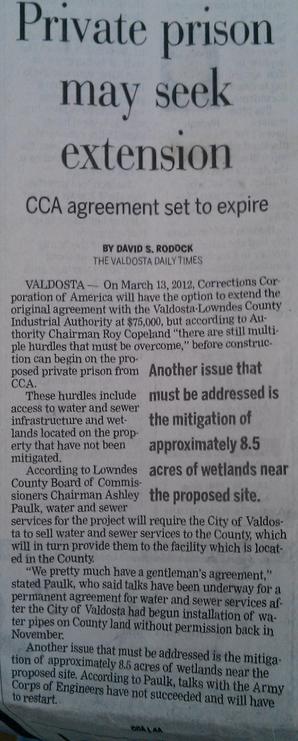
How the Industrial Authority can stop the CCA private prison: no third extension by 13 March 2012

Apparently the Industrial Authority can end the contract for CCA’s private prison six weeks from now, by simply not doing anything until then.

CCA has already paid for two extensions on their Option Agreement for land purchase. The Second Extension Term was paid for in March 2010 and forwarded to the land owner. Here’s video of Col. Ricketts announcing it to the VLCIA board 15 March 2011. That second extension expires 13 March 2012, six weeks from today.

A Third Extension Term is possible, but has to be negotiated. Here’s what Purchase and Development Agreement of 17 August 201 says:

1.4.2.3. Third Extension Term. The Authority shall use commercially reasonable efforts to obtain an option for a third extension term of twelve (12) months (the “Third Extension Term“). In the event the Authority is able to obtain such extension option on terms and conditions such that any required earnest money to be paid by the Company in connection with the exercise of such extension option does not exceed $75,000, and there is no increase of the price of the Site or any other payments not already required by the Option Agreement, then the Authority shall enter into a written agreement (the “Third Extension Term“) with the Seller reflecting the terms and conditions of such extension option….
What happens if the Authority does not provide such an extension option? Continue reading

the relatives of those people don’t care who is winning (the drug war) —Carlos Fuentes

A writer of fiction tells the truth about the failed war on drugs. We’re way past the beginning and middle of this story: time to end it. Which makes this a very bad time to build a private prison that depends on the war on drugs.

Anita Singh wrote for the Telegraph today, Carlos Fuentes: legalise drugs to save Mexico,

Fuentes, Mexico’s greatest writer and a former diplomat, addressed the contemporary problems of Latin American — in particular, Mexico’s drug problem.

He said: “The drug traffickers are in Mexico, they send the drugs to the US and once they get across the border what happens? We don’t know who consumes them. We can’t prosecute, we can’t defend. It’s a very difficult situation for us Mexicans. The governments of the US and Mexico have to fight drug trafficking together.”

Fuentes believes that decriminalising drugs is the only way to end the violence that in the past five years has claimed nearly 50,000 lives of gang members, security forces and innocent bystanders.

“It is a confrontation. Sometimes we win, sometimes they win. But there are 50,000 killed and the relatives of those people don’t care who is winning.

Nobody is winning except the profiteers in arms and pesticides, such as Monsanto. And even mighty MON is losing to Boliviana negra. Alcohol prohibition produced Al Capone and other gangsters; the failed War on Drugs produced drug gangs and ever more vicious militarization of police forces, right up to the Mexican failed “solution” of calling out the Army into the streets.

We’re all losing through lack of money for education and militarization of our own police. We can’t afford this costly failed experiment. The real solution is the same today as in 1933: legalize, regulate, and tax. That will also drop the U.S. prison population way down, saving a lot of money that can be used for education. It’s going to happen eventually, so building more prisons that will end up being closed is a bad idea.

-jsq

How to end the epidemic of incarceration

There are historical reasons for why we lock up so many people, some going back a century or more, and some starting in 1980 and 2001. Knowing what they are (and what they are not) lets us see what we can do to end the epidemic of incarceration that is damaging education and agriculture in Georgia.

Adam Gopnik wrote for the New Yorker dated 30 January 2012, The Caging of America: Why do we lock up so many people?

More than half of all black men without a high-school diploma go to prison at some time in their lives. Mass incarceration on a scale almost unexampled in human history is a fundamental fact of our country today—perhaps the fundamental fact, as slavery was the fundamental fact of 1850. In truth, there are more black men in the grip of the criminal-justice system—in prison, on probation, or on parole—than were in slavery then.
In Georgia, 1 in 13 of all adults is in jail, prison, probation, or parole: highest in the country (1 in 31 nationwide). Georgia is only number 4 in adults in prison, but we’re continuing to lock more people up, so we may get to number 1 on that, too.
Over all, there are now more people under “correctional supervision” in America—more than six million—than were in the Gulag Archipelago under Stalin at its height. That city of the confined and the controlled, Lockuptown, is now the second largest in the United States.

The accelerating rate of incarceration over the past few decades is just as startling as the number of people jailed: in 1980, there were about two hundred and twenty people incarcerated for every hundred thousand Americans; by 2010, the number had more than tripled, to seven hundred and thirty-one. No other country even approaches that. In the past two decades, the money that states spend on prisons has risen at six times the rate of spending on higher education.

And we can’t afford that, especially not when we’re cutting school budgets. That graph of education vs. incarceration spending is for California. Somebody should do a similar graph for Georgia.

The article does get into why we lock up so many people: Continue reading