Category Archives: Georgia Power

Prisoners as cheap labor

Quite likely you thought massive prison populations used as cheap labor were some sort of medieval tradition. Nope. Here’s an article that debunks that misconception and informs you about many other things I (and perhaps you) didn’t know about prisoners as cheap labor.

Locking Down an American Workforce Steve Fraser and Joshua B. Freeman wrote for TomDispatch 19 April 2012, Prison Labor as the Past — and Future — of American “Free-Market” Capitalism,

Penal servitude now strikes us as a barbaric throwback to some long-lost moment that preceded the industrial revolution, but in that we’re wrong. From its first appearance in this country, it has been associated with modern capitalist industry and large-scale agriculture.

So where and when did it come from?

As it happens, penal servitude — the leasing out of prisoners to private enterprise, either within prison walls or in outside workshops, factories, and fields — was originally known as a “Yankee invention.”
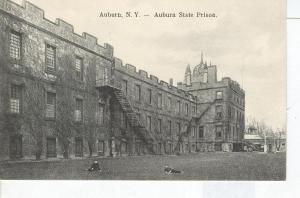
First used at Auburn prison in New York State in the 1820s, the system spread widely and quickly throughout the North, the Midwest, and later the West. It developed alongside state-run prison workshops that produced goods for the public sector and sometimes the open market.

A few Southern states also used it. Prisoners there, as elsewhere, however, were mainly white men, since slave masters, with a free hand to deal with the “infractions” of their chattel, had little need for prison. The Thirteenth Amendment abolishing slavery would, in fact, make an exception for penal servitude precisely because it had become the dominant form of punishment throughout the free states.

In case you’ve never read it or have forgotten, here is the Thirteenth Amendment (emphasis added):

Section 1. Neither slavery nor involuntary servitude, except as a punishment for crime whereof the party shall have been duly convicted, shall exist within the United States, or any place subject to their jurisdiction.

Section 2. Congress shall have power to enforce this article by appropriate legislation.

Got a population you don’t like? Continue reading

Austin Energy changed from anti-solar to pro-solar in one year

At the end of 2003, Austin Energy (AE) suddenly went from very anti-solar to very pro-solar. Formerly coal-smoking Cobb EMC is doing it right now. If AE and Cobb EMC can do it, so can Georgia Power: change in one year from opposed to aggressively promoting solar power.

Mike Clark-Madison wrote for the Austin Chronicle 5 December 2003, AE drops a solar bomb,

In a near-complete turnaround from its public position just a week ago, Austin Energy has announced plans to adopt specific, highly ambitious, and undeniably expensive goals for adding solar energy to the Austin electric and economic mix. At a town hall meeting held Tuesday night to discuss the AE plan — also the subject of a public hearing at City Council today (Thursday) — AE’s Roger Duncan announced the utility’s commitment to develop 15 megawatts of solar generating capacity by 2007, escalating to 100 megawatts by 2020. The AE plan also calls for a study of the “comprehensive value” of solar power — putting a dollar amount on the economic and environmental benefits to Austin, in addition to the cost of solar-generated electricity itself. This would determine the price Austin Energy would pay for electricity generated by privately owned solar installations, just as AE now buys wind power from third parties.

Georgians tend to think Georgia Power’s foot-dragging and disinformation campaign about solar is so entrenched it will never change. But I’ve seen it happen, and it happened despite people’s expectations set by the power utility, and it happened very quickly and very big:

Continue reading

Dr. Sidney Smith speaks about solar tonight in Savannah

Received Tuesday. -jsq

Savannah, Ga.— The Coastal Group Sierra Club is sponsoring a presentation by Dr. Sydney Smith, owner of a solar farm in Bulloch County and co-founder of Lower Rates for Customers, which is currently providing solar power to a business in Savannah and looking to expand, selling its solar power below Georgia Power’s rates.

Although Georgia’s solar potential is enormous, Georgia is one of four states that does not allow energy to be purchased from private suppliers. Learn how Smith is challenging the law and Georgia Power to pave the way for lower rates and green energy.

The presentation begins at 7 p.m., Thursday, April 19 at the First Presbyterian Church, 520 Washington Ave., in Savannah.

We’re just ripe for solar power –Cobb EMC

We already saw that private investment is funding a 100 acre 10 MW solar farm with Cobb EMC as a customer. What does that mean for Cobb EMC’s direction? How big is Cobb EMC, anyway? And what does all this mean for Georgia Power, and for solar power in Georgia and all the jobs it can produce? What does it mean for everyone running for the Georgia legislature?

Chip Nelson, CEO of Cobb EMCKristi E. Swartz wrote for the AJC 16 April 2012, Solar project could be a catalyst for more if policies allow it,

“I always thought solar power was something further out for Georgia. We just weren’t in the right time,” said Chip Nelson, chief executive officer of Cobb EMC. “The way things have been moving in the utility industry, particularly the last two or three years, I find that we’re just ripe for it.”

Ripe indeed! Coal is dead. Nuclear is going down. 30 MW solar farm near Austin Solar will eat the lunch of utilities that don’t start generating it. It’s time for utilities to get out in front and generate their own solar power. Austin Energy continues to show the way in Texas with a 30 MW solar farm. Now Cobb EMC can do the same for Georgia.

Nelson isn’t some fresh outsider: he’s a Cobb EMC lifer. According to Patty Rasmussen in Georgia Trend February 2012, Power Players: Taking Over At Cobb EMC,

Nelson worked for Cobb EMC for 37 years, most recently serving as chief operations officer. He stepped in as interim CEO in February 2010 and decided to apply for the full-time position.

And Cobb EMC is not small. According to Kim Isaza in MDJonline.com 20 July 2011 New Cobb EMC chief Nelson ready to ‘turn page’ on past costly litigation, divisiveness,

Continue reading

Private capital funding 100 acre 10 MW solar farm with customer Cobb EMC

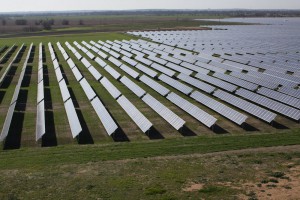
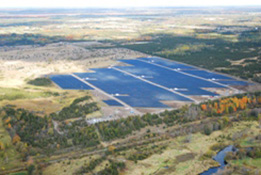
So Cobb EMC can do something other than coal, and can do it without wasting EMC customers’ money! Private investment is funding a 100 acre solar farm with Cobb EMC as customer.

Urvaksh Karkaria wrote for Atlanta Business Chronicle 12 April 2012, Smart Energy, Jacoby Development plan 100-acre solar farm in Georgia

A 100 acre solar power farm — billed as the largest in in the state — is planned for middle Georgia.

Smart Energy Capital and Jacoby Development Inc., inked a power purchase agreement with Cobb EMC to buy generation from the 10 MW solar farm to be built in Davisboro, Ga. The project, expected to go online in summer 2015, will generate enough power to light up about 1,500 homes.

Smart Energy Capital, a solar development and finance company, and Jacoby Development, will develop, finance and build the facility. The power generated will be sold to Marietta, Ga.-based Cobb EMC.

Imagine if instead of wasting Cobb EMC’s money on a coal boondoggle that Cobb EMC had moved ahead with this sooner.

But it’s finally starting to happen anyway:

Despite anemic subsidies, the absence of a renewable energy portfolio and, what some claim is Georgia Power Co.’s halting embrace of solar power, the Peach State is attracting solar development.

That’s right, in spite of Georgia Power.

Hey, what if Georgia Power stopped dragging its feet and got on with solar for its own profit?

-jsq

The costs of coal on your neighbors’ health

We can’t afford the costs of coal on our health.

John Sepulvado wrote for CNN Radio 1 April 2012, A power plant, cancer and a small town’s fears,

The two of them invested their life savings building their home. It’s a large ranch house on several acres, and the plan was the two of them would leave it for their sons and grandchildren. They gave up that dream after Maddox’s mother developed a rare form of ear cancer and died after living at the home for three years.

“I’m not going to bring my grandchildren up in this,” Maddox says. “Anybody who does would be a fool, I think.”

The problem, Maddox explains, is now he and his neighbors are getting sick. For Maddox, the first signs of trouble would come in the middle of the night, when he would wake up with nose bleeds mixed with clear mucus. Then his muscles started twitching, and then he got kidney disease, and then sclerosis of the liver.

Where does he live? Down the road from Plant Scherer in Juliette, Georgia: the nation’s dirtiest coal plant.

Georgia Power’s solution? Buy houses like his, cap the well, and raze the house.

Better solution? Get off of health-destroying moribund coal and get on with clean distributed wind and solar, for the profit (even to Georgia Power), for energy independence, for resilience, and yes, for our health.

-jsq

Judge OKs Barnes and Richardson CWIP suit against Georgia Power

Historic Davids get approval for slingshot against power company Goliath.

Judge allows lawsuit over Georgia Power surcharge to go forward,

Fulton Superior Court Judge Ural Glanville’s ruling Thursday allows the lawsuit filed by former Gov. Roy Barnes and ex-Republican House Speaker Glenn Richardson to go forward.

The complaint said Georgia Power has improperly collected sales tax and fees on a surcharge created by a 2009 law. They say it has added up to as much as $100 million in costs to ratepayers.

This lawsuit opposes Georgia Power’s Construction Work in Progress (CWIP) that is already charging gapower customers for the Plant Vogtle nukes that won’t produce any power for years yet. If this lawsuit wins, they may not ever be built.

But you don’t have to wait for this lawsuit, or for the legislature to ban CWIP. You can oppose CWIP by paying for it in a separate check.

Maybe soon we can get rid of Georgia Power’s territoriality law so we can, like we could in 46 other states, generate our own solar or wind power and sell it to whomever we choose.

-jsq

Solar eating fossil fuels’ cake in Germany

Why is Georgia Power still peddling misinformation about solar power instead of moving ahead with it? What’s happening in Germany could be a clue.


Giles Parkinson wrote for Crikey.com 28 March 2012 (it’s tomorrow in Australia), Why power generators are terrified of solar,
The first graph illustrates what a typical day on the electricity market in Germany looked like in March four years ago; the second illustrates what is happening now, with 25GW of solar PV installed across the country. Essentially, it means that solar PV is not just licking the cream off the profits of the fossil fuel generators — as happens in Australia with a more modest rollout of PV — it is in fact eating their entire cake.
So solar is taking the profits out of coal and natural gas. So sad!
Deutsche Bank solar analyst Vishal Shah noted in a report last month that EPEX data was showing solar PV was cutting peak electricity prices by up to 40%, a situation that utilities in Germany and elsewhere in Europe were finding intolerable. “With Germany adopting a drastic cut, we expect major utilities in other European countries to push for similar cuts as well,” Shah noted.

Analysts elsewhere said one quarter of Germany’s gas-fired capacity may be closed, because of the impact of surging solar and wind capacity. Enel, the biggest utility in Italy, which had the most solar PV installed in 2011, highlighted its exposure to reduced peaking prices when it said that a €5/MWh fall in average wholesale prices would translate into a one-third slump in earnings from the generation division.

You know, if the utilities got out in front and generated energy from solar and wind themselves, they wouldn’t be having this problem.

Here in Georgia, even Georgia Power could get going and do that, instead of fighting this:

Continue reading

Net Metering in California: Megawatts and jobs

Net metering of solar energy works fine in California, where it increasingly provides electricity to meet peak demand. Georgia has a 2001 law that requires power utilities to do a version of net metering, but it’s a weak version and there’s a low cap on how much you can sell back to the utility.

The Georgia version, according to GEFA:

Net metering is the process whereby an energy consumer produces energy and then sells some or all of this energy to the “grid”, or major energy producers in the state. Under Georgia’s net metering laws, state residents and businesses can purchase and operate green energy capital, including photovoltaics, wind energy and fuel cells, and use this energy on-site. These residents and businesses may then sell any un-used, additional energy produced on-site to their energy provider. There is a maximum of 10 kilowatts (kW) for residential applications and up to 100 kW for commercial applications.
As you can see by GEFA’s pie chart, solar energy was too small to chart as a source of energy in Georgia as of 2004. With solar, we can burn less coal and uranium.

Solar Energy Industries Association (SEIA) has a report, Solar Net Metering in California,

Protecting Net energy metering (NEM) is the top policy priority of the Solar Energy Industries Association (SEIA) for California in 2012. NEM is a billing arrangement that allows utility customers to offset some or all of their energy use (up to 1 MW) with selfgenerated renewable energy.
The definition sounds the same, except for the cap: 1 megawatt is 1000 kilowatts, so California’s current cap is 100 times the Georgia residential cap and 10 times the Georgia commercial cap, with apparently no distinction between residential and commercial.

The result is this: Continue reading

Barnes and Richardson against Georgia Power’s CWIP

Two former big-time politicos join the fight against CWIP.

Melissa Roberts wrote for CBS Atlanta yesterday, Unlikely duo challenges Ga. utility over rates,

The unlikely duo of ex-Democratic Gov. Roy Barnes and former Republican House Speaker Glenn Richardson are heading to court to challenge Georgia Power over a surcharge they say has cost ratepayers as much as $100 million.

They're going after Construction Work in Progress (CWIP)!

Jim Galloway in the AJC yesterday noted the irony,

The gentleman knows of what he speaks, and that is only one of the ironies here. The legislation that has allowed Georgia Power, for the last 15 months, to charge ratepayers for financial costs associated with the construction of two new nuclear power plants, was passed in 2009 during Richardson’s final session as the second- most powerful man in the Capitol.

Maybe he can help undo the harm he helped do. Ditto Roy Barnes, who got coal-plant-building Cobb EMC former head Dwight Brown off on a technicality.

Melissa Roberts wrote:

The lawsuit contends the utility is charging sales tax on the finance surcharge and the franchise tax paid to cities. Richardson said in a phone interview he and Barnes are two "Davids against the Goliath."

Add those two Davids to the two Davids of Savannah, Drs. Sidney Smith and Pat Godbey and their Lower Rates for Customers LLC. Add a few more thousand Davids around the state paying their CWIP in separate checks with objections.

New Hampshire banned CWIP and their nuke-building utility went bankrupt. Missouri banned CWIP. Iowa is working on banning CWIP. Georgia can ban CWIP, too. Watch out Goliath!

-jsq