Category Archives: Georgia Power

How long until solar beats gas?

We’ve heard even German coal importers say solar beats coal. How long until clean solar beats dirty natural gas fracking?

Southern Company has already cut energy production from coal in half, from 70 or 80% to 35%. Unfortunately, SO did that mostly by shifting to natural gas. Natural gas produced through “a revolution in shale gas”, commonly known as fracking. Do we want to trade dirty water for clean air?

Unlike Johnson & Johnson and Dell (and Coke and Pepsi and Amazon and and more than a dozen more, including even Wal-Mart), the Southern Company has not cut ties with ALEC and its pro-fracking and anti-solar campaign. Why is the Southern Company betting on a dirty horse?

How long until SO CEO Thomas A. Fanning’s “one day” when renewable energy becomes economical? Sooner than his prediction of next decade, as in two years ago solar crossed nuclear, wind is already at parity with nuclear, and even Southern Company realizes coal doesn’t beat anything anymore.

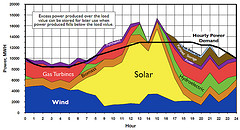
How long before solar beats natural gas, relegating gas to much-reduced use as a backup for sun and wind power, as John Blackburn already projected in March 2010 can happen in North Carolina?

How long will it take for the sun and the wind, with a little water and even less natural gas, to power the world? How long? Not long.

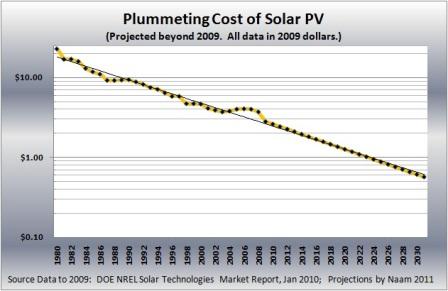
Because the arc of the solar Moore’s Law is long, but it bends down for price per watt, while the price of fracking, no matter the quakes and dirty water for ever, does not.

-jsq

Johnson & Johnson and Dell dump ALEC: where’s Southern Company?

J&J and Dell ditched ALEC, for two dozen bailing out of that ship of dubious lobbying. Where's The Southern Company? Still supporting ALEC's pro-fracking and anti-solar campaign?

A week ago Rebeka Wilce reported for PR Watch that Johnson & Johnson 19th Company, 23rd Private Sector Member, to Cut Ties with ALEC. Today Scott Keyes reported for ThinkProgress that Dell Becomes 21st Company To Drop ALEC. So many companies have ditched the corporate-legislative private-public partnership American Legislative Exchange (ALEC) that it's hard to keep count. Yet we still haven't heard from The Southern Company (SO), even as ALEC continues its drive to dismantle incntives for renewable energy and preserve fracking loopholes, and The Southern Company continues expanding use of natural gas (knowing it comes from fracking) while putting off solar and wind until "one day" some time next decade maybe, and (through its subsidiary Georgia Power) actively opposing fixing Georgia legislative hurdles to renewable energy. All that plus wasting Georgia Power customer cash and taxpayer dollars on useless new nukes at Plant Vogtle.

Come on, Southern Company and CEO Thomas A. Fanning: you can do better than that! Turn to the sun and the wind for clean green jobs for community and profit.

If you're a Georgia Power customer and you'd like to help persuade SO, you can pay your Plant Vogtle Construction Work in Progress (CWIP) charge in a separate check and write on it what you'd like instead. Even if you're not, it's election season, and every member of the Georgia legislature is running: you can contact your candidate and find out what they're willing to do to get us solar and wind for energy independence, jobs, community, and profit.

-jsq

SO CEO Fanning: Policy, jobs, and the economy plus fracking

You may have wondered, how was Southern Company (SO) CEO Thomas A. Fanning so ready and able to respond at length to any question at the SO shareholder meeting? Because he’s a class A CEO who does his homework, such as this white paper he wrote dated September 2011: American Energy Policy, Jobs and the Economy, in which he explains what he meant by “the revolution we have seen in the shale gas industry”.

So, natural gas is important, but it’s not a panacea. Here’s why.

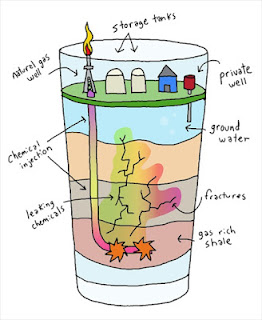
First, the reason prices have dropped so far is because of a new technology called fracking, which releases natural gas from so-called tight rock formations, such as shale gas. Fracking is the injection of chemicals underground, which have the effect of fracturing the rock deposits, thereby releasing the natural gas. There are environmental concerns around the chemicals associated with the fracking process. Those concerns have to be resolved.

Those concerns range from polluted groundwater to earthquakes. It’s great that SO is turning away from coal. I don’t think it’s so great to trade dirty air from coal for dirty water and earthquakes from fracking.

Secondly, many of these shale gas deposits are in places where there is no sufficient pipeline infrastructure necessary to move the gas to the places it’s needed to generate the electricity. Pipelines will have to be built. It will take time. We need to resolve that issue, too.

Meanwhile, rooftop solar Continue reading
Solar Lowndes High?

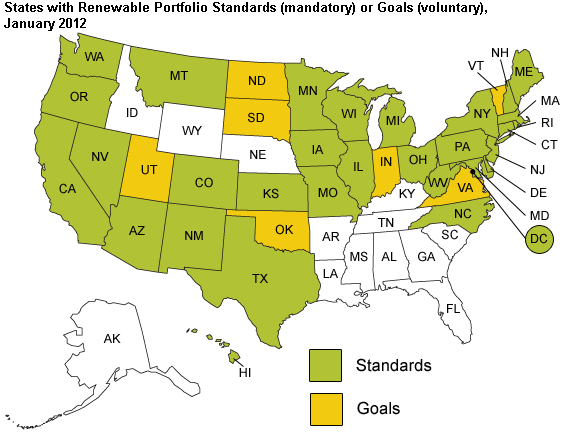
What does the world see driving north up I-75 past Valdosta? The empty roofs of Lowndes High School. Every south-facing one of which could hold solar panels.


View Larger Map

That would do more to put Lowndes County and Valdosta on the map as supporting solar and thus knowledge-based jobs than any amount of exit beautification.

Run out of roof space? What about those parking lots:


View Larger Map

And it wouldn’t take a Ted Turner to do it. In all but a few states the Lowndes County Board of Education (LCBOE) could let a private company finance and install all those solar panels and then lease the electricity for a fixed rate for 20 years, greatly reducing the school’s electricity bill and promoting our local community, all without any expense to we the taxpayers.

But you can’t do that in Georgia! Because Georgia Power doesn’t want us to. Unless we get some laws changed. Follow the link for how.

-jsq

PS: I haven’t forgotten Valdosta High School. All the economic advantages would apply just as well for the Valdosta Board of Education and Valdosta taxpayers. Even Valwood could do this and profit. If we get Georgia law changed to permit it.

Company installs solar and leases it to New Jersey school: you can’t do that in Georgia

Schools can’t do this in Georgia, because of the Territoriality Law. They can’t have a company finance and install solar panels on their property and lease the power from them at a fixed rate. You can’t, either, not even on your own private property. Does that seem right to you?

US DoE EERE wrote (no date), NJ School Installs 6.1 MW Solar System,

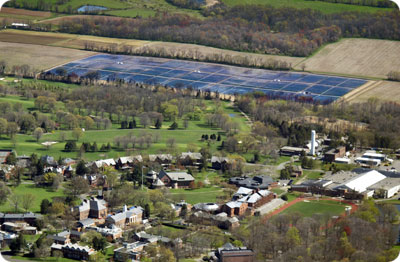
A 100-year old private school, Lawrenceville School, in Lawrenceville, N.J., installed a 6.1 megawatt ground-mounted system on 30 acres of school-owned farm land. The system features 24,934 SolarWorld solar panels, manufactured at the company’s U.S. headquarters in Hillsboro, Oregon. KDC Solar leased the land for the project from the school and owns and maintains the solar equipment. Through a power purchase agreement, the Lawrenceville School will buy electricity produced by the array over the next 20 years.

The school says the Lawrenceville Solar Farm was dedicated 4 May 2012., and adds that they also keep bees on the same land, plus what six megawatts means:

The Lawrenceville School Solar Farm consists of a nearly 30-acre, net metered, 6.1 megawatt solar facility, and honey-producing bee hives, which ring the perimeter of the array. The nearly 900,000 resident honey bees are nourished by a special wildflower mixture planted among and around the solar panels. The Farm offsets 6,388 metric tons of CO2 annually, the equivalent of taking 1,253 cars off the road annually.

The 24,934 solar panels generate six megawatts of energy, covering 90 percent of the School’s needs. During the day, the array can produce nearly twice the amount of energy needed by the School. The excess is imported to the local electrical utility, Public Service Electric & Gas (PSE&G) and credited to the School. The School will draw excess energy and all other required energy from PSE&G after sundown.

Here’s a PDF with more details.

The big picture is: you can do that in all but about four states. Georgia is one of those four states, Continue reading

The solar train is leaving the station, but the nuclear buggywhip is in the way

The president of the Georgia Solar Energy Association Solar Energy Industries Association says the solar train is leaving the station nationwide, but Georgia remains enmeshed in tangled legislation. We could have changed that last year with SB 401 if Georgia Power and Southern Company’s vested interested in new nuclear plants at Plant Vogtle hadn’t gotten in the way. We can change it next year with a similar or better law. The time to contact your Georgia legislator or candidate is now, while election season is on.

Update 14 June 2012: Fixed Rhone Resch employment attribution.

Rhone Resch wrote for the Saporta Report, 3 June 2012, It’s time to put solar to work in Georgia

There are now more than 100,000 Americans employed at over 5,600 solar businesses in all 50 states. Many of these are small businesses that have been hit hard by the recession, but they are finding new opportunity for growth in the solar industry.

In Georgia, there are more than 80 companies in the solar value chain including Suniva, MAGE Solar, Inc. and Enfinity Corporation. I will be joining representatives of each of these fine companies — and many others — at the Southern Solar Summit on June 15 in the Georgia Tech Research Institute Conference Center in Midtown Atlanta to talk about the strides solar is making, and what remains to be done.

These companies are leading rapid innovation — across the entire value chain, from manufacturing improvements to new financing and sales mechanisms, that are allowing more and more Americans to go solar.

He points out that more solar was installed in 2011 than the total installed in 2008 and 2009, which shows that Moore’s Law continues to work for solar: the price per watt continues to go down, causing demand to go up. He projects forward:

The U.S. is on pace to install nearly 3,200 megawatts of new solar capacity this year with an annual growth rate of 30 percent through 2016.

At that rate, the United States would add more than 25,000 megawatts of new solar capacity between now and 2016. That is roughly the size of 25 coal-fired power plants and represents a significant opportunity for states that aggressively move to obtain a share of this exponentially growing market.

Hm, at Plant Vogtle the operating nuclear reactors produce about 2,430 megawatts and the two new ones under construction are supposed to produce about 2,200 megawatts. So that 25 gigawatts of new solar capacity by 2016 would be about 20 nuclear plants, a number that may be familiar from what Germany has already deployed. Somebody remind me again: why are we building any new nukes? How about if we end the nuke boondoggle and get on with clean green jobs for community and profit?

Rhone Resch says what Georgia can do:

Continue reading

Videos of Shareholder Questions to Southern Company @ SO 2012-05-23

Slides and sound for Southern Company (SO) CEO Thomas A. Fanning’s main presentation at the 23 May 2012 SO shareholder meeting are available from SO on their website. SO doesn’t seem to have posted videos yet, although they had professional video equipment in use, and I was told just after the event that their videos would be on the web later that same day.

These items have already been blogged about this meeting:

I missed at least one questioner: Colleen Kiernan, Director of the Georgia Sierra Club. I plead unfamiliar cameras. Maybe soon SO will publish its own videos. SO was using a camera in front of the questioners, so you should be able to see them better.

Related blog posts:

Many more blog posts are in the nuclear category in the blog.

Here’s a video playlist for the 23 May 2012 SO shareholder meeting:

Videos of Shareholder Questions to Southern Company
Shareholder Meeting, Southern Company (SO),
Callaway Gardens, Pine Mountain, Georgia, 23 May 2012.
Video by John S. Quarterman for Lowndes Area Knowledge Exchange (LAKE).

-jsq

Clean green jobs for community and profit

Tell me who doesn’t want clean jobs for energy independence and profit?

“Environmental sustainability… can lead to more and better jobs, poverty reduction and social inclusion,”

The above quote is Juan Somavia in an article Stephen Leahy wrote for Common Dreams 1 June 2012, For an Ailing Planet, the Cure Already Exists,

Germany’s renewable energy sector now employs more people than its vaunted automobile industry.

No wonder, when German solar power produces more than 20 nuclear plants. How many jobs? According to Welcome to Germany 13 April 2012, Renewable Energies Already Provide More Than 380,000 Jobs in Germany, which cites a report from the German government,

The boom in renewable energies continues to create new jobs in Germany. According to a recently published study commissioned by the Federal Environment Ministry, the development and production of renewable energy technologies and the supply of electricity, heat and fuel from renewable sources provided around 382,000 jobs in 2011.

This is an increase of around 4 percent compared to the previous year and more than double the 2004 figure.

“Current employment figures show that the transformation of our energy system is creating entirely new opportunities on the job market,” said German Environment Minister Norbert Röttgen.

“It is the major project for the future for German industry. This opens up technological and economic opportunities in terms of Germany’s competitiveness as an exporter and location to do business.”

Wouldn’t we like some of that here in sunny south Georgia, a thousand miles south of Germany?

Back to the Stephen Leahy article:

Globally, the renewable energy sector now employs close to five million workers, more than doubling the number of jobs from 2006-2010, according to a study released Thursday by the International Labor Organization (ILO).

The transformation to a greener economy could generate 15 to 60 million additional jobs globally over the next two decades and lift tens of millions of workers out of poverty, concluded the study, “Working towards sustainable development”.

Everyone will benefit. Everyone can benefit starting right now.

Continue reading
Last Year’s Southern Company Stockholders Meeting —Steve Willis @ SO 2011-05-25

Received Thursday about last year’s Southern Company (SO) 2011 Annual Meeting of Stockholders. -jsq

Questions for Southern Company:

  1. Virtually all empirical evidence for decades indicates that climate disruption, related ocean acidification, sea rise and global warming are not only happening, but consistently occurring at the highest range of modeled projections. Events which were projected within 100 years twenty years ago, and within 50 years 10 years ago, are happening now. Instead of fighting a delaying, rear-guard action against big, dynamic change in energy production, wouldn’t it be better for our company to set the standard for transformation? It seems we have the most to lose, and, therefore, the most to gain.
  2. Unless there is some unexpected reversal in the climate change trends which have been occurring for decades, it seems inevitable that National Renewable Energy Portfolio Standards (RPS) will be legislated well before the end of this decade. Moody’s cited this likelihood in their recent credit downgrade of Southern Company. Since it seems highly unlikely that biomass and nuclear will be considered renewable energy sources under a RPS, where will Southern Company acquire mandated renewable energy — perhaps 20% or more of the total mix by 2020? And will the PSC allow us to load our full profits to rates for this energy on top of the big profits to the probable merchant suppliers, such as West Texas Wind?
  3. I have heard reports that Santee Cooper in South Carolina and

    This one has happened. -jsq
    Duke Energy in North Carolina are exploring the possibility of a joint venture to develop off-shore wind. Wouldn’t it be advantageous to ally with them in a joint venture? The Carolinas have a very long coast and very good wind resources, and a combined effort could reduce risk for all of us and significantly increase our combined political leverage. If we do not create some credible Georgia renewable energy resource, isn’t it possible that we will be forced to buy wind power from the Carolinas at an exorbitant rate within the next decade?
  4. Between the likelihood of carbon pricing and a National Renewable Energy Standard, it seems almost certain that Southern Company’s extreme reliance on coal fired power generation will be significantly reduced, voluntarily or by fiat, this decade. Nuclear seems more unlikely and expensive a salvation than ever. Isn’t it time we changed course and embraced proven and rapidly improving solar and wind technology before we are forced into them by National mandate?
  5. According to the information on your climate change Web site, Southern Company supports the target of an 80% reduction in carbon emissions by 2050. Can you tell us the approximate mix of nuclear, renewables, and efficiency that you envision to reach that goal?
-Steve Willis

Fukushima destroying nuclear-owning electric power utilities

The world’s worst nuclear disaster at Fukushima in Japan has had economic effects on nuclear-owning power utilities. What will happen to the Southern Company as Georgia Power customers and U.S. taxpayers get tired of paying for cost overruns which are already almost a billion dollars?

Erik Kirschbaum wrote for Reuters 26 May 2012, Germany sets new solar power record, institute says,

The German government decided to abandon nuclear power after the Fukushima nuclear disaster last year, closing eight plants immediately and shutting down the remaining nine by 2022.

And closing those nuclear plants caused German electric utility E.ON to lay off up to 11,000 staff, to take its first quarterly loss in a decade, and to cut its shareholder dividend. According to Forbes, E.ON in 2006 was the biggest electric utility in the world (and TEPCO, owner of the Fukushima nuclear plants, was number 6). In March 2012, E.ON was number 22. (TEPCO dropped from number 6 to number 45.) Southern Company (SO) jumped from number 16 in 2006 to number 6 this year, quite possibly because E.ON and TEPCO and others dropped so rapidly.

Hm, I wonder what Southern Company’s nukes, already almost $1 billion over budget, will do to SO’s ranking in Forbes’ list of top utilities? Maybe there’s a reason Moody’s called nuclear “a bet-the-farm risk”. What will SO do when this big nuclear bet goes bad? And how big a bill do Georgia Power customers and we the taxpayers want to let SO run up that we’ll get stuck with?

-jsq