On the anniversary of the French Revolution against a corrupt old regime,
the U.S. House of Representatives took a step towards independence from
the clammy grip of the fossil fuel companies.
This has direct implications on Moody AFB.
No more pipelines. Solar power now.
Bethany Allen-Ebrahimian, 14 July 2017,
In Landmark Move, GOP Congress Calls Climate Change ‘Direct Threat’ to Security:
Extreme weather and rising seas threaten bases from Virginia to Guam. For the first time, a Republican House has voted to recognize that.,

One
study
last year found that rising oceans threaten 128 military
installations on the coasts, including naval facilities worth around
$100 billion.The Pentagon has been aware for years of
the looming danger
represented by climate change. But partisan infighting in Congress,
budget sequestration, and the toxic nature of the climate debate
have hamstrung the Defense Dept. from taking steps to protect key
assets — or even identifying which facilities face the most
serious threats.This week, though, the Pentagon may have gotten a boost — from
the unlikeliest of places.
The Republican-controlled House retained an
amendment to the 2018
defense funding bill affirming that “climate change is a
direct threat to the national security of the United States.”
It orders defense officials to draw up a report laying out which
facilities would be most affected.

It’s not just the DoD’s over-extended worldwide bases that are at risk,
nor even its troops in theatres with vulnerable supply lines to outposts
if they aren’t yet converted to sun or wind power,
nor even the coastal bases in the
study.
Moody Air Force Base
Moody Air Force Base (AFB) is not immune to effects of floods when
they ravage its host county (Lowndes) and city (Valdosta),
as they did in 2009 and 2013. Sure, those were mostly caused
by too much clearcutting and paving.
But those floods are not going to get less as the weather worsens.
Moody AFB is a training base,
so this paragraph in
the amendment
is directly relevant to Moody:
(7) The Government Accountability Office (GAO) has stated: “DOD
links changes in precipitation patterns with potential climate
change impacts such as changes in the number of consecutive days of
high or low precipitation as well as increases in the extent and
duration of droughts, with an associated increase in the risk of
wildfire. . . this may result in mission vulnerabilities such as
reduced live-fire training due to drought and increased wildfire
risk.”.
And when Moody personnel are deployed overseas, which climate change
will make increasingly likely, they’re not here shopping. Not to mention
some of them won’t come back, which is not good.
(5) Former Chief of Staff of the U.S. Army Gordon Sullivan has
stated: “Climate change is a national security issue. We found
that climate insta bility will lead to instability in geopolitics
and impact American military operations around the world.”.
Southern Company solar deployment
Southern Company has been busily putting solar farms at military
bases in
Georgia
and
Florida, some of them the same coastal bases of
th
study.
Georgia Power’s biggest ever solar farm is
139 MW recently at
Warner Robins AFB
(bigger than the 10 MW solar farm someobdy else already did there three years ago).
I’m told (by a very highly placed source) that Georgia Power
is negotiating about Moody AFB.
Pipeline workers need to start retraining for solar jobs
You know what makes pipeline personnel mad?
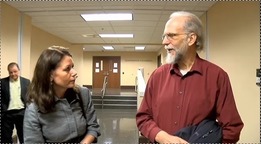
When you point out they’re directly contributing to climate change,
thus their pipeline is a threat to national security.
That’s certainly what happened when I pointed that out to
Sabal Trail’s governmental contact after a Lowndes County Commission
meeting several years ago.
That’s why he’s stalking around furious in the background in
the WALB TV report.
Sure, the workers doing the actual installation may not know that,
but the people who are selling these pipeline boondoggles to local,
state, and federal governments do, and their corporate executives certainly
do know.
Fossil fuel executives and their sales amd marketing people know they’re
buying short-term profit at the expense of their country’s national security,
not to mention at the expense of local water, air, and property rights.
And pipeline workers better look at the handwriting on the wall
and start retraining, because all those pipelines are going to be
stranded assets before long, and their industry is going down, taking their jobs with it.
Maybe they should follow the money.
Matt Egan, CNN Money, 25 May 2017,
Solar jobs are growing 17 times faster than the rest of the economy,
“It seems to be one of the few areas of high-paying, blue-collar
jobs — and you don’t have to learn to code,” said Bryan
Birsic, CEO of Wunder Capital, a fintech company that allows
investors to help finance solar panel installations.
Southern Company already
more than doubled the renewable energy percentage
of its energy mix in one year.
Southern Company CEO Tom Fanning and Georgia Power CEO Paul Bowers:
well done!
And please get on with doing more.
All you other utilities, including yes, you, FPL, please get on with sun power for the Sunshine State and everywhere else.
Solar power is on track to produce more U.S. electricity than any other source by 2023.
That’s even though
Southern Company is reducing its last year’s solar budget of $4.5 billion
to $1.5 billion this year.
Sure, solar tax credits may end.
But solar prices keep dropping due to sheer economy of scale,
and even at higher prices a few years ago SO could have already
installed enough sun and wind power for just the amount of the cost overruns
at its Plant Vogtle nuclear quagmire to supply just as much power as
those two nuke units ever would if they were every finished.
To quote Fanning: “Oh, solar panels! Oh, heck yeah!”
The Amendment

It’s not quite the Declaration of Independence or the Storming of the Bastille.
Or maybe it is, since the U.S. House of Representatives has recently
been the fortress of fossil fuels futilely defending against the sun rising.
And that fortress seems to have fallen to… the U.S. military.
Here is the text of
the amendment:
AMENDMENT TO H.R. 2810
OFFERED BY MR. LANGEVIN OF RHODE ISLANDAt the appropriate place in title III, insert the following:
1 SEC. 3ll. REPORT ON EFFECTS OF CLIMATE CHANGE ON
2 DEPARTMENT OF DEFENSE.
3 (a) FINDINGS.—Congress makes the following find-
4 ings:
5 (1) Secretary of Defense James Mattis has
6 stated: “It is appropriate for the Combatant Com-
7 mands to incorporate drivers of instability that im-
8 pact the security environment in their areas into
9 their planning.”.
10 (2) Secretary of Defense James Mattis has
11 stated: “I agree that the effects of a changing cli-
12 mate — such as increased maritime access to the
13 Arctic, rising sea levels, desertification, among oth-
14 ers — impact our security situation.”.
15 (3) Chairman of the Joint Chiefs of Staff Jo-
16 seph Dunford has stated: “It’s a question, once
17 again, of being forward deployed, forward engaged,
18 and be in a position to respond to the kinds of nat-2
1 ural disasters that I think we see as a second or
2 third order effect of climate change.”.
3 (4) Former Secretary of Defense Robert Gates
4 has stated: “Over the next 20 years and more, cer-
5 tain pressures-population, energy, climate, economic,
6 environmental-could combine with rapid cultural, so-
7 cial, and technological change to produce new
8 sources of deprivation, rage, and instability.”.
9 (5) Former Chief of Staff of the U.S. Army
10 Gordon Sullivan has stated: “Climate change is a
11 national security issue. We found that climate insta-
12 bility will lead to instability in geopolitics and impact
13 American military operations around the world.”.
14 (6) The Office of the Director of National Intel-
15 ligence (ODNI) has stated: “Many countries will en-
16 counter climate-induced disruptions—such as weath-
17 er-related disasters, drought, famine, or damage to
18 infrastructure—that stress their capacity to respond,
19 cope with, or adapt. Climate-related impacts will also
20 contribute to increased migration, which can be par-
21 ticularly disruptive if, for example, demand for food
22 and shelter outstrips the resources available to assist
23 those in need.”.
24 (7) The Government Accountability Office
25 (GAO) has stated: “DOD links changes in precipita-
3
1 tion patterns with potential climate change impacts
2 such as changes in the number of consecutive days
3 of high or low precipitation as well as increases in
4 the extent and duration of droughts, with an associ-
5 ated increase in the risk of wildfire. . . this may re-
6 sult in mission vulnerabilities such as reduced live-
7 fire training due to drought and increased wildfire
8 risk.”.
9 (8) A three-foot rise in sea levels will threaten
10 the operations of more than 128 United States mili-
11 tary sites, and it is possible that many of these at-
12 risk bases could be submerged in the coming years.
13 (9) As global temperatures rise, droughts and
14 famines can lead to more failed states, which are
15 breeding grounds of extremist and terrorist organi-
16 zations.
17 (10) In the Marshall Islands, an Air Force
18 radar installation built on an atoll at a cost of
19 $1,000,000,000 is projected to be underwater within
20 two decades.
21 (11) In the western United States, drought has
22 amplified the threat of wildfires, and floods have
23 damaged roads, runways, and buildings on military
24 bases.4
1 (12) In the Arctic, the combination of melting
2 sea ice, thawing permafrost, and sea-level rise is
3 eroding shorelines, which is damaging radar and
4 communication installations, runways, seawalls, and
5 training areas.
6 (13) In the Yukon Training Area, units con-
7 ducting artillery training accidentally started a wild-
8 fire despite observing the necessary practices during
9 red flag warning conditions.
10 (b) SENSE OF CONGRESS.—It is the sense of Con-
11 gress that—
12 (1) climate change is a direct threat to the na-
13 tional security of the United States and is impacting
14 stability in areas of the world both where the United
15 States Armed Forces are operating today, and where
16 strategic implications for future conflict exist;
17 (2) there are complexities in quantifying the
18 cost of climate change on mission resiliency, but the
19 Department of Defense must ensure that it is pre-
20 pared to conduct operations both today and in the
21 future and that it is prepared to address the effects
22 of a changing climate on threat assessments, re-
23 sources, and readiness; and
24 (3) military installations must be able to effec-
25 tively prepare to mitigate climate damage in their5
1 master planning and infrastructure planning and de-
2 sign, so that they might best consider the weather
3 and natural resources most pertinent to them.
4 (c) REPORT.—
5 (1) REPORT REQUIRED.—Not later than one
6 year after the date of the enactment of this Act, the
7 Secretary of Defense shall submit to the Committees
8 on Armed Services of the Senate and the House of
9 Representatives a report on vulnerabilities to mili-
10 tary installations and combatant commander re-
11 quirements resulting from climate change over the
12 next 20 years.
13 (2) ELEMENTS.—The report on vulnerabilities
14 to military installations and combatant commander
15 requirements required by paragraph (1) shall include
16 the following:
17 (A) A list of the ten most vulnerable mili-
18 tary installations within each service based on
19 the effects of rising sea tides, increased flood-
20 ing, drought, desertification, wildfires, thawing
21 permafrost, and any other categories the Sec-
22 retary determines necessary.
23 (B) An overview of mitigations that may
24 be necessary to ensure the continued oper-
25 ational viability and to increase the resiliency of6
1 the identified vulnerable military installations
2 and the cost of such mitigations.
3 (C) A discussion of the climate-change re-
4 lated effects on the Department, including the
5 increase in the frequency of humanitarian as-
6 sistance and disaster relief missions and the
7 theater campaign plans, contingency plans, and
8 global posture of the combatant commanders.
9 (D) An overview of mitigations that may
10 be necessary to ensure mission resiliency and
11 the cost of such mitigations.
12 (3) FORM.—The report required subparagraph
13 (1) shall be submitted in unclassified form, but may
14 contain a classified annex.
-jsq
Investigative reporting costs money, for open records requests, copying, web hosting, gasoline, and cameras, and with sufficient funds we can pay students to do further research. You can donate to LAKE today!
Pingback: The real worst and best cases of climate change | On the LAKE front