Tag Archives: Elections

Make sure people in my age group know who they’re voting for —Brett Huntley @ LCC 2013-02-26

Brett Huntley responded to the Commission's mysterious ruling against the public at the 26 Febuary 2013 Lowndes County Commission meeting, to close the only public access to the Alapaha River in Lowndes County. Neither County Manager Joe Pritchard nor County Engineer Mike Fletcher were paying any attention.

I would like to publicly say that I am shocked with the decision. I feel the decision was in favor of a sole person, and not in the interests of the community and the citizens. We tried to speak and explain our side of the story. And the county road has not ceased to be used. It's been being used in our county for over 100 years. I feel your guys just made a decision that will have an impact on our culture and heritage in the community that is not good. It's a bad decision, I feel.

I kind of feel hurt. I feel it's a personal thing for our community. That whole road abandonment idea stems from one sole person

Continue reading

Ninety percent of life is just showing up. —VDT

I hate to agree with the VDT, but I do with this editorial of 8 February 2013, The importance of ‘showing up’,

If you can’t show up for meetings at least 90 percent of the time, you shouldn’t have sought office or volunteered for an authority seat in the first place.

-jsq

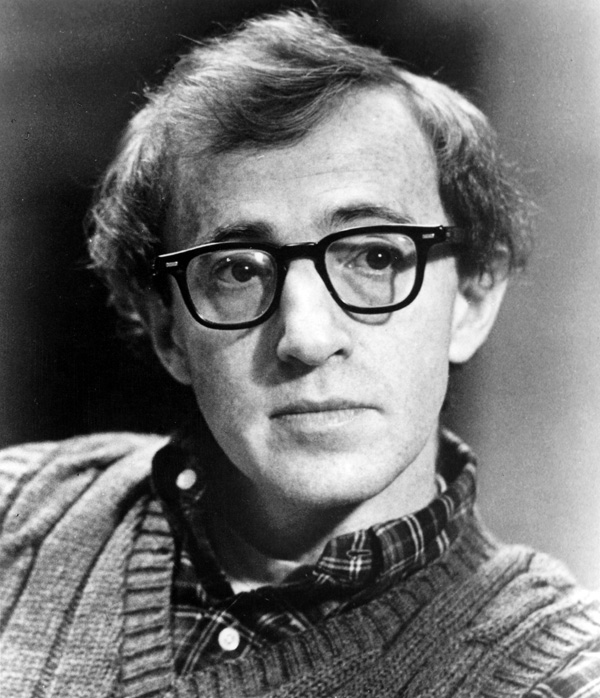
PS: This is what Woody Allen actually said, which has pretty much the same meaning, in Woody Allen Interview by Vicky Cristina Barcelona, 15 August 2008.

You have to do the stuff. Everything in life turns out to be a distraction from the real thing you want to do. There are a million distractions and when I was a kid I was very disciplined. I knew that the other kids weren’t. I was the one able to do the thing, not because I had more talent, maybe less, but because they simply weren’t applying themselves. As a kid I wanted to do magic tricks. I could sit endlessly in front of mirror, practicing, practicing, because I knew if you wanted to do the tricks you’ve got to do the thing. I did that with the clarinet, when I was teaching, I did that with writing. This is the most important thing in my life because I see people striking out all the time. It’s not because they don’t have talent, or because they don’t want to be, but because they don’t put the work in to do it. They don’t have the discipline to do it. This was something I learned myself. I also had a very strict mother who was no nonsense about that stuff. She said ‘If you don’t do it, then you aren’t going to be able to do the thing.’ It’s as simple as that. I said this to my daughter, if you don’t practice the guitar, when you get older you wouldn’t be able to play it. It’s that simple. If you want to play the guitar, you put a half hour in everyday, but you have to do it. This has been the biggest guiding principle in my life when I was younger and it stuck. I made the statement years ago which is often quoted that 80 percent of life is showing up. People used to always say to me that they wanted to write a play, they wanted to write a movie, they wanted to write a novel, and the couple of people that did it were 80 percent of the way to having something happen. All the other people struck out without ever getting that pack. They couldn’t do it, that’s why they don’t accomplish a thing, they don’t do the thing, so once you do it, if you actually write your film script, or write your novel, you are more than half way towards something good happening. So that I was say my biggest life lesson that has worked. All others have failed me.


As went Maine Yankee, so goes San Onofre: another reactor will close

San Onofre 4 will stay down, if opponents can stop the hidden experiment shell game. Maine Yankee was down for about a year, and never started up again.

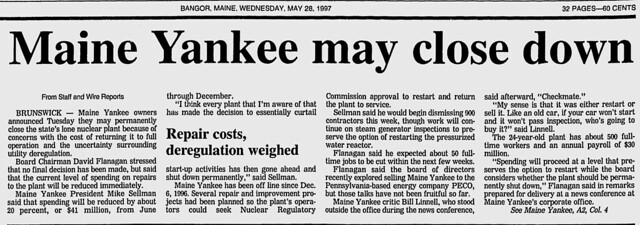
Front page of the Bangor Daily News 28 May 1997, Maine Yankee plant may be closed down: Owners weigh repair costs, deregulation,

Page 1A Bangor Daily News 28 May 1997

Maine Yankee President Mike Sellman said that spending will be reduced by about 20 percent, or $41 million, from June through December.

“I think every plant that I’m aware of that has made the decision to essentially curtail start-up activities has then gone ahead shut down permanently,” said Sellman.

Maine Yankee has been off line since Dec. 6, 1966. Several repair and improvement projects had been planned so the plant’s operators could seek Nuclear Regulatory Commission approval to restart and return the plant to service.

See also “It has to close because of the pocketbook.” —Kyle Jones on Maine Yankee nuclear power plant.

-jsq

“It has to close because of the pocketbook.” —Kyle Jones on Maine Yankee nuclear power plant

Instead of demonstrating to influence legislators, sometimes it's better to get elected and legislate: that's what Kyle Jones did in Maine, and he closed the Maine Yankee nuke, de-monopolized the state's electrical utilities, and instituted a 30% renewable energy goal. All this was helped by the nuclear industry's own incompetence.

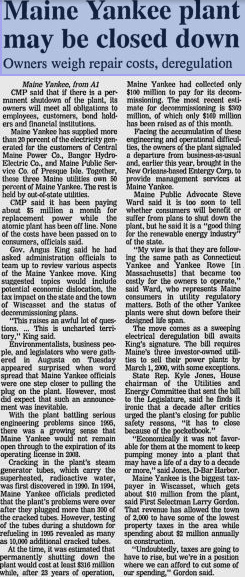
Bangor Daily News, Page A2, 28 May 1997, Maine Yankee plant may be closed down: Owners weigh repair costs, deregulation,

Page 2A Bangor Daily News 28 May 1997 Cracking in the plant's steam generator tubes, which carry the superheated, radioactive water, was first discovered in 1990. In 1994, Main Yankee officials predicted that the plant's problems were over after they plugged more than 300 of the cracked tubes. However, testing of the tubes during a shutdown for refueling in 1995 revealed as many as 10,000 additional cracked tubes.

Sounds a lot like San Onofre.

At the time, it was estimated that permanently shutting down the plant would cost at least $316 million while, after 23 years of operation, Maine Yankee had collected only $100 million to pay for its decommissioning. The most recent estimate for decommissioning is $369 million, of which only $169 million has been raised as of this month.

Facing the accumulation of these engineering and operational difficulties, the owners of the plant signaled a departure from business-as-usual and, earlier this year, brought in the New Orleans-based Entergy Corp. to provide management services at Maine Yankee.

Oh, my! The same Entergy that's now likely to close Vermont Yankee. And Vermont Yankee wasn’t the first to follow this financial path to closure:

Continue reading

Rural AIDS: poverty the cause, solar power part of the solution

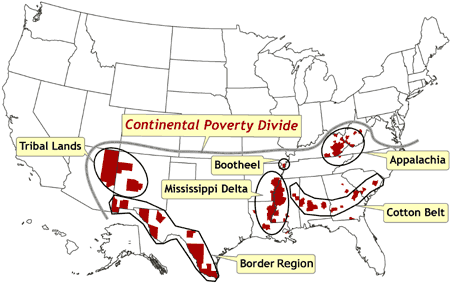
Director Lisa Biagiotti spent two years travelling around the South interviewing people about AIDS to make a film, deepsouth. She found rural AIDS is a bigger and faster-growing problem than AIDS in center cities, yet most health and prevention funding goes to urban areas. The root cause seemed clear to her: poverty. Here’s some deeper dirt (literally) on rural poverty in the U.S., and one thing we know can help with that: distributed solar power, for jobs, for reduced electrical bills, and for energy independence. What politician wouldn’t want jobs for their constituents?

The director said the screening at VSU at the end of November drew more people than the day before in Little Rock. There were clearly more than 150 in the audience in Valdosta. It’s a topic very relevant to here, as Dean Poling wrote in the VDT 26 November 2012,

Organizers note that Georgia is ranked sixth highest nationally for its cumulative number of AIDS cases reported through December 2009. More than 40,000 known HIV/AIDS cases were reported in Georgia as of 2010.

The South Health District’s 10 counties, which include Lowndes and surrounding counties, report 950 confirmed cases of HIV/AIDS, while many more are likely infected and risk becoming sick because they are not being treated. More specifically, there are about 460 reported cases in Lowndes County.

In reporting these numbers, HIV is the virus (HIV disease) and AIDS is the medical diagnosis made by a doctor of the symptoms, according to South Health District.

It’s a great movie and I highly recommend it. Director Biagiotti spent a substantial amount of her own money and two years to make this film, yet there are aspects she could only note in passing, such as incarceration. She can’t be expected to have researched every aspect; maybe somebody else can step up and help follow more threads.

The movie starts with some maps about poverty and AIDS in the South. It did not, however, look outside the South for poverty. Here are better poverty maps, from the CDC:
Continue reading

Rep. Austin Scott (R GA-08) @ VLCoC 2013-01-10

Ron Borders introduced Congressman Austin Scott (R GA-08) who made some remarks on the front porch at the Chamber of Commerce Thursday 10 January 2013.

Bookended by some formulaic remarks about debt (without mentioning that it’s already mostly solved), the Congressman noted he is on the Committee on Armed Services. He said there is no current BRAC (Base Realignment and Closure Commission), although one has been asked for. He said a BRAC wouldn’t do anything for near-term debt, anyway (but he didn’t say anything about ending the war in Afghanistan or stopping funding for un-needed weapons systems as ways of saving money).

He said he is the chair of a House Agriculture Subcommitee (Horticulture, Research, Biotechnology, and Foreign Agriculture). He said he was for research, for the agricultural extension, and for agricultural exports.

Here’s the WCTV news report, with responses by Gretchen Quarterman, Chair of the Lowndes County Democratic Party (LCDP).

Here’s a video playlist:

Continue reading

Videos: money and transparency @ LCC 2013-01-08

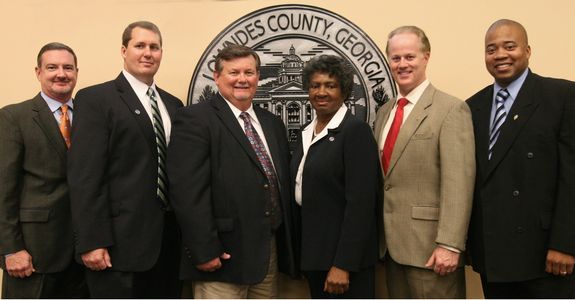
The new Commission with the new portrait got to hear about money and transparency right away. And a surprise alcoholic vote caused by their lack of transparency.


Crawford Powell (Dist. 3), Richard Raines (Dist. 2), Bill Slaughter (Chairman), Joyce Evans (Dist. 1), John Page (Dist. 5), Demarcus Marshall (Dist. 4).

Here’s the agenda, with links to videos, and a few notes, followed by a video playlist. See also the Monday Work Session.

Continue reading

Make available packets Commisioners see? —Gretchen Quarterman @ LCC 2013-01-08

Gretchen Quarterman thanked and congratulated Commission members at the 8 January 2013 Lowndes County Commission Regular Session.

Then she reminded them she ran on a platform of transparency, and she asked them to make Commission packets available to the public, and move CWTBH to the beginning of the meeting so citizens can comment before the commissioners vote.

Here’s the video:

Make available packets Commisioners see? —Gretchen Quarterman
Regular Session, Lowndes County Commission (LCC),
Video by Gretchen Quarterman for Lowndes Area Knowledge Exchange (LAKE), Valdosta, Lowndes County, Georgia, 8 January 2013.

-jsq

Videos @ LCC 2013-01-07

The public defender said the county palace (that we’re still mysteriously paying on) didn’t have space for his office. The Industrial Authority request to buy some still-unspecified property “has been pulled from the agenda” by unspecified forces. The new 4-H agent spoke and a bus was discussed. One Commissioner forgot to show up until late to hear Workers’ compensation is going up and the Commission’s own schedule is being adjusted for holidays. There was little substantive discussion, and there’s no sign anything will change at the Lowndes County Commission unless enough people want it to. They vote this evening at 5:30 PM, and they do have Citizens Wishing to be Heard, although it is still at the end, after all the votes.

Here’s the agenda, with links to videos, and a few notes.

Continue reading

New Clayton County Commissioners fire County Manager, fund forensic audit

A few new Commissioners on a five-member board is producing significant changes in Clayton County. What changes will the new Lowndes County Commissioners make?

Tammy Joyner write for the AJC Election results usher in period of change for Clayton,

The new County Commission set the tone this week by ushering in a raft of changes aimed at creating better accountability in Clayton’s finances while putting greater control in the hands of the new chairman. The board removed County Manager Wade Starr, a long-time kingmaker in Clayton politics, and will bring in a chief financial officer to manage county finances.

The balance of power clearly has swung to newly elected Commissioners Jeff Turner and Shana Rooks. Turner, who replaces Eldrin Bell as chairman, and Rooks, who defeated Wole Ralph, teamed with returning Commissioner Michael Edmondson to create a new voting bloc on the five-member board, and they appear intent on taking swift action.

“They hit the ground running,” said Carl Swensson, chairman of the Clayton County Citizens Oversight Committee. “The former power triumvirate has been absolutely shattered. We’re going to have good people in position where they can do the most good for this county. You’re going to find a more receptive ear in the new structure.”

Naturally the remaining old guard took issue:

Continue reading