Previously writing about biomass and carbon dioxide I said I’d supply an example of the sort of thing I’m looking for as a regional analysis for renewable energy, including biomass, solar, wind, wave, tides, and others.
Here it is: the Highland Renewable Energy Strategy
approved by the Highland Council at its 4 May 2006 meeting.
It’s a 58 page document about renewable energy strategy and planning guidelines,
considering numerous types of renewable energy, pros and cons
of each, power distribution, effects on environment, protected
areas, etc., illustrated copiously with detailed maps.
And updated:
Continue reading →
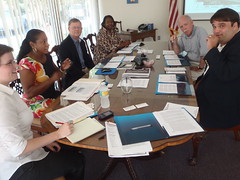
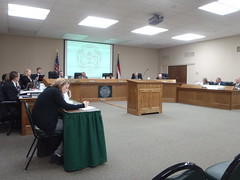
Natasha Fast (SAVE), Pastor Angela Manning (New Life Ministries), Allan Ricketts (Project Manager), Geraldine Fairell, Ken Klanicki, Brad Lofton (Executive Director), picture by John S. Quarterman (LAKE)
Pictured is a group of concerned citizens meeting about the
proposed biomass plant with Valdosta-Lowndes County
Industrial Authority (VLCIA)
Project Manager Allan Ricketts
and Executive Director Brad Lofton.
Ricketts and Lofton gave a two-hour presentation,
took some action items, and have provided a schedule
on which they will fulfill them.
I thank them for that and look forward to the further materials.
Lying in the center of the table in the picture is this document:
The copy on the table is dated April 7, 2010; the online version
is dated May 2010.
It’s a powerpoint presentation that makes many good points,
among them that coal doesn’t grow back, while trees do.
So in theory it would be possible, by organizing harvesting of biomass
over a region to make burning biomass for electricity carbon neutral.
The document comes right out and says:
At point of combustion, CO2 emissions per unit of energy produced
are generally higher for biomass fuels than for fossil fuels.
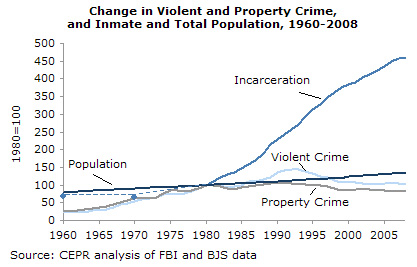
The United States currently incarcerates a higher share of its population than any other country in the world. We calculate that a reduction in incarceration rates just to the level we had in 1993 (which was already high by historical standards) would lower correctional expenditures by $16.9 billion per year, with the large majority of these savings accruing to financially squeezed state and local governments. As a group, state governments could save $7.6 billion, while local governments could save $7.2 billion.
These cost savings could be realized through a reduction by one-half in the incarceration rate of exclusively non-violent offenders, who now make up over 60 percent of the prison and jail population.
A review of the extensive research on incarceration and crime suggests that these savings could be achieved without any appreciable deterioration in public safety.
There’s a 19 page PDF report published by the Center for Economic and Policy Research,
but that one graph pretty much spells it out:
incarceration went up abruptly starting in the early 1980s and continued up,
while crime did not.
What we have here is a very expensive policy mistake.
An interesting series of exchanges here.
First Coy Brightwell compared the proposed Glen Laurel subdivision
(on Old Pine Road) to the existing Greyfield subdivision (off Oak Street
Extension) with a number of specific points: run down quickly, rental property, etc.:
Then a Mr. Mulligan gets into an interesting discussion about code enforcement:
Continue reading →
I just got a call from the county saying Monday’s morning work session of the Lowndes County Board of Commissioners is cancelled
due to lack of items. This happened a month ago, as well.
The regular public meeting is still on for Tuesday 22 June at 5:30 PM at 325 W. Savannah Ave. (under the water tower). The agenda does seem a mite slim: no rezoning cases, no ULDC changes. Still, there’s Citizens Wishing to be Heard. I’ll be there.
The Glen Laurel Subdivision rezoning case that the Lowndes County
Board of Commissioners decided on Tuesday June 8 (REZ-2010-06)
raises all sorts of issues.
Let’s start by hearing Coy Brightwell (he lives just across Old Pine Road from
the proposed subdivision) summarize some points against
the rezoning, saying going all the way from RA to PD is too far,
and that the neighbors are asking for a compromise:
There’s a theme here: “we’re not against development”.
We’ll come back to that.
This is about exclusion zones around wells, and maybe about
restrictions on putting new wells next to pollution sources such
as cotton fields.
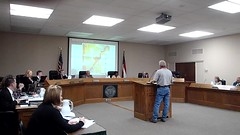
At their 8 June 2010 regular meeting, the Lowndes County Board of Commissioners,
at the recommendation of County Planner Jason Davenport,
tabled revisions to the Uniform Land Development Code (ULDC) about
wellhead protection.
Such protections are a new requirment by the Georgia EPD,
and it’s taking a while to figure out what is appropriate for the
ten wells operated by the county and the 140 private community wells,
many of which have trust indentures with the county that require the
county to take them over if their current operators do not supply
enough water, or of good enough quality.
Picture by John S.Quarterman, video by Gretchen K. Quarterman
for LAKE, the Lowndes Area Knowledge Exchange, 8 June 2010.
Previously, the Valdosta City Council appointed City Council member
Robert Yost to the
Valdosta-Lowndes County Parks & Recreation Authority (VLPRA).
The Lowndes County Board of Commissioners debated appointing a Commissioner
to the VLPRA at their June 8 meeting:
They decided to appoint their chairman, Ashley Paulk, to the VLPRA.
Chairman Paulk said he would serve, but as a private citizen.
I wonder then what the point was of appointing him, rather than
someone else.
In April 2009, the City of Valdosta was awarded a Georgia Historic Preservation Fund grant by the Historic Preservation Division, Georgia Department of Natural Resources, to produce a Geographic Information Systems (GIS)-enabled web site to be used by family members, historians, genealogists, and anyone interested in learning about the generations of Valdostans laid to rest at the city-owned Sunset Hill Cemetery.
You can search for people by name, and it will show you birth date, death date, lot number, and pan to the correct location on a map. Quite a difference from when aunt Jane and I used to have to try to guess
when the caretaker would be in to look up who was buried where, or just
stomp around until we found the marker.
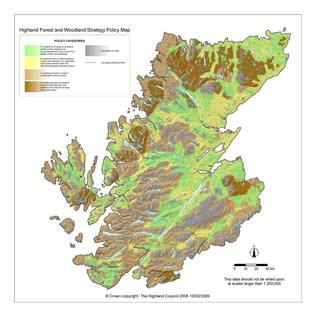 Previously writing about biomass and carbon dioxide I said I’d supply an example of the sort of thing I’m looking for as a regional analysis for renewable energy, including biomass, solar, wind, wave, tides, and others.
Here it is: the Highland Renewable Energy Strategy
approved by the Highland Council at its 4 May 2006 meeting.
It’s a 58 page document about renewable energy strategy and planning guidelines,
considering numerous types of renewable energy, pros and cons
of each, power distribution, effects on environment, protected
areas, etc., illustrated copiously with detailed maps.
And updated:
Continue reading
Previously writing about biomass and carbon dioxide I said I’d supply an example of the sort of thing I’m looking for as a regional analysis for renewable energy, including biomass, solar, wind, wave, tides, and others.
Here it is: the Highland Renewable Energy Strategy
approved by the Highland Council at its 4 May 2006 meeting.
It’s a 58 page document about renewable energy strategy and planning guidelines,
considering numerous types of renewable energy, pros and cons
of each, power distribution, effects on environment, protected
areas, etc., illustrated copiously with detailed maps.
And updated:
Continue reading