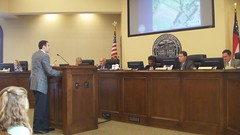
Nolen Cox said he knows standard reporting procedures for expenses.
He also doesn’t like regulations.
Once again the city Attorney responded.
Dan Davis said he had similar concerns about the city’s travel policy.
He added that he thought “these meetings should be televised”.
That got a brief round of applause.
Hm, that sounds like
something I’ve suggested several
times to the same council.
Since Dan Davis and I couldn’t get much farther apart on most political issues,
maybe televised meetings are an issue with bipartisan support!
They both talked about expenses for sales representatives.
I wonder if that’s all they think elected officials are.
After a student award was announced,
Roy Taylor’s attorney addressed the council about
the mayor’s expenses during Citizens to be Heard.
Roy Taylor is visible in the audience as the camera pans.
The mayor was not there;
he has since explained
he was spending quality time with his family.
The mayor’s expenses —Roy Taylor @ VCC 21 March 2011 Part 1 of 3:
Regular monthly meeting of the Valdosta City Council (VCC),
Valdosta, Lowndes County, Georgia, 21 April 2011,
Videos by George Boston Rhynes for LAKE, the Lowndes Area Knowledge Exchange.
So he was surprised when he discovered a group proposing to
finance such a plant.
And he later learned that there were many health problems
with biomass plants, and he now thinks it would be wrong to build it.
So as my mother would say, Rev. George Bennett is a big man!
Rev. George Bennett is a big man @ LCDP 2 May 2011
Debate between proponents of school system unification (CUEE) and opponents,
at Lowndes County Democratic Party (LCDP), Gretchen Quarterman chair,
Videos by George Rhynes, Jim Parker, John S. Quarterman, and Gretchen Quarterman
for LAKE, the Lowndes Area Knowledge Exchange, Valdosta, Lowndes County, Georgia, 2 May 2011.
I asked if he wanted publicity about this and he said yes. -gretchen
May 5, 20011 marks the 6th anniversary of
the arrest of the Valdosta 15.
It was the day that 15 of Valdosta’s finest citizens were arrested
in City Council, charged with “Disrupting a Public Meeting,” and taken to
the Lowndes County Jail. We were denied bail, and a telephone call. And,
in some instances, medicine.
The city spent thousands of dollars on our arrests and appeals. In the
end, the Georgia Supreme Court ruled
We have complaints that some people couldn’t understand
what Dr. Mark George was saying in
the previous post of his remarks at Monday’s Lowndes County Democratic Party meeting,
so here’s another version from a different camera.
Feedback, please.
He said the Chamber of Commerce said schools were not its issue.
Dr. George pointed out that it was the Chamber and the
real estate industry that largely produced the current situation
by funelling people to the county schools.
He said the unification project started with a request from
the Industrial Authority, who said it didn’t look good when
potential industry saw there was a black school system and
a white school system.
(The timing of this is interesting, because it comes after
Brad Lofton was hired as VLCIA Executive Director,
and other people formerly associated with VLCIA say they
were never asked by any potential industry how many school
systems we have.)
Dr. George discussed many other interesting points, such as CUEE’s
terminology drift from consolidation to integration to unification.
Camera 2: Dr. Mark George about CUEE @ LCDP 2 May 2011 Part 1 of 2:
Debate between proponents of school system unification (CUEE) and opponents,
at Lowndes County Democratic Party (LCDP), Gretchen Quarterman chair,
Videos by George Rhynes, Jim Parker, John S. Quarterman, and Gretchen Quarterman
for LAKE, the Lowndes Area Knowledge Exchange, Valdosta, Lowndes County, Georgia, 2 May 2011.
In this second video from camera 2,
Dr. George noted
that the Valdosta school system is internally segregated.
He said both he and Rev. Rose asked to have somebody put
on the CUEE council, and that that didn’t happen.
There’s more; you can watch it for yourself.
Here’s
Part 2 of 2:
Camera 2: Dr. Mark George about CUEE @ LCDP 2 May 2011 Part 2 of 2:
Debate between proponents of school system unification (CUEE) and opponents,
at Lowndes County Democratic Party (LCDP), Gretchen Quarterman chair,
Videos by George Rhynes, Jim Parker, John S. Quarterman, and Gretchen Quarterman
for LAKE, the Lowndes Area Knowledge Exchange, Valdosta, Lowndes County, Georgia, 2 May 2011.
Dr. Mark George pointed out that school consolidation didn’t solve
some problems last time:
In 2011 our schools were more segregated racially than they were in 1968.
He questioned why people should believe that consolidation, even if called
unification, would solve those same problems this time.
Continuing the
debate between proponents and opponents of unification of the
Valdosta and Lowndes County School Systems, organized by
Gretchen Quarterman, chair of the
The Lowndes County Democratic Party (LCDP).
Here, speaking against, is Dr. Mark George.
I’m on the CUEE board because
I believe a unified school system can better serve children
of our community, and particularly children in the city of Valdosta.
Gretchen Quarterman, chair of the
The Lowndes County Democratic Party (LCDP),
organized a debate between proponents and opponents of unification of the
Valdosta and Lowndes County School Systems.
Here, speaking for, is Dr. George Bennett, on the board of
Community Unification for Educational Excellence (CUEE).
I can describe some reasons our members oppose unification.
We believe VBOE has discriminated against black students with
alternative school referrals.
We believe VBOE has discriminated against black teachers in hiring,
firing, promotions and demotions. I can’t describe the details of personal
cases, but last year when the RIF directive came down, nearly 60% of
those fired were black, and black professionals only represent 20-25%
of the employees.
The VBOE system is over 70% black students, yet the black students
are not given equal opportunities to achieve. I can describe issues
we brought to the Department of Justice, as well as issues about the
Alternative school, and a very serious issue about how the Alternative
school was given a different school code, which we believe was a ploy to
artificially inflate the test scores at the students’ home schools. We
have evidence that we gave to the DOJ that students were sent to PLC
based on minor infractions.
Many of our members went through the consolidation in the sixties and
don’t want to see their children put into a situation where they will be
even more of a minority. Our children are in the majority at Valdosta
City Schools, but yet we still fight serious issues of discrimination
and inequality in education.
Many of us attended the CUEE education session at Serenity Church,
and did not hear anything that changed our minds.
Many of us distrust an “education” initiative brought forth from
the Chamber of Commerce. Our branch is a member of the Chamber, and we
support Chamber events and some policies, but we don’t support this
one. I can’t remember a time when “business” thought it knew what
was best for education except when school privatization was going on,
and the studies indicated that there was no benefit to that direction
insofar as student achievement.
Mr. Parris and Mr. Rowell, come to some of our branch meetings and we’ll
be glad to talk to you about it, so you can hear directly from us, I
am unable to completely explain the many different opinions that were
presented at the branch meeting when this came up for a vote. Also,
a former teacher named Dr. Marilyn McCluskey has written about many of
the issues we were involved in, and these descriptions can be found at
her blog TheNakedTruth4U.
-Leigh Touchton
Note it was
Alex Jones
who commented on this blog today; I’m pretty sure Alex Rowell has
a different opinion.
In three years, a private-prison construction and management company, the
Corrections Corporation of America, has seen the value of its contracts
with the state soar from nearly $23 million in 2006 to about $700 million
three months ago – all without competitive bidding. Even in a state
accustomed to high-dollar contracts, the 31-fold increase over three
years is dramatic.
During the same period, the company’s campaign donations rose
exponentially, from $36,750 in 2006, of which $25,000 went to the state
Republican Party, to $233,500 in 2007-08 and nearly $139,000 in 2009.
The donations have gone to Democrats, Republicans and ballot measures. The
company’s largest single contribution, $100,000, went to an unsuccessful
budget-reform package pushed last year by Gov. Schwarzenegger.
CCA contributed to cutting funding for other services while
getting more contracts for itself.
Is that what we want in Georgia?
Cut education funding while paying private prison companies?
Is that what we want in Lowndes County?
Costs vary, but CCA receives about $63 per day per inmate, or about
$23,000 annually.
That would pay for a lot of rehabilitation and education.
How about we do that instead?
Dr. Noll has a few questions. This came in as a comment Saturday.
I’ll be happy to ask VLCIA Chairman Jerry Jennett these and other
questions when he calls me back. -jsq
Let me see if I got this right:
The week before the last meeting of the Industrial Authority (IA)
Wiregrass Biomass LLC sent a letter to the IA asking for an extension
of the agreement to build the biomass incinerator. (June 1, 2011, is
the current deadline.)
Based on comments made by Chairman Paulk and others, all indications
were that the IA may have been ready to vote down such an application
for an extension of the agreement.
However, the vote on biomass never came up at the IA meeting, and
as a matter of fact, biomass wasn’t even discussed, as it was not even
on the agenda. Apparently a few hours before the IA meeting, “biomass”
(or a vote on the extension of the agreement with Wiregrass Biomass LLC)
was removed from the agenda.
This change of events (i.e. the removal of a vote on biomass)
was based on an initiative by Mr. Jennett (Chair of the IA board),
Mr. Ricketts (Project Manager of the IA) and Mr. Gupton (the IA lawyer)
who went to Atlanta to have a little chat with Wiregrass Biomass LLC
(or Sterling Planet).
As a result of that talk, Wiregrass Biomass LLC withdrew their
application for an extension of the agreement. Thus, there was no contract
(or an extension of a contract) to vote on at the last IA meeting.