Category Archives: Georgia Power

Smart Metering in Finland Compared to Georgia Power

Georgia Power: putting customer convenience and utility last! Let’s compare how Georgia Power is “selling” its smart meters to how one of the leaders in smart metering in Europe does it. Let’s compare Finland to Georgia Power. The result may give you reason to vote in the Public Service Commissioner election going on right now.

Current Smart Meter customer benefits include:

With the Smart Meter program, your electric meter will be read remotely through communication towers. In the future, a number of new customer benefits will become available, including access to online energy usage information.
  • Reading your meter and generating your bill without having a representative visit your property on a regular basis.
  • Reducing the time needed to handle service orders, such as starting or stopping power.
  • Remotely checking a meter to ensure it is working properly.
  • Reducing the number of vehicles on the road resulting in less pollution and fuel saving because in-person meter readings are not required.
  • Power outage notification — In the event of a power outage in your area, Smart Meters help us better manage power restoration.
Future Smart Meter benefits include:
  • Accessing energy usage information online — view your hourly and daily usage.
  • Offering innovative rate options that meet your lifestyle — better manage your energy usage and control your energy bill.

All of the immediate benefits are tailored for the power company, not the customer. Sure, you might like not having a Georgia Power employee on your property, but the real benefit is to Georgia Power in reducing costs. The direct benefits to the customer are all deferred to some unspecified time in the future.

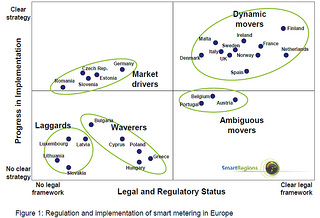
Meanwhile, for Finland, Look at page 32 of this report: European Smart Metering Landscape Report, by Stephan Renner, Mihaela Albu, Henk van Elburg, Christoph Heinemann, Artur Łazicki, Lauri Penttinen, Francisco Puente, Hanne Sæle, smartregions.net, Vienna, February 2011,

There are some minimum functional requirements for the metering system defined by the regulator in Finland:
Figure 1: Regulation and implementation of smart metering in Europe, page 14
  • Remotely readable hourly interval measurement data available next day to market actors including the customer;
  • If requested by the customer, the DSO must deliver metering equipment that has standardised connection for real-time hourly based monitoring;
  • Consumer must receive the data at the latest when the electricity seller receives it;
Continue reading

The Emperor’s New Clothes —Michael Noll

The VDT apparently declined to print this LTE submission. I added the links and images. -jsq

When I opened a recent “Sunday Business” section of the Valdosta Daily Times I was expecting to see a thorough discussion of the pros and cons of smart meters. After all, the headline read: “Smart Meters — Fact or Fiction?” What I found, however, was quite different. In case you missed it, here a summary of the highlights:

According to Georgia Power “concerns about smart meters are nothing more than myths.” These concerns range from health risks and increased bills to an invasion of your privacy and house fires started by electrical shorts. Myths or not, the best way to counter customers’ concerns would be to provide studies that, for example, show that smart meters are less dangerous than cellular phones or that electricity bills have not increased as a result of smart meters. However, customers only get assurances which, frankly, do nothing to dispel existing concerns.

Georgia Power also claims that it is using smart meters to be more environmentally

Continue reading

Professor unrepentant in latest fracking payola case

Apparently the natural gas industry pays professors to greenwash their polluting product, like back in the hey-day of radio record companies used to pay disk jockies to play their records. Remember: natural gas from fracking is the main thing Southern Company and Georgia Power are switching to from coal (not that they’re even abandoning coal, just rebranding it as “21st century coal”). That and their nuke boondoggle at Plant Vogtle. All approved by the Georgia Public Service Commission, all of whose members apparently accept massive direct or indirect contributions from the utilities they regulate. Two GA PSC Commissioners slots are up for election right now.

The professor most recently found to be in the pay of a fracking company when he reported on fracking is unrepentant. Terrence Henry wrote for State Impact Texas yesterday, Texas Professor On the Defensive Over Fracking Money

So the questions remaining are: Why didn’t Groat disclose this in the study? And did he fail to tell anyone at the University about it?

The professor would not agree to an interview, but in an email to StateImpact Texas he says the Public Accountability Initiative report is “a mixture of truths, half truths, and unfounded conclusions based [on] incorrect interpretations of information. I don’t want to discuss it.”

The University of Texas requires that financial conflicts of interest be disclosed by employees when it has “potential for directly and significantly affecting the design, conduct, or reporting of … research or is in an entity whose financial interest appears to be affected by that research.”

Dean Sharon Mosher of the Jackson School of Geosciences says that Groat submitted the financial conflict of interest form to her office in previous years, but that he had not done so this year. “I was not aware that he was still a member of the board,” Mosher tells StateImpact Texas. “Had I known he was still a member of the board and being paid, I would have insisted that he disclosed it.”

What report? Follow the links in here. Terrence Henry wrote for State Impact Texas 23 July, Fracking Company Paid Texas Professor Behind Water Contamination Study,

Earlier this year, a study led by Dr. Charles “Chip” Groat for the Energy Institute at the University of Texas at Austin made headlines for saying there was no link between fracking and groundwater contamination. (When we reported on the study in February, we noted that the study also found some serious issues around the safety and regulation of fracking that weren’t getting much press coverage.)

But according to a new report out today by the Public Accountablitiy Initiative (PAI), a nonprofit watchdog group, the conclusions in Groat’s report aren’t as clear cut as initially reported. And Groat himself did not disclose significant financial ties to the fracking industry.

Groat, a former Director of the U.S. Geological Survey and professor at the Jackson School of Geosciences at the University of Texas at Austin, also sits on the board of Plains Exploration and Production Company, a Houston-based company that conducts drilling and fracking in Texas and other parts of the country. According to the new report (and a review of the company’s financial reports by Bloomberg) Groat received more than $400,000 from the drilling company last year alone, more than double his salary at the University. And one of the shales examined in Groat’s fracking study is currently being drilled by the company, the report says.

Since 2007, Groat has received over $1.5 million in cash and stock awards from the company, and he currently holds over $1.6 million in company stock, according to the PAI report. (Update: we clarified with PAI, and that $1.6 million in stock comes from the stock awards over the years. PAI says Groat’s total compensation from the company is close to $2 million.)

And it gets worse from there: rough drafts published, unsubstantiated peer review claims, etc.

This isn’t an isolated case:

This isn’t the first time that academic studies of drilling have been called into question because of industry ties. In an earlier report on a State University of New York at Buffalo study on fracking’s environmental risks, Public Accountability Initiative found that it “suffered a number of critical shortcomings” and the “report’s authors had strong industry ties.”

And in today’s investigation from Bloomberg, they found other instances of industry influence and financial ties at Pennsylvania State University and University of Wyoming.

Do we want to trade air pollution by coal for groundwater pollution by fracking? When we have a better future already at hand through conservation and efficiency along with solar and wind power?

-jsq

Heat shuts baseload nuclear plants

Baseload nuclear plants can’t take the heat! Meanwhile, zero stories of solar plants shutting down due to heat. Quite the opposite: more sun, more solar power!

Scott DiSavino wrote for Reuters 18 July 2012, Four U.S. power reactors shut & NYC sweats during heat wave,

Several nuclear plants on the U.S. East Coast shut down by early Wednesday and New York’s Consolidated Edison power company reduced the voltage in parts of Manhattan as the obsessive heat wave stressed the region’s power system.

Despite the shutdown of four giant nuclear reactors in New York, Pennsylvania, Maryland and South Carolina, the power systems delivered the juice needed by the regions’ homes and businesses to keep air conditioners humming on the projected last day of a brutal heat wave.

Then there’s this excuse:

Although the heat makes it more difficult to use the warmer river water to cool power plants and can stress power lines due to high usage, the reactors did not necessarily shut due to the heat.

They shut down due to faulty sensors, leaks, or unknown causes, and that’s somehow better?

Meanwhile, solar just keeps generating. I’ve never heard of a wind plant shutting down due to heat, either.

Remind me again, why is Georgia Power’s and Southern Company’s bet-the-farm risk on new nukes at Plant Vogtle a good idea? Wasn’t it supposed to be about dependable power?

-jsq

PS: Owed to Mandy Hancock.

Austin Energy’s Biomass Buyer’s Remorse

Georgia Power’s parent Southern Company (SO) is bragging about selling a 100 MW biomass plant to Austin Energy. Funny how SO’s press release doesn’t mention Austin Energy’s buyer’s remorse. Let’s see why Austin Energy should regret buying biomass.

SO PR 18 July 2012, Southern Company brings nation’s largest biomass power plant on line: Nacogdoches facility contributes to Austin Energy renewables goal

Southern Company SO announced today that the nation’s largest biomass plant is putting electricity on the grid in Texas. Southern Company President, Chairman and CEO Thomas A. Fanning joined state and local dignitaries today at the company’s Nacogdoches Generating Facility to mark commercial operation for the 100-megawatt unit.

Austin Energy is receiving energy from the plant through a 20-year power purchase agreement.

The PR goes on about local jobs and taxes, which could have been produced through building solar or wind generation. How much did that biomass plant cost Austin Energy? Funny how that’s not in the PR!

The City of Austin owns Austin Energy, and the Mayor and City Council are its Board of Directors. Vicky Garza wrote for the Austin Business Journal 20 July 2012, Austin Energy’s buyers remorse for biomass,

Austin City Council Member Mike Martinez wouldn’t mind a do-over on the $2.3 billion, 20-year energy contract the council approved in 2008.

The contract calls for Austin Energy to buy the entire output from the Nacogdoches Generating Facility, a 100-megawatt wood-waste-fueled biomass power plant.

“When the contract was initially brought to Council, it appeared to be a good deal to help us reach our adopted goals for renewables,” Martinez said.

It seemed like a good idea at the time.

$2.3 billion for 100 MW is about $23 per Watt. How does that compare to the 30 MW Webberville solar farm Austin Energy opened this year? Continue reading

It is time to finally put the pieces of a larger energy puzzle together —Michael Noll

Seen today on the WACE facebook page: an online comment the VDT declined to let appear. It was on Natural gas use expanding; station planned for Valdosta by Kay Harris, VDT, 22 July 2012. -jsq

There are some major problems with this article, but let’s first begin with the points one can agree with:

Mr. Putnam is correct when he says that natural gas is a much cleaner source of energy than coal and oil. It is also true that natural gas is a “bridge fuel” which can buy us time to develop new technologies. However, here are the points that are missing (or were glanced over) simply because we are, again, looking for a quick fix to our dependence on foreign oil, while doing little to address issues that really matter:

  1. Neither Mr. Putnam nor the VDT seem to fully understand or recognize the environmental damage fracking does. This new technology is not only responsible for our nation’s current natural gas surplus, but also comes at an enormous price to both people and the environment.
  2. Time and again we are talking about the need to become independent of foreign oil, yet little attention is paid to the need to conserve. Instead we continue to ‘live it up” and consume more energy per capita than any other western nation. If you are addicted to a “drug” (as in an overly consumptive lifestyle) hopping from marijuana to heroin won’t help your general problem.

It is time to finally put the pieces of a larger energy puzzle together because at the end of the day natural gas, too, is a finite source. But how will we ever get there when a) entities like Southern Company (i.e. Georgia Power) refuse to embrace truly clean sources of energy production like solar and wind, when b) people like Mr. Putnam and papers like the VDT only present a one-sided view of an important and complex issue, and when c) we, the consumers, refuse to accept our responsibilities in this whole mess as if we had a God given right to be wasteful?

-Michael Noll

4 of 5 incumbent GA PSC Commissioners accept massive utility campaign contributions

Could contributions produce influence? Neither of the incumbent Public Service Commissioners showed up for last night’s GPB debate, just as they didn’t show up for the previous weekend’s GIPL debate. Saturday the AJC examined the incumbents’ campaign finance and regulatory records, and let’s look a bit into how they’ve acted as regulators towards their biggest indirect contributors: Georgia Power.

Kristi E. Swartz wrote for the Augusta Chronicle or AP 21 July 2012, Donors to Georgia Public Service Commission members vested in decisions,

Four of Georgia’s utility regulators have accepted at least 70 percent of their campaign contributions from companies and people that could profit from the agency’s decisions, a review of five years of campaign finance records by The Atlanta Journal-Constitution revealed.

The fifth member of the state Public Service Commission, Tim Echols, campaigned on the promise that he wouldn’t take money from employees or lobbyists for businesses regulated by the agency.

Even so, nearly one in five dollars in Echols’ contributions came from people or companies whose business is affected by PSC decisions, the review found.

Together, the PSC commissioners took in nearly $750,000 in the last five years, records show. Two of them — Stan Wise and Chuck Eaton — are seeking re-election this year to their $116,452-a-year posts.

Wise and Eaton would be the two incumbents who can’t be bothered to show up for debates. Doesn’t make them look very responsive to the people, does it? Who do they respond to, then?

A review of major decisions that have come before the PSC in the past five years shows utilities have received much — but not all — of what they have asked for.

Georgia Power donors

In the past five years, for example, Georgia Power’s rates have risen 24 percent, although they dipped in June. The PSC must sign off on the company’s rate changes.

Current and former employees of Georgia Power, its parent Southern Co. and its law firm, Troutman Sanders, poured $52,650 into the campaign coffers of four of the sitting PSC members.

A Georgia Power spokeswoman argued that including Troutman Sanders and other company vendors in an analysis of spending “is false.” But critics say including them is critical to capturing the full influence of the utilities on the PSC.

Influence like this? Melissa Stiers wrote for GPB News 19 July 2011, PSC Nixes Vogtle Cost Check,

Continue reading

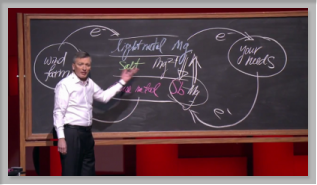
Invent batteries to the price point of the electricity market —Donald Sadoway

MIT Prof. Donald Sadoway thinks he’s found a way to build electric-grid-scale batteries out of dirt.

Electric utilities complain solar and wind power are not baseload, capacity, energy sources because they are intermittent. You know, if they weren’t busy running up cost overruns that could easily exceed the entire annual budget of the state of Georgia, maybe the utilities could solve this problem. Meanwhile, Prof. Sadoway, instead of looking for the snazziest coolest most efficient new method of energy storage, defined the problem in terms of the market:

the demanding performance requirements of the grid, namely uncommonly high power, long service lifetime, and super low cost. We need to think about the problem differently. We need to think big. We need to think cheap.

Then he set parameters on the solution:

If you want to make something dirt cheap, make it out of dirt. Preferably dirt that’s locally sourced.

He cast about for possible precedents and found aluminum smelting gave him some ideas for using low density liquid metal at the top, high density liquid metal at the bottom, and molten salt in between. Choosing the right metals is the trick, which he thinks he’s found: magnesium at the top, and antimony at the bottom.

Is Sadoway right? Will his battery work at grid scale? I don’t know. But he’s asking the right questions, and it’s worth a try.

As Kyle Sager wrote for Heliocurrent 4 May 2012, Renewable Storage: Leave it to MIT,

Has Dr. Sadoway achieved the holy grail of renewable energy? Judge for yourself. Our attention is compelled by the degree of his certainty and the seeming simplicity of the approach. Watch MIT’s Donald Sadoway explain his vision here (link).

Seems to me there are at least two major approaches:

Continue reading

Debate: Georgia Public Service Comission candidates this afternoon on GBP

Rumor is that, like last weekend, the incumbents won't show up for this afternoon's Public Service Commission debates, this time on Georgia Public Television.

GPB does still list them as "invited", with this schedule for today, Sunday 22 July 2012:

Date and TimeDebateInvited Candidates
Sunday, July 22 at 4:30 pm Public Service Commission District 3 Republican Chuck Eaton and Matt Reid
Sunday, July 22 at 5 pm Public Service Commission, District 5 – Republican Pam Davidson and Stan Wise

If the incumbents don't bother to show up, how responsive to the people are they?

-jsq

Pam Davidson is running for Georgia Public Service Commission

Pam Davidson is running for GA PSC District 5, challenging incumbent Stan Wise in the Republican Primary. In this video she spoke to the Cobb County Republican Party, first emphasizing that she wouldn’t take money from regulated companies, and then she spoke about those new Southern Company nukes:

The largest economic development project in the southeast is the two nuclear reactors at Plant Vogtle. Now you may say, “I’m a Cobb EMC customer.” Well, when Georgia Power, as the largest regulated utility in the state builds a new facility, often that serves as a merchant facility, or Georgia Power will sell it to the EMCs. So indirectly the Commission votes on EMC issues.

According to Oglethorpe Power the statewide consortium of EMCs of which Cobb EMC is the largest,

Oglethorpe Power is a 30 percent owner of Plant Vogtle’s existing Units 1 and 2 and will own 30 percent of the two new units as well.

Back to Pam Davidson:

But you want to be very very careful about those nuclear plants. And we have problems, ladies and gentlemen. We have problems with nuclear reactors 1 and 2. And all those problems are really cost problems. I am in favor of nuclear energy. I think it’s a great source of energy. However, nuclear energy cannot survive a rennaissance if it’s so expensive.

Here’s the video:

When I spoke to her recently, Pam Davidson said:

Continue reading