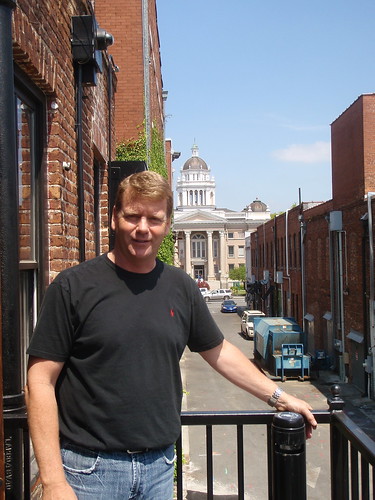
No, not the courthouse. Older than that. 119 North Patterson Street. Here Pat explains the hidden windows they found: Continue reading
No, not the courthouse. Older than that. 119 North Patterson Street. Here Pat explains the hidden windows they found: Continue reading
 Elisabeth Rosenthal write in the NY Times about
Europe Finds Clean Energy in Trash, but U.S. Lags:
Elisabeth Rosenthal write in the NY Times about
Europe Finds Clean Energy in Trash, but U.S. Lags:
Far cleaner than conventional incinerators, this new type of plant converts local trash into heat and electricity. Dozens of filters catch pollutants, from mercury to dioxin, that would have emerged from its smokestack only a decade ago.Here’s the catch:
Denmark now has 29 such plants, serving 98 municipalities in a country of 5.5 million people, and 10 more are planned or under construction. Across Europe, there are about 400 plants, with Denmark, Germany and the Netherlands leading the pack in expanding them and building new ones.That means the biomass plant proposed for Valdosta is not that kind of clean incinerator.By contrast, no new waste-to-energy plants are being planned or built in the United States, the Environmental Protection Agency says — even though the federal government and 24 states now classify waste that is burned this way for energy as a renewable fuel, in many cases eligible for subsidies. There are only 87 trash-burning power plants in the United States, a country of more than 300 million people, and almost all were built at least 15 years ago.
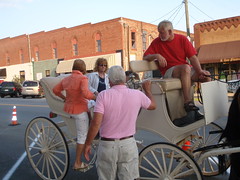
How many people can fit in a horse cart?
Don’t forget the children:

Let’s try to count them as they get out:
Cast: Walter Bird (driving), Sam (the horse), Nancy Evans Parr, Winfrey Murray Hendley, Wayne Bullard, Beverly Brown Underwood, Barbara Stratton, several children, and watching on the sidewalk, John S. Quarterman.
Third Thursday, 15 April 2010, Hahira, Lowndes County, Georgia.
Pictures by Gretchen Quarterman.
For entertainment, I read daily the Rant and Rave in the local newspaper. Now, I know some people here think that what’s written there is so horrible that they can’t stand it. Others think it is just for those too afraid to say something in public. Nonetheless, I read it nearly daily as I find it an interesting window into our area.
Lately, there have been several people writing in about the advertising signs posted around both Valdosta and the county. They note that the messaging on these signs is in direct conflict with Valdosta’s new litter campaign slogan. I can only assume they mean the yellow “Got Junk?” signs.
For example Continue reading
The other is about the Metropolitan Planning Organization’s 2035 Transportation Plan. $400 million. Hm, I wonder how much rail and bus passenger service we could implement with a fraction of that.
 This appears to be the date and location for the Georgia EPD
air quality hearing for the Wiregrass Biomass plant proposed
for Valdosta:
This appears to be the date and location for the Georgia EPD
air quality hearing for the Wiregrass Biomass plant proposed
for Valdosta:
6:30 PM, 27 April 2010We’ve been waiting on this date for a while. EPD is going to send a press release to the VDT a few weeks in advance and post it on its own website, www.georgiaair.org. Assuming, of course, that the date and place don’t change again.
Multipurpose Room
Valdosta City Hall Annex
300 North Lee Street
Valdosta, Georgia
Why should you care? This plant proposes to burn sewage sludge, which can release numerous hazardous chemicals into the air. Here is Seth’s letter to the editor of the VDT of 21 Feb 2010: Continue reading
With Congress and the White House considering spending scarce dollars to jump-start employment, they’ll need to get the biggest jobs bang for the buck to give Americans confidence that they’re spending our money wisely. Probably the biggest jobs generator of all, and one of the least recognized, is investing in forest and land restoration and sustainable management, with conservation, watershed projects, and park investment coming close behind.

That’s a very interesting jobs comparison; I didn’t know that.
To summarize, reforestation and restoration outperforms even the second-most jobs-intense activity analyzed by 74 percent, and conservation exceeds other major jobs alternatives, including especially new highway construction, Wall Street, and conventional energy sources like oil and nuclear.In fact, nuclear comes in dead last in this comparison.
And biomass produces less than half as many jobs as reforestation and land resto ration.
 FacingSouth reports on
TURNING THE LOCK-EM-UP TIDE: State prison populations decline for first time since 1972:
FacingSouth reports on
TURNING THE LOCK-EM-UP TIDE: State prison populations decline for first time since 1972:
Locking people up in jails and prisons is expensive. State officials know this all too well: In a country that puts more people behind bars than any other — the U.S. has less than 5% of the world’s population, but 25% of its prisoners — over 91% of the incarcerated are under state or local supervision.The lock-’em-up approach to criminal justice that took off in the 1980s and ’90s may have helped a few political careers, but it has crushed state budgets: By 2008, states were spending over $50 billion a year on incarceration.
What else can you do?
But as Facing South has been reporting (see here and here), the Great Recession helped change that, pushing states to explore less expensive (and often more effective) options like alternative sentences for non-violent offenders and streamlining probation and parole.Today, the Pew Center has released a report showing the shift in approach is bearing fruit: For the first time in 38 years, state prison populations are in decline.
Georgia, on the other hand, increased its prison population by 1.6%. Maybe instead of making massive cuts in education, Georgia could do something about the prison problem.
 What to do with Detroit?
Cindy Perman writes for CNBC:
What to do with Detroit?
Cindy Perman writes for CNBC:
Mayor Dave Bing is apparently working on a radical plan that would bulldoze a quarter of the city — some of the most desolate areas — and return it to farmland, the way it was before the automobile. Any residents still there would be relocated to stronger neighborhoods.
Dan Kildee, treasurer of Genessee County, containing Flint, Michigan, remarks:
“The obsession with growth is sadly a very American thing. Across the US, there’s an assumption that all development is good, that if communities are growing they are successful. If they’re shrinking, they’re failing.”Actually, building more subdivisions just increases the deficit between tax revenues collected and cost of services provided.
Perman concludes:
Welcome to the future. Why does it look so much like 1910 instead of 2010?Perhaps because 1910 had railroads for mass transit and cities were still dense and close to existing services?
.jpg) Sea Island Co. had
a reputation for immunity to economic whims while over-borrowing and over-expansion?
Hm, they’re not the only ones.
As recently as 28 April 2008 the VDT published a story
“Analyst: Valdosta ‘recession-proof'”:
Sea Island Co. had
a reputation for immunity to economic whims while over-borrowing and over-expansion?
Hm, they’re not the only ones.
As recently as 28 April 2008 the VDT published a story
“Analyst: Valdosta ‘recession-proof'”:
RALEIGH, N.C. (AP) — Using data from the Bureau of Labor Statistics, business consultant and president of JobBait.com Mark Hovind ranked every metropolitan statistical area across the country, highlighting those he deemed to be “recession-proof.” The city of Valdosta was the only Georgia city to make the list.Continue reading