Batteries are just one of many reasons,
including electric vehicles, smart grid, solar and wind power
(including
pass HB 57 and you can profit by getting financing
for your own solar panels),
plus massive savings on health care and electricity bills;
batteries are one of many reasons that fixing climate change will
save us all money, clean up our air and water, expand our forests,
preserve property rights, and make some people rich:
In fact, a recent report suggests that revenue from the distributed
energy storage market — meaning battery packs and other
storage devices located directly at homes and businesses (many of
which now generate electricity through solar) —
could exceed $16.5 billion by 2024.
Another report predicts
$68 billion in revenue in the same time frame from the grid-scale storage market.
This includes large-scale battery packs, hydro-storage systems that
use cheap abundant electricity to pump water uphill to drive
turbines later on, or even solar thermal systems that store energy
as heat in molten salt.

And it’s all happening fast,
so fast your jaw will drop if you’re not paying attention.
So let’s stop talking about the costs of fixing climate change.
It’s not just
no-cost and free, not just in the future but right now;
we’re all actually going to be better off through fixing climate change:
healthier and more prosperous.
Sami Grover wrote
the above quote for mnn 31 January 2014,
Why everyone is talking about energy storage:
Renewable energy is already growing rapidly. But these recent developments in energy storage could prove to be a game changer.
See also
Sami Grover, treehugger, 29 October 2014,
Gigafactory schmigafactory: $1BN “stealth” energy storage start-up moves to NC tobacco plant,
Tesla’s plans for a
$5bn “gigafactory” battery manufacturing plant
have been making headline news for some time now. Alongside the
positive potential to drive down costs for energy storage,
the $1.3bn in incentives the company will receive from Nevada have
raised eyebrows in some quarters.So its interesting, then, that
Alevo—a new energy storage
start-up backed up by $1bn from anonymous Swiss investors—has
sought no state incentives for moving to a former Philip Morris
plant in Concord, NC. Alevo says it will be producing hundreds of
its “Gridbank” utility-scale energy storage and analytics units
within a year, and is planning on creating up to 2,500 jobs within
the first three years.
No state incentives, unlike Southern Company’s nuke boondoggle
at Plant Vogtle
where
Georgia Power can’t even get a schedule from its own contractors
while
ratepayers get charged every month
for power they aren’t getting from Vogtle
and
Georgia Power can keep charging for shutdown even if it’s cancelled.

The bar chart above is from
Distributed Energy Storage Revenue To Exceed $16.5 Billion By 2024
by Joshua S. Hill, Clean Technica, 13 January 2015.
And that graph is way too conservative, being more linear than exponential.
Economies of scale will drive batteries up faster than that,
just like they’re
already driving solar deployments 66% more each year
without batteries.
So conservative that the same day in the same venue James Ayre wrote
Grid-Scale Energy Storage Is Expected To Generate More Than $68 Billion In Revenue Between 2014-2024, According To Navigant Research.
And what happens when something like
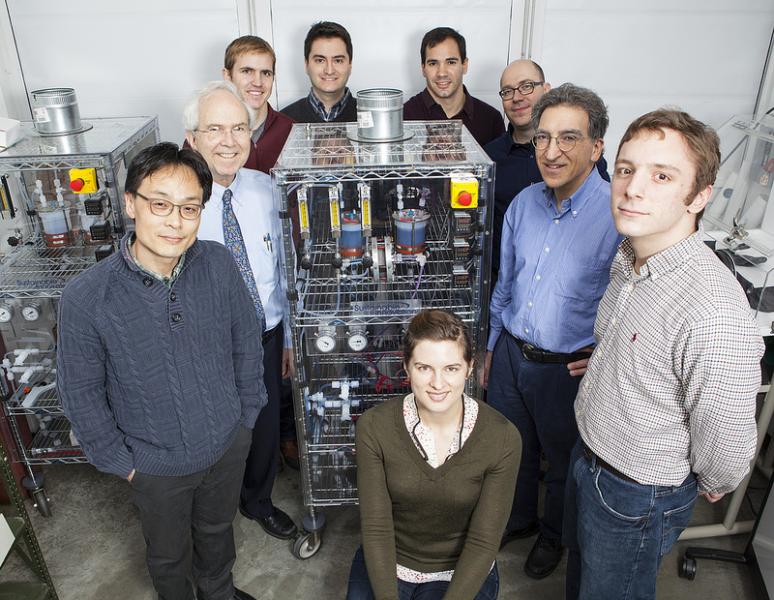
Harvard’s no-metal organic battery gets deployed?
A battery no bigger than a furnace you can grow in your basement….
Electric utilities have mostly been slow to adopt solar and wind because
they have a hard time figuring out how they can profit from distributed
power generation.
But even Southern Company and Georgia Power
are now
bragging about the four 30MW-each solar farms
they installed at military bases in Georgia in 2014,
plus all the other solar projects in gear.
What happens if
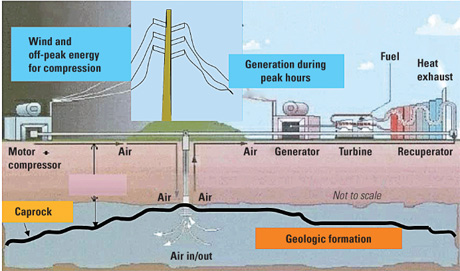
Southern Company’s underground pressurized air storage project
works for utility scale?
I don’t want it in our fragile limestone here in south Georgia,
but there’s plenty of granite in north Georgia.
And Georgia Power would suddenly have utility-scale
storage for massive solar and wind generation: profit for Georgia Power,
and savings for the rest of us.
Speaking of profit,
heat waves back in 2012 already saw smart grid deployment
in states outside Southern Company’s territory.
When Southern Company decides to get off its duff and smarten up
its own grid, they’ll see more profit.
If you want to profit directly,
help pass HB 57 in the Georgia legislature right now
so you can get financing for your own solar panels.

If you have some spare cash to invest in stocks,
solar stock prices went down with oil prices last year
(Travis Hoium, Motley Fool, 11 January 2015),
even though
oil prices actually don’t directly affect the solar market
(Travis Hoium, Motley Fool, 31 January 2015)
because to date oil is mostly for transportation while
solar energy is for electricity.
Sure, natural gas also generates electricity, but it’s not directly
comparable because solar power doesn’t require fuel or fracking or
pipelines.
Eventually investors will catch on to solar deployments continuing
to boom while oil and gas prices plummet,
with
the solar industry adding workers almost 20 times faster than the overall economy,
accounting for 1.3% of all U.S. jobs created in 2014 (National Solar Jobs Census, The Solar Foundation, 2015).
Let’s not forget
solar already accounts for more jobs than in production and nonsupervisory
oil and gas extraction.
Once investors catch on to these simple facts,
solar stocks will skyrocket again.
(Disclosure: yes, I own some solar stocks; also Southern Company.)

Let’s not forget the
Stanford study that shows every U.S. state can power itself
with sun, wind, and water and nothing else even without
batteries.
As I wrote
For Georgia, that’s 40% solar PV plants, 35% offshore wind, 13%
rooftop PV (6% residential and 7% commercial), 5% concentrating
solar plants, 5% onshore wind, and 1% each wind, tide, and
conventional hydro power. Plus 210,200 construction jobs and 101,000
operation jobs. And saving $14.3 billion per year or 4% of Georgia’s
GDP saved by avoiding illness and mortality, including avoiding
1,580 air pollution deaths each year. Oh, and costs per
kilowatt-hour would drop by more than half.
That’s right, stop poisoning people through air and water pollution
and save $16.8 billion per year just in Georgia.
For comparison
the total 2015 fiscal year budget for the
government of the state of Georgia is $20.8 billion.
That’s right: save 80% of the amount of the state budget in health care costs alone.
Justin Gillis, NYTimes, 16 September 2014,
Fixing Climate Change May Add No Costs, Report Says,
In decades of public debate about global warming, one assumption has
been accepted by virtually all factions: that tackling it would
necessarily be costly. But a
new report casts doubt on that idea,
declaring that the necessary fixes could wind up being effectively
free.A global commission will announce its finding on Tuesday that an
ambitious series of measures to limit emissions would cost $4
trillion or so over the next 15 years, an increase of roughly 5
percent over the amount that would likely be spent anyway on new
power plants, transit systems and other infrastructure.When the secondary benefits of greener policies — like lower
fuel costs, fewer premature deaths from air pollution and reduced
medical bills — are taken into account, the changes might wind
up saving money, according to the findings of the group, the
Global Commission on the Economy and Climate.
That report adds even more benefits, such as more extensive forests,
public transportation, less urban sprawl.
It also mostly recommends new large-scale government incentives.
But as Alevo and the 66% increased annual solar deployment indicate,
new incentives will merely accelerate what’s already happening.
But you want government action?
Pass
HB 87.
Stop the
unnecessary, destructive, and hazardous Sabal Trail fracked methane pipeline.
Comment on the
EPA’s proposed methane rule.
And stop the stealth corporate give-away treaties
Trans-Pacific Partnership (TPP)
and
Transatlantic Trade and Investment Partnership (TAFTA)
that would add dozens of “free trade” countries and promote
LNG export.
Ban fracking, not just in
New York state,
also in
Oklahoma
and
Florida
where there’s
already a bill in the legislature.
Stop giving BP a free pass to
pollute the Gulf of Mexico.
Oppose the horrible idea of
opening the U.S. Atlantic coast to the same kind of destruction.
Oh, and
divest from fossil fuels:
VSU is right up there with Divest Harvard for advocating that,
and may soon see success.
You probably noticed most of this government action I propose is about
stopping subsidizing fossil fuels, which get five times more
subsidies than solar and wind, even before accounting for the
massive destructiveness of fossil fuels, such as
the oil Exxon dumped all over an Arkansas neighborhood and won’t clean up,
not to mention pipeline leaks, explosions, sinkholes, and property takings.

Stopping that destruction isn’t sacrifice: it’s common sense,
now that we already have the technology right now to replace it:
solar power, already increasing 66% in deployments each year.
People who say it can’t be done or it will cost too much
are like
the 1898 urban-planning conference in New York City
that couldn’t figure out how to keep horse manure from piling up nine-feet deep.
Yet
the horseless age came.

And the smoke-less age without fossil fuels is already all around you,
and soon it will be everywhere, much faster than the previous big shift.
Solar power will win like the Internet did as fast as you went from having a voice-only phone to having a supercomputer smart phone in your pocket.
Within a decade more U.S. electricity will be produced by solar power than any other source, as predicted by former FERC Chair Jon Wellinghof back in 2013.
And as batteries and other storage technology kick in, transportation will convert to
electricity.
The world is already converting to sun, wind, and water, with no fossil fuels.
For profit, for health, for a clean environment, for property rights:
go solar, go wind!
-jsq