Tag Archives: jail

CCA Go Away

Somebody else is trying to



drive away CCA.

Near Ft. Lauderdale, CCA wants to put a detention center
in Southwest Ranches, Florida, and
CCA Go Away
(facebook)
is organizing against that.

Lots of clever signs, from the unmistakable:


CCA Go Away

to the symbolic

orange jailbirds holding oversize $20 and $100 bills.

Plenty more

in their flickr set:


No Prison Here in This Town

Put Residents Before Profit

The Prison is No Longer A Secret


Did You Know?

A Prison is coming to your neighborhood!

Say No to

Corrections Corporation of America

No CCA
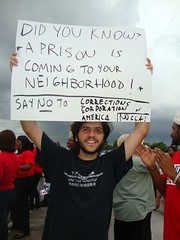


If they can do it, we can, too.
Come to the prison site Tuesday 5PM to help

Drive Away CCA!

-jsq

George Rhynes is back on the air

George Rhynes is back on the air on WGOV 950 AM Majic 95.
He talked quite a bit about what he’s been doing since he was last
on the radio, including keeping the Quitman 10 story alive,
Citizens Wishing to be Heard at the Valdosta City Council,
jail issues, and more, which is what he said he would do:

PURPOSE AND DIRECTION OF TODAYS PROGRAM: To keep citizens informed;


help eliminate the deaf; dumb; and blind process in our beloved
community. For too long local radio has failed to have open
disucssion about the real issues that too often are not published
and excluded from our history.

This is an honest attempt to keep alive what others may not believe
to be of value to us; or coming generations that will look for a
real and true history of what took place today. So I hope this will
be carried on by others in our beloved community for the good of all
human beings.

Here’s video:

Welcome back, George!

-jsq

PS: Other people may call him crazy; I call him dedicated.

“I want him in my jail, not a private jail.” —Sheriff Chris Prine

Last week Sheriff Chris Prine volunteered his opinion of private prisons:

You were talking about the private jail system.
I’d like to voice my opinion of that.
The private jail from our study so far, the cost….
I’m going to use a figure of around 800 inmates;
we’re pretty close to 900 in our jail now.
We figure around maybe $36 a day to feed the inmate,
counting of course the food and our employment.

And looking at the private jail sector.
And of course I’m responsible for the inmate whether he is in a private
jail or in my jail.
If I’m going to be responsible for that inmate, I want him here;
I want him in my jail, not a private jail.

[applause]

Another thing is the cost factor.

Continue reading

How to end the epidemic of incarceration

There are historical reasons for why we lock up so many people,
some going back a century or more, and some starting in 1980 and 2001.
Knowing what they are (and what they are not)
lets us see what we can do to end the epidemic of
incarceration that is damaging education and agriculture in Georgia.

Adam Gopnik wrote for the New Yorker dated 30 January 2012,

The Caging of America:
Why do we lock up so many people?

More than half of all black men without a high-school diploma go


to prison at some time in their lives. Mass incarceration on a scale
almost unexampled in human history is a fundamental fact of our country
today—perhaps the fundamental fact, as slavery was the
fundamental
fact of 1850. In truth, there are

more black men in the grip of the
criminal-justice system—in prison, on probation, or on
parole—
than were in slavery then.


In Georgia,

1 in 13 of all adults is in jail, prison, probation,
or parole:
highest in the country (1 in 31 nationwide).
Georgia is only number 4 in adults in prison, but we’re continuing
to lock more people up, so we may get to number 1 on that, too.


Over all, there are now more people under
“correctional supervision” in America—more than
six million—than
were in the Gulag Archipelago under Stalin at its height. That city of
the confined and the controlled, Lockuptown, is now the second largest
in the United States.

The accelerating rate of incarceration over the past few decades is just
as startling as the number of people jailed: in 1980, there were about


two hundred and twenty people incarcerated for every hundred thousand
Americans; by 2010, the number had more than tripled, to seven hundred
and thirty-one. No other country even approaches that. In the past two
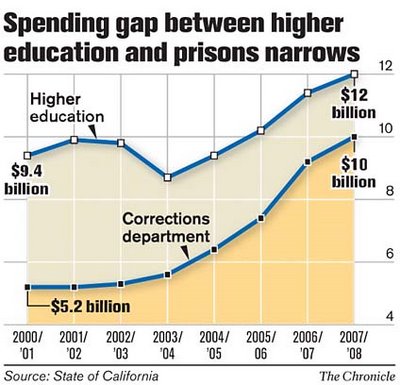
decades, the money that states spend on prisons has risen at six times
the rate of spending on higher education.

And we can’t afford that, especially not when we’re cutting school budgets.
That graph of education vs. incarceration spending is for California.
Somebody should do a similar graph for Georgia.

The article does get into why we lock up so many people:

Continue reading

If Gov. Deal can investigate school elections, why not jail deaths? — George Rhynes

George Rhynes suggests that if Gov. Deal can

investigate a school board election in Brooks County
,
he
could also


issue another Executive Order and STOP the jail deaths in the Valdosta,
Lowndes County Jail. (30 Jail deaths from 1994-2009) Today the general
public is told that the public does not have a right to know under
the law.

In

this video

George goes into many years of evidence regarding jail violations.

-jsq

Map of prisons in Georgia

The Georgia Department of Corrections (GDOC) does not provide
a map of prisons in Georgia; at least not that I’ve been able to find.
CCA does not provide a map of its private prisons, either.
This omission seems odd for an industry that brags about how good it is
economically.

But someone has composed

this google map

that gives the big picture.
I don’t know if this map is current or accurate, but the spot checks
I’ve made show markers for real prisons.
Did you know there were so many?


Apparently,

  • the reddish circles are county prisons;

  • the red arrows are state prisons for men like Valdosta State Prison;

  • the yellow arrows are state prisons for women
    (Pulaski)
    or juveniles
    (Arrendale),
    except Washington State Prison

    appears to be back to housing men
    ;

  • the blue arrows are Regional Youth Detention Centers (RYDC);

  • and the green arrows are at least some of CCA’s private prisons,


Prisons are
bad economics
, producing no longterm improvement in employment, and risking closure, leaving communities with expensive white elephants.

We don’t need a private prison in Lowndes County, Georgia.

Spend those tax dollars on rehabilitation and education instead.
Follow

this link

to petition the Valdosta-Lowndes County Industrial Authority.

-jsq

I really support … allowing non-violent offenders the opportunity to work and rehabilitate — Jessica B. Hughes

Received yesterday on

Ankle monitoring for Lowndes County Jail
. -jsq

I really support this idea. Initially, I was concerned about it, because


I know that things like the SCRAM bracelet and the ignition interlock
devices are very expensive to install and maintain, especially if you
consider the costs involved with probation fees. $213.00/month may not
sound like a lot of money to some people, but it is a king’s ransom
to others (saying $7.00/day makes it seem more manageable). Still,
allowing non-violent offenders the opportunity to work and rehabilitate
themselves outside of a prison is a big step forward in the philosophy
of crime and punishment in this county, in my opinion.

-Jessica B. Hughes

Ankle monitoring for Lowndes County Jail @ LCC 13 December 2011


Tuesday the Lowndes County Commission approved ankle bracelet monitoring
for nonviolent jail inmates so they can serve the rest of their time
outside the jail, putting them in a better environment and
decreasing expenses at the Sheriff’s office.
This sounds like a good idea.
I have not expressed an opinion because,

as Barbara Stratton pointed out
,
the public doesn’t really know what was in the proposal County Commissioners
got in their agenda packet.
However, I would like to compliment Commissioner Joyce Evans about trying to do
something about nonviolent prisoners.

Summarizing the

ankle monitoring discussion of Monday morning
,
County Manager Joe Pritchard Tuesday evening asked the Lowndes County Commission
to approve continued work by county staff with the Sheriff’s office in implementing
an ankle monitoring system to move some inmates out of the county jail.

Commissioner Richard Raines gave the credit to Commissioner
Joyce Evans for both proposing a drug court and for
proposing ankle monitoring.

Commissioner Evans declined comment but did make the motion,
seconded by Commissioner Powell, and approved unanimously.

The VDT had a little more information
in David Rodock’s Wednesday story:

Continue reading

8.a. Ankle Monitoring System —Joe Pritchard @ LCC 12 December 2011


County Manager Joe Pritchard briefly described

agenda item

8.a. Ankle Monitoring System

He said it would permit jail inmates to serve some of their time outside the jail.
He mentioned early discussions with Commissioners Joyce Evans and Richard Raines,
and said it started related to drug court, but the idea had expanded.
He recommended the board approve the County Manager working with the
judges to organize the monitoring.

Chairman (and former Sheriff) Ashley Paulk remarked that this could lower the jail population.
He seemed to be in favor of it.

Sheriff Chris Prine had some concerns that were hard to hear,
but seemed to be related to budget.

Pritchard indicated that everybody realized the program was an experiment,
and everyone would work with the Sheriff to avoid any unnecessary impact.

Commissioner Raines also reassured the Sheriff along the same lines.

They vote on it

tonight, 5:30 PM.

Here’s

the video:


8.a. Ankle Monitoring System –Joe Pritchard @ LCC 12 December 2011

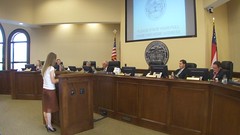
Work Session, Lowndes County Commission (LCC),

Valdosta, Lowndes County, Georgia, 12 December 2011.

Videos by Gretchen Quarterman for LAKE, the Lowndes Area Knowledge Exchange.

-jsq

Open record requests and jail deaths —George Boston Rhynes


George Rhynes complimented Ashley Paulk for having provided
information about people in jail when Paulk was Sheriff,
and noted that unfortunately that had not been the case since.
He asked if someone could point him to where he could get such
information.
Chairman Paulk reminded him that the Sheriff is a constitutional
officer, and the Commission did not direct him.
George Rhynes responded:

Everywhere I go, I hear that.
I go to Brooks County, and they inform me of the same thing.

Chairman Paulk noted:

… by state law.

They agreed on that, and George said he thought nonetheless:

Seems like somebody in the state of Georgia would know how to get that information,
if it is open.

George also said:

Continue reading