Tag Archives: jail

Atlanta police use 5 to 1 odds to arrest peaceful protesters in middle of night

CBS News wrote
26 October 2011

“Occupy Atlanta” camp cleared, dozens arrested
,


With helicopters hovering overhead, police moved into a downtown Atlanta
park and arrested around 50 Occupy Wall Street protesters who had been
encamped there for about two weeks early Wednesday….

Organizers had instructed participants to be peaceful if arrests came,
and most were. Many gathered in the center of the park, locking arms,
and sang “We Shall Overcome,” until police led them out, one-by-one
to waiting buses. Some were dragged out while others left on foot,
handcuffed with plastic ties.

Police included SWAT teams in riot gear, dozens of officers on motorcycles
and several on horseback. By about 1:30 a.m. Wednesday the park was
mostly cleared of protesters….

Hundreds of others stood on Atlanta’s famous Peachtree Street, booing
police. They shouted “Shame!” and “Who do you protect? Who do you serve?”

And according to

Occupy Atlanta this morning:
Continue reading

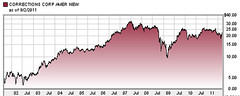
Time to divest from private prison companies

It’s time to stop private prison profiteering by refusing to take
their profit: divest private prison company stock from personal,
pension, and church funds.

There’s no need to speculate that private prison companies have
incentive to keep more people locked up: CCA says so.
Kanya D’Almeida wrote for IPS 24 August 2011,

‘Profiteers of Misery’: The U.S. Private Prison Industrial Complex
:


CCA’s 2010 annual report
states categorically that, “The demand for our
facilities and services could be adversely affected by the relaxation
of enforcement efforts, leniency in conviction or parole standards
and sentencing practices or through the decriminalization of certain
activities that are currently proscribed by our criminal laws — for
instance, any changes with respect to drugs and controlled substances
or illegal immigration could affect the number of persons arrested,
convicted, and sentenced, thereby potentially reducing demand for
correctional facilities to house them.”

CCA continues, “Legislation has been proposed in numerous jurisdictions
that could lower minimum sentences for some non-violent crimes and
make more inmates eligible for early release based on good behaviour,
(while) sentencing alternatives under consideration could put some
offenders on probation who would otherwise be incarcerated. Similarly,
reductions in crime rates or resources dedicated to prevent and enforce
crime could lead to reductions in arrests, convictions and sentences
requiring incarceration at correctional facilities.”

What’s this got to do with Georgia?

Continue reading

30 jail deaths since 1994 to 2009 —George Boston Rhynes

Received today on Alabama
bishops criticize ALEC’s immigration law
-jsq

Churches and pastors need to view this video and see about these
animals. That is since we read so much

information about the Animal
Shelter in our area about abused animals.
What about these animals
and the thirty deaths that no elected official, church, human being or
orgnzations seem to care about.


Did you know that Valdosta-Lowndes County Jail is leading the State
of Georgia in Jail Deaths for whatever reason. Yet, no one is talking
about these people many of whom are military veterans that served their
nation. So where is the humanity to man?

Yes, we have had

30 jail deaths since 1994 to 2009

and not the
Lowndes County Attorney has put it in a letter in so many words

Continue reading

Disparity in Criminal Justice

Is a private prison “good clean industry” as a local leader once told me?


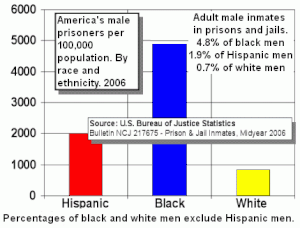
According to the CRF [Constitutional Rights Foundation], over 25 percent
of black males and 16 percent of Hispanic males spend time in prison,
while only 4 percent of white males do so. Blacks make up only 12 percent
of the United States population.

Why?

Continue reading

Interview with an architect of Portugal’s successful drug decriminalization

One of the architects of Portugal’s successful drug decriminalization policy
says,
“to make
demands of addicts who are enslaved by their addiction is senseless.”
Well, it makes sense to those who profit by it, such as private prison
companies.
And Georgia is now proposing

to make field slaves
out of them,
for

failing a drug test.

Inês Subtil wrote for communidad segura 11 May 2009,

Portugal: Success in harm reduction
:


In 1999, Portugal broke new ground by enacting legislation that
decriminalized all drug use. Ten years later, the results are there
for all to see, results of a change that João Goulão, president of
the do Instituto da Droga e Toxicodependência (The Drugs and Chemical
Addiction Institute) IDT, believes show the law has been instrumental in
solving the problem of drug abuse, and crucial for bringing legislation
into harmony with practices and people.

A family doctor, Goulão was condecorated by the president of the
Portuguese Republic, but he says he is always ready for to roll up
his sleeves and get out in the field. At 55, he is a candidate for the
Presidency of the European Drugs Observatory, but that has not clowded
his sobriety about the work at hand.

In an exclusive interview to Comunidad Segura, Goulão discusses the
workings and the structure of the institution that he presides over, that
has set a world-wide example of success. For him, drug use is closely
associated to self-esteem. “If we could restore drug addicts their
human dignity, we would be able to demand something in return. But to make
demands of addicts who are enslaved by their addiction is senseless,”
he said.

Now that makes a lot of sense.
And Portugal demonstrates that it works.

He has more sensible things to say in the interview, including this:

Continue reading

1 in 13 Georgia adults in the prison system —Pew Center on the States


Georgia is number 1 in something: locking people up,
1 in 13 of adults,

according to the Pew Center on the States.


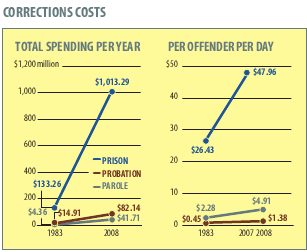
That costs us more than a billion dollars a year in tax money,
5.9% of the state budget.
That’s up from $133.26 million in 1983, increased by more than a factor of seven.


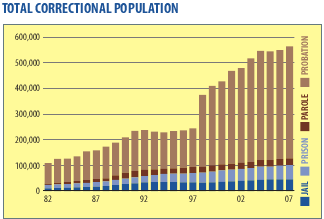
Meanwhile, the correctional population swelled from around 100,000 in 1982 to more
than 550,000 in 2007.
And while other states have started decreasing their prison populations,
Georgia’s continues to increase.
The state is even coming up with new ways to lock people up,
such as kicking them out of mental institutions.
We seem headed back towards

plantation slave labor

and

prison road gangs

in for minor drug infractions.

How about we reverse this trend?

Continue reading

Eligible for prison road labor

In for a drug offense?
Got out but failed a drug test?
You may be eligible for a prison road gang!

AP wrote 4 July 2011,

GA parolees & road maintenance


Georgia is expanding a pilot program that sanctions some parolees by
putting them to work rather than returning them to prison.

The program began in Milledgeville, Gainesville, Columbus and Dalton. This
summer it will be expanding to communities across Georgia.

Parolees are eligible if they have committed low-level violations of
their supervision requirements, such as the onetime failure of a drug
test or curfew violations.

How long will it take before these prisoners are sent to work in fields?

Wouldn’t it make more sense to stop wasting taxpayer dollars
on locking up people for minor drug offenses?

Or maybe prison slave labor is a good way to celebrate July 4th.

-jsq

PS: Gretchen got this item from Dwight Rewis of Echols County.

Budget Hearing wrapup: no questions were entertained from citizens


Paulk and Pritchard wrapped up the budget hearing,
quite well, except at the very end,
when about 2 seconds were allowed for citizens to say they
wanted to speak before the hearing was ended.
So that’s two budget hearings with no citizen input:

the first one nobody knew about
,
and this one where nobody was permitted to speak.

Chairman Ashley Paulk thanked county employees for their cooperation.
He noted that even the constitutional officers, who could appeal
their budgets, had not.
He noted the jail accounted for about half the sheriff’s budget,
calling it an expensive operation.
He said that his office had accounted for 3 of the 8 layoffs
last time, and fortunately there were no more this time.
He said:

Continue reading

Budget presentation —Stephanie Black @ LCC 28 June 2011

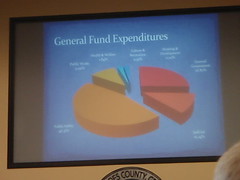
More than half of Lowndes County expenditures go to law enforcement, including sheriff, courts, and the jail.


At Tuesday’s budget hearing,
Lowndes County Finance Director Stephanie Black
presented the proposed 2012 budget to the Commission.


Here are the

details of the budget,

as photographed by Gretchen from the single copy provided for the public
to see by the county clerk.


Here are

photographs of her slides.

Here’s

a playlist of the videos.

A couple more videos of this hearing
to come of remarks by Chairman Ashley Paulk
and County Manager Joe Pritchard in this budget hearing,
plus a related video from the Citizens Wishing to be Heard later
that same day.

-jsq

Coalition against private prisons in Shelby County, Tennessee

In at least one southern county, church groups are working together with
other groups to prevent private prisons.
Why not here, too?

The Mid-South Peace and Justice Center is organizing

a broad coalition against private prisons in Shelby County, Tennessee:


No Private Prisons

The Shelby County Commission is in the process of trying to privatize
our criminal justice system. Private prisons have a well-documented
history of inefficient security, poorly trained and underpaid workers,
high turnover rates, scant benefits and unprofessional and unsupervised
treatment of inmates.

The Coalition Against Private Prisons has been created to fight this
privatization plan. So far this coalition involves Grassroots Leadership,
the Mid-South Peace and Justice Center, the AFSCME local 1733, Shelby
County Corrections Officers, Women’s Action Coalition, Mid-South
Interfaith Network, educators, faith leaders, artists, and activists.

To address this we are working with our coalition partners and other
community organizations to educate Memphians about the dangers of
privatization, and to mobilize Memphians around the issue.

They’ve got a report,

Progress or Profit? Positive Alternatives To Privatization and Incarceration in Shelby County, Tennessee.

Continue reading