Just as
four years ago I projected solar growth ten years ahead,
a quarter century ago I projected Internet growth ten years into the future:
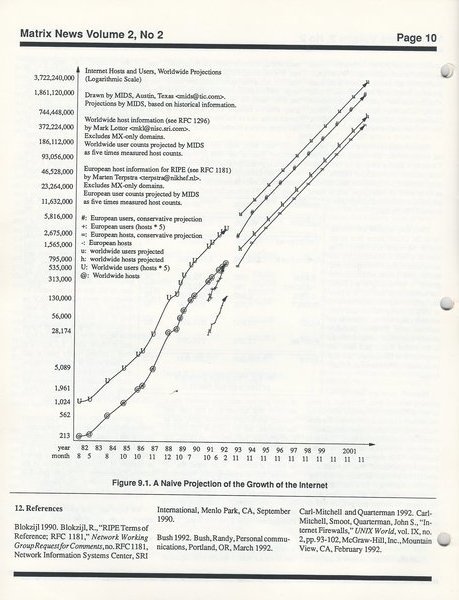
Graph:
A Naive Projection of the Growth of the Internet,
John S. Quarterman, Matrix News 2.2, MIDS, February 1992.
From 7.7 million Internet users in 1992, I projected the exponential
growth of the previous few years ahead a decade, to about
3.8 billion people in 2002.
How close was that estimate?
According to
Internet World Stats,
in April 2002 there were about 0.558 billion Internet users worldwide.
So by that number I was off by a factor of about 6.8,
and the same source says it took until 2017 to reach 3.8 billion.
For the year 2000 I projected about 1 billion and the same source
says there were about 0.3 billion, so I was off then only by
a factor of about 3.3.
For 1999 I projected about 0.5 billion, and the same source says
I was off by only a factor of about 2, which ain’t bad for seven years out.
Why the sudden slump in Internet growth after 1999?
Well, in 2000 the dot-com bubble burst, and Internet growth .
greatly slowed for a while.
As I wrote in 1992, it was a naive projection.
It didn’t attempt to forecast economic downturns;
I never pretended to be Hari Seldon.
Pew Research, 22 December 2003,
The growth of the Internet population has slowed, but Internet users are doing more online,
Online activity has consistently grown over the course of our
research. Internet users discover more things to do online as they
gain experience and as new applications become available. This
momentum often fuels increasing reliance on the Internet in everyday
life and higher expectations about the things people can do online.Despite this growth in activity, the growth of the online population
itself has slowed. There was almost no growth over the course of
2002 and there has been only a small uptick in recent months to
leave the size of the online U.S. adult population at 63% of all
those 18 and over.Different people use the Internet in different ways. The report is
full of examples of how people in different demographic groups use
the Internet for different purposes.Experience and the quality of online connections matter. Those with
more experience online and those who have high-speed connections at
home generally do more online more often than those with lower
levels of experience and those with dial-up connections. The growth
of the cohort of veteran users, those with at least three years of
online experience, has been striking. Nearly three-quarters of
Internet users have at least three years of experience.
And it turns out a later issue of Matrix News
led to one of the things Internet users started using the most:
Amazon; but that’s another story.
The basis of this Internet user projection twenty five years ago was when I estimated
(How Big is the Matrix?, Matrix News 2.2, February 1992)
somewhere between 3.6 and 7.2 million people using
the Internet proper, and between 7.7 and 14.2 million people using
the Internet and all the other networks that would soon be subsumed
into the Internet.
It is clear that by the next presidential election,
in 1996, if not by the one this year,
network users will be a force to be reckoned with.
There are probably already more people on the networks in the United States
than there are people in New Hampshire.
In a few years, there will be moe than in California.Network users are used to expressing their opinions.
They think, to some extent, differently than people who do not use networks,
because they are used to communicating with many people
across boundaries of time, space, and politics.
They have a powerful organizational medium at their fingertips.
Will they use that medium for political organizaitonn?
Will the social organization the medium naturally promotes affect politics anyway?
To some extent these things are already happening.
How much the effects on society and politics will increase as the networked population increases,
we will see.
I didn’t predict that the Internet would be blamed for pretty much everything,
whether or not it had anything to do with causing it.
But for sure it does have political effects.
Bill Clinton and Al Gore did have an election website in 1996,
with
a press release featuring extensive comments by Gore,
in which he notes that the sitting Clinton-Gore administration was the
first to have email addresses and the first to get all cabinet officers online.
He also noted:
…the assault weapons ban.
Incidently on that point, it’s important to have home pages like
these so that people can read for themselves the exact words that
the candidates use and the exact words describing the
accomplishments that are under discussion. Yesterday Senator Dole
made a statement that is really hard to interpret. It was apparently
about the assault weapons ban — those three words were
contiguous to one another in the Dole statement — but various
people have scratched their heads and tried with great difficulty to
decipher what he was trying to say.And I was interested to read in the morning news that the chief
lobbyist for the National Rifle Association, when asked for her
interpretation of Senator Dole’s statement on the assault weapons
ban, just smiled and said she knew for an absolute fact that he was
not changing his position on the assault weapons ban, that he would
not veto a repeal of the assault weapons ban, and she seemed to have
no difficulty whatsoever in interpreting what Senator Dole was
saying. It’s important to have direct access — see for
yourself — but Senator Dole is wrong on the assault weapons
ban, he was wrong when he filibustered the ban, he was wrong when he
sponsored an amendment that blocked the assault weapons ban, he was
wrong when he worked so hard to repeal the assault weapons ban, and
made it a priority to repeal it, and he is just as wrong —
dead wrong — today, when he says that the ban is irrelevant.
Senator Dole thinks it’s enough just to keep these deadly weapons
away from felons. President Clinton thinks we should keep them off
our streets, period. There’s no room for weapons that are only meant
to kill and maim people in America.
In addition to the deja vu of the same discussion still going on two decades
later, note Gore’s point:
“it’s important to have home pages like
these so that people can read for themselves the exact words that
the candidates use and the exact words describing the
accomplishments that are under discussion.”
Experienced Internet users were also active in the elections that brought
us George W. Bush in 2000 and 2004.
But the first presidential candidate to consciously and effectively
use the Internet as a key tool to help win through
fundraising and organization was
Barack Obama in 2008.
See
The Political Impact of the Internet on US Presidential Elections,
Valentino Larcinese and Luke Miner, 2017, STICERD – Economic Organisation and Public Policy Discussion Papers Series 63, Suntory and Toyota International Centres for Economics and Related Disciplines, LSE.
All this is to say that I was pretty close when I projected Internet growth
a quarter century ago, and
so far Jon Wellinghoff and I are even closer
in our Internet growth projections.
21st century renewable sun and wind energy are the only power sources growing exponentially,
with solar power growing faster.
This is what happened to one of the most prominent networks as the Internet took off:
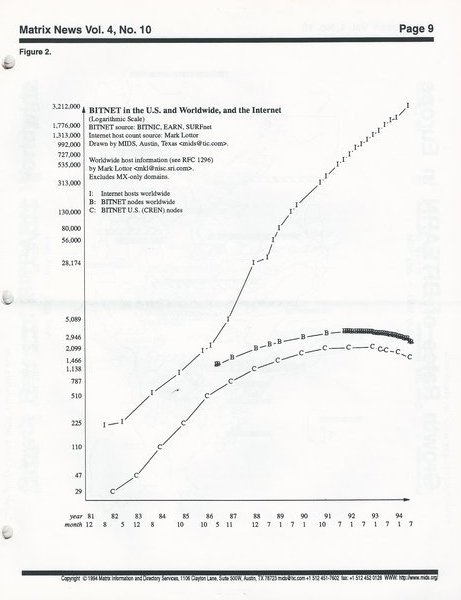
BITNET in the U.S. and Worldwide, and the Internet,
John S. Quarterman, Matrix News 4.10, MIDS, October 2014.
All the other networks fell the same way, so that you’ve probably never
even heard of them: FidoNet, UUCP, USENET, etc.
(You can actually still see and use USENET, but it is completely carried on the Internet now.)
20th century fossil fuels including coal, oil, and the plutocrats’ failed hope
of natural gas, plus nuclear power, are all going down, just like those old networks did.
Solar power
will win like the Internet did.
-jsq
Investigative reporting costs money, for open records requests, copying, web hosting, gasoline, and cameras, and with sufficient funds we can pay students to do further research. You can donate to LAKE today!
Pingback: Why Bezos started Amazon | On the LAKE front
Pingback: Solar power will win like the Internet did | On the LAKE front