Tag Archives: Valdosta

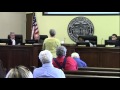
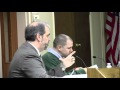
Joyce Evans and Frank Morman reappointed to Land Bank Authority @ LCC 2012 03 27

We previously discovered who was on the Valdosta-Lowndes County Land Bank Authority (VLCPRA) (VLCLBA) because the state publishes that information. Lowndes County has reappointed Joyce Evans and Frank Morman. Maybe the county will also put some information about that Authority online?

Here’s the video:


Joyce Evans and Frank Morman reappointed to Land Bank Authority
Regular Session, Lowndes County Commission (LCC),
Valdosta, Lowndes County, Georgia, 27 March 2012.
Video by Gretchen Quarterman for Lowndes Area Knowledge Exchange (LAKE).

-jsq

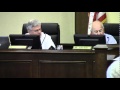
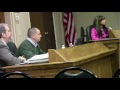
Bicycles noted in appointment to VLMPO Citizens Advisory Committee @ LCC 2012 03 27

Lowndes County cares about bicycles? That’s news!

The Lowndes County Commission appointed Edward Rawls, retired professional engineer and Blake Waagner, owner of Valdosta Bike Center to the Valdosta-Lowndes County Metropolitan Planning Organization (VLMPO) Citizens Advisory Committee. Commissioner Crawford Powell surprisingly said:

I think the perspective from the bicycle group would be interesting on the MPO.
Interesting development!

Also, the Commission continued the tradition which I believe was started by Commissioner Joyce Evans of attempting to get all applicants for appointed boards to introduce themselves. I think that’s a good thing.

Here’s the video:


Bicycles noted in appointment to VLMPO Citizens Advisory Committee
Regular Session, Lowndes County Commission (LCC),
Valdosta, Lowndes County, Georgia, 27 March 2012.
Video by Gretchen Quarterman for Lowndes Area Knowledge Exchange (LAKE).

-jsq

Lowndes County and Valdosta history: origins of the old boys

If we want good clean industry for jobs for local people, we need good clean local government, too. Why do our local government bodies hide when they discuss public goods like waste disposal, try to avoid stating public positions on issues, and fail to publish minutes of elected bodies?

A little reading in local histories of the area or talking to people who were involved even a generation or two back indicates that Lowndes County has always been a cliquish sort of place, mostly run by old boys, for reasons that made some sense in the early days (lack of resources, mainly), but doesn’t so much anymore in these days of I-75 and I-10, airport, railroads that still go everywhere, Moody AFB, VSU as a regional university, technical and community colleges, two hospitals and medical industry, TitleTown, Grand Bay WMA, Wild Adventures, and south Georgia sunshine we can export to Atlanta and points north.

Here are a few books about the old days, all available in local libraries and possibly in local bookstores: Continue reading

The socialized costs and privatized profits of waste disposal

In her response to my post about Commissioners panic about trash at undisclosed location, Barbara Stratton seems unfamiliar (like most people) with economic externalities. Here’s a definition:

A negative externality occurs when an individual or firm making a decision does not have to pay the full cost of the decision. If a good has a negative externality, then the cost to society is greater than the cost consumer is paying for it. Since consumers make a decision based on where their marginal cost equals their marginal benefit, and since they don’t take into account the cost of the negative externality, negative externalities result in market inefficiencies unless proper action is taken.

When a negative externality exists in an unregulated market, producers don’t take responsibility for external costs that exist—these are passed on to society.

Which is socializing the losses. A famous ongoing case of this is BP making record corporate profits while dumping huge amounts of oil into the Gulf of Mexico, continuing to destroy shrimping, wetlands, wildlife, and local people’s health.

And that’s what the County Commission is doing: privatizing the profits of trash pickup and socializing the losses onto landowners (who have to pay for fences and gates), onto the general public (who have to pay for law enforcement to catch dumpers), and onto those who can’t afford to pay for private dump fees (who will get stuck with fines instead). That is indeed, as Barbara says, “redistribution of wealth”: redistribution from the rest of us to the private waste pickup companies.

The Commission is ducking its responsibility to find an equitable solution that everyone can afford. Funny how they can deal with special tax lighting districts for subdivisions but they claim they can’t come up with a way to publicly fund waste collection. Could it be because all the voting Commissioners are town-dwellers who don’t understand that rural people don’t have exactly the same needs or resources as city people?

Barbara advocates,

Continue reading

Avoid crony capitalism or conflict of interest —Barbara Stratton

Received Monday on Commissioners panic about trash at undisclosed location. My response is in the next post. -jsq

There are many injustices of socialism and redistribution of wealth (or garbage) and I’m glad to see you recognize this in the shifting of illegal dumping costs to landowners. I am also glad to see that at least the county is talking about privatization and not public/private partnerships (so far). When Hahira almost succeeded in placing a regional waste transfer station on city owned property
REZ-2007-32 City of Hahira, 0028 027 6751 Union Road, 2 lots, R-21 to M-2, DRI
I was concerned that the county was complacent in this because the Lowndes Board of Commissioners November 2007 meeting minutes showed they agreed to rezone the property for the purpose of the transfer station against the recommendations of the county planner, Jason Davenport. That rezoning action replaced a DRI (Development of Regional Impact) request for waste transfer station rezoning so it was easy to assume the county and possibly the region had a mutual agenda for the transfer station. During a recent discussion on the dangers of regional government with Valdosta mayor, Larry Hanson, I asked if the transfer station was a regional interest. He assured me the City of Valdosta had no knowledge and no interest in that transfer station prior to articles in the Valdosta Daily Times. I’ve not had an opportunity to discuss the possibility of mutual agenda with the county and if it comes up again in the future I am assuming proper procedures will be followed which mandate public meetings and input into the planning before a third DRI is entered, not after.

I worked a contract for the IT of a Pensacola, FL software company that had waste management software contracts all over the US. It was my job to be

Continue reading

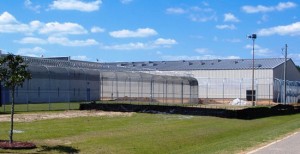
Good thing we didn’t buy a “jail to nowhere”

Still more evidence that private prisons are bad business. If the Industrial Authority won't do due diligence before buying into boondoggles like biomass and private prisons, we'll have to do it for them.

Kirsten Bokenkamp wrote for ACLU Texas 4 April 2012, Nobody wants a “Jail to Nowhere”,

…a number of Texas counties and towns ( the article points to Anson, Littlefield, and Angelina, Newton, Dickens and Falls Counties as a few examples) were sold on the idea that mass incarceration was in Texas to stay. According to the article, most of the privately operated county jails sit less than half full, and guess who is left holding the bill? (Hint – it is not the for-profit prison company).

Meanwhile, we can look askance at anything else that is pushed by ALEC, like private prisons and charter schools are.

-jsq


Savannah River #4 for total toxic discharges

The table shows Savannah River as number four in the nation for toxic discharges. It took two states to do that. I wonder where the Altamaha River ranks? And if they did it normalized per mile of river or by population, how about the Withlacoochee River?

Kiera Butler wrote for Mother Jones today, America’s Top 10 Most Polluted Waterways,

An eye-opening new report (PDF) from Environment America Research and Policy Center finds that industry dishcarged 226 million pounds of toxic chemicals into America’s rivers and streams in 2010. The pollution included dead-zone producing nitrates from food processors, mercury and other heavy metals from steel plants, and toxic chemicals from various kinds of refineries. Within the overall waste, the researchers identified 1.5 million pounds of carcinogens, 626,000 pounds of chemicals linked to developmental disorders and 354,000 pounds of those associated with reproductive problems.

The article says the situation has actually improved, but also notes we don’t really know much about it:

We’ll have to take their word for it, since the companies are not required to release the results of their chemical safety testing to the public, nor do they have to reveal how much of each chemical they are releasing. The Clean Water Act doesn’t even apply to all bodies of water in the US; exactly how big and important a waterway must be to qualify for protection has been the subject of much debate. Rivers get the big conservation bucks; they’re the waterway equivalents of rhinos and snow leopards. But pollutants in oft-neglected ditches, canals, and creeks—the obscure bugs of the waterway world—also affect ecosystems and our drinking water quality. Sean Carroll, a federal field associate in Environment America’s California office, estimates that 60 percent of US waterways aren’t protected. “The big problem,” he says, “is that we don’t know how big the problem is.”

Sounds like room for improvement, starting with better transparency.

-jsq


Fresh Kills Landfill Solar Farm

New York City’s new wind and solar farm will be a dump.

Mathias wrote for Cleantechnica 22 March 2012, NYC to Build Wind and Solar Farm on Old Dump Site,

Who would know that an old garbage dump at Staten Island in New York City would house 20 MW of renewable power? If they succeed with their plans, “Fresh Kills landfill” will be transformed into a combined solar and wind farm that could generate enough electricity to power 6,000 average American households!

The old landfill has serviced the city for 53 years, and taken care of a whopping two billion tons of thrash, before closing early in 2011.

Sounding like a mayor from Texas with a vision, Continue reading

Support Public School education! —Karen Noll

Received today. -jsq

Dear Friends,

After learning abut the for-profit charter school issue from and the tax credits for private school tuition, I interpret today’s VDT articles as part of a political agenda to further dismantle a Georgia Constitutional right to Free Public School Education. Here we are again, let’s paint the schools as failing and then try to legitimize further defunding of the schools. And instead of Free Public Education the students from poor families will continue to get what ever is left when the well-to-do take their large piece of the public school education pie.

CHARTER SCHOOLS SERVE STUDENTS ALREADY SERVED WELL IN PUBLIC EDUCATION:

It is important that we understand that Free Public Education is clearly being
Continue reading

Local Heirloom Tomatoes and More @ HLTF 2012 03 22

Here are videos of “Local Heirloom Tomatoes and More”, the 22 March 2012 Lunch and Learn by Healthy Living Task Force, organized by Diane Howard (dhoward202@mchsi.com) and Traci Gosier (tqgosier@dhr.state.ga.us) 229.245.8758

The program has been grant funded and has had previous topics of:

February 2012:
“Lovin’ Local-Grown: Grits, Cheese, and More” featuring Gayla’s Grits and Sweet Grass Dairy Cheeses
19 January 2012:
Juicing Jubilee Lunch and Learn event

The final session will be 26 April 2012, 12:00PM til 1:30PM at Valdosta City Hall Annex.

Here’s a playlist:


Local Heirloom Tomatoes and More,
Lunch and Learn, Healthy Living Task Force, (HLTF), Healthy Living Task Force,
Valdosta, Lowndes County, Georgia, 22 March 2012.
Videos by Gretchen Quarterman for Lowndes Area Knowledge Exchange (LAKE).

-gretchen