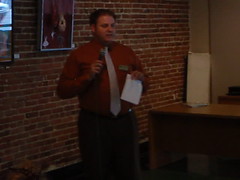
Scott Orenstein made a very good point at the end of the 7 March 2011
Valdosta City Council meeting:
…spirit of concern and participation in the community.
I’d just like the videographer to pan around and see how many
people are still here at the conclusion of the meeting.
And then talk about their true concern for the community.
Are they really concerned
when they get up and leave in the middle of the meeting?
Regular monthly meeting of the Valdosta City Council (VCC),
Valdosta, Lowndes County, Georgia, 7 April 2011,
Videos by Gretchen Quarterman for LAKE, the Lowndes Area Knowledge Exchange.
The mayor re-opened Citizens to Be Heard at the end of the meeting
so
Continue reading →
Regular monthly meeting of the Valdosta City Council (VCC),
Valdosta, Lowndes County, Georgia, 7 April 2011,
Videos by Gretchen Quarterman for LAKE, the Lowndes Area Knowledge Exchange.
Adjournment!
Little joke there.
But adjournment is not the end of interacting with the city government at a city council meeting.
For example,
Council Deidra White stopped on the steps of City Hall
to talk to people.
Three people were there.
All of us lived in the county outside Valdosta.
Not a single person who lives in Valdosta stayed
to talk to her.
Among other things, she said she thought she made clear at the end of
the last Council meeting that the mayor didn’t speak for her.
That was at the end of the meeting, in the
“Council Comments” item on the agenda.
However, apparently nobody stayed to hear that, either.
The 75% pot of T-SPLOST funds is what the project lists recently
submitted by Lowndes County
and the City of Valdosta are about,
according to
Corey Hull, continuing his presentation on T-SPLOST at the Lowndes County
Democratic Party (LCDP) meeting.
Those are projects of regional significance
that the local jurisdictions want the voters to actually
vote on that project.
The other 25% goes to local jurisdictions, like this:
Corey Hull of the Valdosta-Lowndes County Metropolitan Planning Organization (VLMPO)
explains T-SPLOST (HB 277) and the Transportation Investment Act of 2010
at the monthly meeting of the Lowndes County Democratic Party (LCDP),
Gretchen Quarterman (Chair), Valdosta, Lowndes County, Georgia.
Video by John S. Quarterman for LAKE, the Lowndes Area Knowledge Exchange.
The plan identifies
$35 billion to meet the needs in Georgia today.
However, $72 billion are needed to meet the transportation
needs to sustain Georgia’s economy into the future.
Of course, that’s according to the Georgia Department of Transportation (GDOT),
which notoriously is not interested in trains or other mass transit:
if it’s not a road or a road bridge, forget it.
Continuing:
And $1 billion is needed here in Lowndes County.
Lowndes County’s transportation plan through the
Metropolitan Planning Organization
has about a billion dollars in projects.
T-SPLOST is a ten-year one-cent sales tax,
organized in twelve regional taxing districts,
through committees composed of county chairs and city mayors,
plus an executive committee with some of them plus 3 people from the
legislature, which funnels transportation funding requests to GDOT,
which picks, and then sends to a referendum in 2012.
Got all that?
No?
Well, Corey explains it much better than I do.
The Georgia legislature passed what was then known as House bill 277
called
Transportation Investment Act of 2010….
It created or proposed a one percent sales tax for transportation purposes
throughout the state of Georgia.
It creates
twelve special transportation taxing districts
that are based on the boundaries of the regional commissions.
And that is where the connection with the regional commission stops.
They are not the same body….
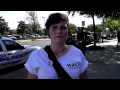
Natasha Fast, co-president of
WACE, Wiregrass Activists for Clean Energy,
explains why she is protesting
outside the most recent
Valdosta City Council meeting.
Natasha Fast of WACE, Wiregrass Activists for Clean Energy outside the
Regular meeting of the Valdosta City Council, 24 March 2011,
Valdosta, Lowndes County, Georgia.
Videos by Gretchen Quarterman for LAKE, the Lowndes Area Knowledge Exchange.
Come hear Chairman Ashley Paulk and MPO Director Cory Hull give
us information about T-SPLOST. The special local option tax for
Transportation.
Ashley Paulk is Chairman of the Lowndes County Commission.
Corey Hull is Coordinator for the
Valdosta-Lowndes County Metropolitan Planning Organization (VLMPO).
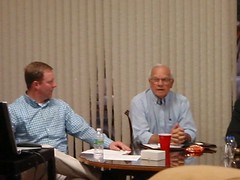
Norman Bennett, VLCIA board member and former chairman of the Lowndes County Commmission,
asked Corey Hull:
Can you explain that again for me about the penalties if the voters don’t pass the tax?
If the county’s got a project, then they’ve got to put up ten percent
or whatever the percentage is?
What’s this about yet another sales tax decided on by
regional transportation boards and GDOT?
Corey Hull of the Valdosta-Lowndes County Metropolitan Planning Organization
(VLMPO)
explained T-SPLOST
at the regular monthly meeting,
Valdosta-Lowndes County Industrial Authority (VLCIA).
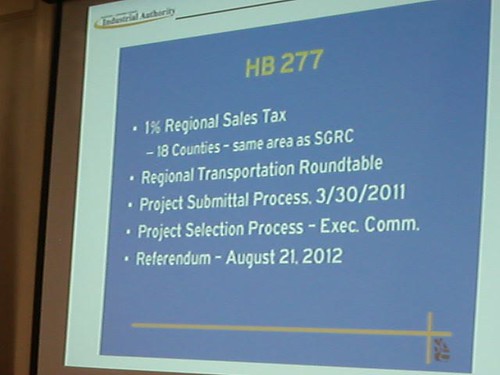
Georgia HB 277, which was passed by the legislature and signed into law
last year,
calls for a 1% regional sales tax (T-SPLOST) to fund
transportation projects.
…spirit of concern and participation in the community. I’d just like the videographer to pan around and see how many people are still here at the conclusion of the meeting. And then talk about their true concern for the community. Are they really concerned when they get up and leave in the middle of the meeting?