Savannah River #4 for total toxic discharges

The table shows Savannah River as number four in the nation for toxic discharges. It took two states to do that. I wonder where the Altamaha River ranks? And if they did it normalized per mile of river or by population, how about the Withlacoochee River?

Kiera Butler wrote for Mother Jones today, America’s Top 10 Most Polluted Waterways,

An eye-opening new report (PDF) from Environment America Research and Policy Center finds that industry dishcarged 226 million pounds of toxic chemicals into America’s rivers and streams in 2010. The pollution included dead-zone producing nitrates from food processors, mercury and other heavy metals from steel plants, and toxic chemicals from various kinds of refineries. Within the overall waste, the researchers identified 1.5 million pounds of carcinogens, 626,000 pounds of chemicals linked to developmental disorders and 354,000 pounds of those associated with reproductive problems.

The article says the situation has actually improved, but also notes we don’t really know much about it:

We’ll have to take their word for it, since the companies are not required to release the results of their chemical safety testing to the public, nor do they have to reveal how much of each chemical they are releasing. The Clean Water Act doesn’t even apply to all bodies of water in the US; exactly how big and important a waterway must be to qualify for protection has been the subject of much debate. Rivers get the big conservation bucks; they’re the waterway equivalents of rhinos and snow leopards. But pollutants in oft-neglected ditches, canals, and creeks—the obscure bugs of the waterway world—also affect ecosystems and our drinking water quality. Sean Carroll, a federal field associate in Environment America’s California office, estimates that 60 percent of US waterways aren’t protected. “The big problem,” he says, “is that we don’t know how big the problem is.”

Sounds like room for improvement, starting with better transparency.

-jsq


County quantifies some infrastructure payback times @ LCC 2012 03 31

Water and sewer take decades for return on investment, and roads and bridges probably aren’t any better. That’s worth remembering whenever solar, busses, or trains come up.

David Rodock wrote for the VDT Sunday, Commission wraps up annual retreat: Utility payments, road projects and waste disposal discussed

The cost of one mile of construction for water takes 23 years for a return on the initial investment; sewer takes 21.3 years.

The VDT didn’t specify the similar return times for road paving or bridge construction, but it’s a safe bet they’re at least as long. The farther water or sewer lines or roads or bridges are from population centers, the more they cost both directly in installation and indirectly in trips for fire and sheriff vehicles, and especially school busses. The county commissioned a report on that several years ago, as Gretchen reminded them last year. In the particular rezoning case on Cat Creek they were discussing then (Nottinghil), they made a decision to table which seems to have caused the developer never to come back with that particular sprawl plan. I congratulated the Commissioners at that time, and I congratulate them again on not promoting sprawl.

Sprawl costs the county, payback takes years, and longer the farther out it goes. What if we did something different? More on that later.

-jsq


Commissioners panic about trash at undisclosed location @ LCC 2012 03 31

The Lowndes County Commission continues to hide when it talks about waste disposal. The VDT got slightly more specific about the undisclosed location of the Lowndes County Commission Retreat, and much more specific about what they were doing, yet according to state law their minutes need to be still more specific. And it’s not clear why they’re panicking about waste disposal when the deficit on that public good has come down rapidly in recent years.

David Rodock wrote for the VDT Saturday, Commission tackles key issues: Waste management, tax lighting districts and SPLOST discussed at retreat,

Commissioners and staff from Lowndes County buckled down Friday at Chairman Ashley Paulk’s guest home to address issues such as waste management, special tax lighting districts, SPLOST negotiations and necessary expenditures for equipment and staff.

A LAKE roving reporter (not me) observed many vehicles at Shiloh Farms’ recent acquisition in Berrien County on the north side of GA 122 a bit east of Old Valdosta Road (Cat Creek Road), so that seems likely the undisclosed location.

By the end of the afternoon, Commissioners made decisions on a few key issues.

It’s good to hear our elected representatives were working, even though they do not appear to have followed state law about this open meeting. And we can look forward to the names of which of them voted for each decision, according to the recent Georgia Supreme Court decision.

Here’s one thing they were working on:
Solid waste management, which is currently handled with collection centers, has run at a deficit of over $300,000.

That’s less than the deficit it was running last time (23 May 2011) the Commission had a meeting at an undisclosed location with no agenda where they talked about waste disposal. According to David Rock in the VDT 24 May 2011, Commissioners want Lowndes out of the trash business,

In total, the county is currently spending $782,058.34 each year for solid waste disposal, a reduction from $1,176,207.75 in 2007.

So that’s a rapid reduction in cost to less than a third of what it used to be, and less than half of what it was only a year ago. Back to Saturday’s VDT report:

County manager Joe Pritchard assured them the budget was in better shape than last year.

So why are they panicking about waste disposal?

Continue reading

Judge OKs Barnes and Richardson CWIP suit against Georgia Power

Historic Davids get approval for slingshot against power company Goliath.

Judge allows lawsuit over Georgia Power surcharge to go forward,

Fulton Superior Court Judge Ural Glanville’s ruling Thursday allows the lawsuit filed by former Gov. Roy Barnes and ex-Republican House Speaker Glenn Richardson to go forward.

The complaint said Georgia Power has improperly collected sales tax and fees on a surcharge created by a 2009 law. They say it has added up to as much as $100 million in costs to ratepayers.

This lawsuit opposes Georgia Power’s Construction Work in Progress (CWIP) that is already charging gapower customers for the Plant Vogtle nukes that won’t produce any power for years yet. If this lawsuit wins, they may not ever be built.

But you don’t have to wait for this lawsuit, or for the legislature to ban CWIP. You can oppose CWIP by paying for it in a separate check.

Maybe soon we can get rid of Georgia Power’s territoriality law so we can, like we could in 46 other states, generate our own solar or wind power and sell it to whomever we choose.

-jsq

Insurgents win majority on Cobb EMC board

According to the Cobb EMC board election results, even without two runoffs, four new members were elected yesterday, so added to the 4 new members elected in November, that’s 8 out of 10 members opposed to coal plants, opposed to corruption, and for transparency.

Kim Isaza wrote for MDJOnline today, Four new Cobb EMC directors elected,

Four more seats on the Cobb EMC board of directors are now in new hands, and two more will be settled in unprecedented runoff elections on April 21.

The winners are: Rudy Underwood, who was unopposed in Area 2; Kelly Bodner in Area 3; Bryan Boyd in Area 8; and Eric Broadwell in Area 9.

One runoff will be for Area 4, where Jim Hudson won 681 votes (42 percent) and David McClellan won 601 votes (37 percent). There were eight candidates competing in Area 4.

The other runoff will be for Area 5, where Tripper Sharp — one of the plaintiffs to the 2007 lawsuit against the EMC — got 775 votes (46 percent), and Charles A. Sevier got 502 votes (30 percent). Nine candidates were vying for that seat.

To quote from Rudy Underwood’s platform:

Continue reading

Georgia Legislators

I blogged about State Rep. Mary Margaret Oliver and then happened to run into her about an hour later, along with her partner in ethics. This time she was in color.


Stephanie Stuckey Benfield (D-85 Atlanta) and Mary Margaret Oliver (D-83 Decatur):
Roswell, Georgia, 31 March 2012.
Pictures by John S. Quarterman for Lowndes Area Knowledge Exchange (LAKE).

-jsq


Hunting for transparency

Some legislators tried to hide potential ethics violations in the name of privacy. They failed in the last hour of the last day of the legislative session.

Jim Galloway wrote for the AJC yesterday, Your morning jolt: The failed attempt to make ‘transparency’ commission a translucent one

In other words, the Georgia Government Transparency and Campaign Finance Commission would have been handed permission to cut off from public view the more pesky complaints against your leaders. Cases that it would decide you didn’t need to know about.

Who did this, and when?

State Rep. David Knight, R-Griffin, introduced the conference report in the House, but didn’t mention the above paragraph. That came to light under questioning from state Rep. Mary Margaret Oliver, D-Atlanta, and other Democrats.

My AJC colleague Chris Quinn described a scene in which the tally board started out with green “yes” votes and red “no” votes evenly divided. But slowly, green lights began blinking out, and the red votes began to grow. At 11:08, the bill was defeated 25-143.

Sanity and ethics prevailed at the eleventh hour.

-jsq


County Commission retreat this weekend

Did you know about the Lowndes County Commission retreat this weekend? It wasn’t mentioned at their recent regular meetings, it’s not on their website calendar, and there’s no agenda posted, either. Fortunately, the VDT at least has been informed about it.

VDT editorial today, Commissioners annual retreat this weekend,

The Lowndes County Commissioners and staff are attending the annual planning retreat this weekend, but are not spending any county funds doing so.

Chairman Ashley Paulk invited the county to hold the retreat at his farm, and he’s doing all the cooking for their meals, at no charge to the county.

It’s good Ashley Paulk wants to contribute to the public good in that way.

However, this is a public meeting of an elected body, and the public has not been informed of where it is, for example, at which of Ashley Paulk’s farms? Maybe they’ll at least keep good minutes.

-jsq


A victory for transparency in government

Best to record those votes! So said the Georgia Supreme Court last month.

G.G. Rigsby wrote for SavannahNow 6 February 2012, Court ruling favors openness in government

The Georgia Supreme Court ruled Monday that votes taken in open meetings must be recorded, even if they are not roll-call votes.

The decision in Cardinale v. the City of Atlanta reverses a Court of Appeals ruling that the state’s open meetings law doesn’t require meeting minutes to reflect how members voted when the vote is not unanimous.

Matthew Cardinale filed a lawsuit against the City of Atlanta for failing to record how each city council member voted when a non-roll-call vote was taken at a February 2010 retreat.

Hm, the Lowndes County Board of Commissioners is meeting in retreat this weekend. Maybe they’ll keep good minutes.

Writing for the majority, Chief Justice Carol Hunstein said, “While the act provides for public access to agency meetings, it also fosters openness by, among other things, requiring agencies to generate meeting minutes that are open to public inspection so that members of the public unable to attend a meeting nonetheless may learn what occurred. …To adopt a contrary holding that agencies possess discretion to decline to record the names of those voting against a proposal or abstaining in the case of a non-roll-call vote would potentially deny non-attending members of the public access to information available to those who attended a meeting.”

Earlier this year, Effingham County’s commissioners took a secret ballot for vice chairman. At their next meeting, after questions from a reporter, they said how they voted so the information could be included in the minutes for the meeting.

The secret vote in Effingham was an indication that the case that was pending before the state Supreme Court was important, Cardinale said.

Effingham County… ah, yes! The county whose Industrial Authority fired Brad Lofton for non-transparent dealings.

Doubtless everything is on the up-and-up around here, so I’m sure all the local government bodies, elected and unelected, will have no problem recording how all their members vote.

-jsq

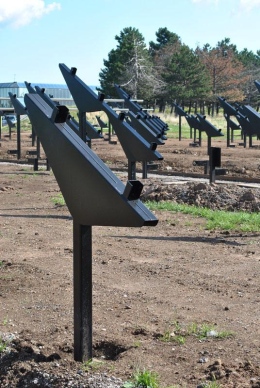
Fresh Kills Landfill Solar Farm

New York City’s new wind and solar farm will be a dump.

Mathias wrote for Cleantechnica 22 March 2012, NYC to Build Wind and Solar Farm on Old Dump Site,

Who would know that an old garbage dump at Staten Island in New York City would house 20 MW of renewable power? If they succeed with their plans, “Fresh Kills landfill” will be transformed into a combined solar and wind farm that could generate enough electricity to power 6,000 average American households!

The old landfill has serviced the city for 53 years, and taken care of a whopping two billion tons of thrash, before closing early in 2011.

Sounding like a mayor from Texas with a vision, Continue reading