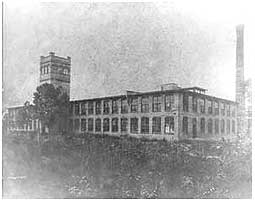
FYI: The Strickland Mill in Remerton is being threatened with demolition. Remerton City Council will meet to discuss this situation on Monday, June 4th at 5:30pm during their work session, and on Monday, June 11th at 5:30pm to vote on the matter. The public is invited to both of these meetings to express opinions on the possible demolition of the Mill. As you all are aware, this mill complex dates to 1899 and is one of the few surviving textile mills in our region. This is an important community landmark and was very influential to the development of Valdosta, not to mention integral to Remerton's existence.
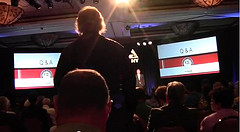
At Southern Company’s (SO) shareholder meeting, I enumerated some examples in the U.S., Japan, and Germany of nuclear gone bad, and pointed out Japan, Germany, and even Bulgaria had already or were getting out of nuclear, while Southern Company and Georgia continued to bet the farm on nuclear, and I asked what was SO’s exit strategy for when that bad bet goes bad? SO CEO Thomas A. Fanning said they had learned everything there was to learn from Fukushima, and besides Plant Vogtle is 100 miles inland where there are no earthquakes. He didn’t mention the same description applies to Chernobyl. He did say SO planned to make the U.S. nuclear industry the best in the world.
You kept using big bets and then bet the farm. Very interesting terminology.
Regarding operations credibility, a year ago Vogtle Unit 1 shut down 2 days after the NRC gave Vogtle a clean bill of health. But the SO CEO says it’s all better now.
Here’s the video, followed by links to sources for the points I made:
Exit strategy for when this big nuclear bet goes bad? –John S. Quarterman Shareholder Meeting, Southern Company (SO), Callaway Gardens, Pine Mountain, Georgia, 23 May 2012. Video by John S. Quarterman for Lowndes Area Knowledge Exchange (LAKE).
Here are the main points I was reading from, with links:
Remember the Southern Company brags about “Our competitive generation business”. The important word there is “our”, as in the Southern Company and its subsidiary Georgia Power gets to compete, and you don’t. Unless you’re big enough.
Some retail competition has been present in Georgia since 1973 with the passage of the Georgia Territorial Electric Service Act. This Act enables customers with manufacturing or commercial loads of 900 kW or greater a one time choice in their electric supplier. It also provides eligible customers the opportunity to transfer from one electric supplier to another provided all parties agree.
Because of that law, you can’t you put up solar panels on your own land and sell your power to somebody somewhere else. And you can’t get a company like SolarCity or Lower Rates for Customers to put up solar panels on your property and sell you the power ( or can you?). Unless you’re generating at least 900 KW; then maybe you can get selected businesses to switch to your power once. Except you probably still won’t qualify, because
Continue reading →
I think of Georgia Power more as like IBM when minicomputers came out. IBM built bigger mainframes. The Internet started to spread, and IBM pushed its own proprietary SNA network. (Remember SNA? I didn’t think so.) Then PCs came out, and IBM layoffs started….
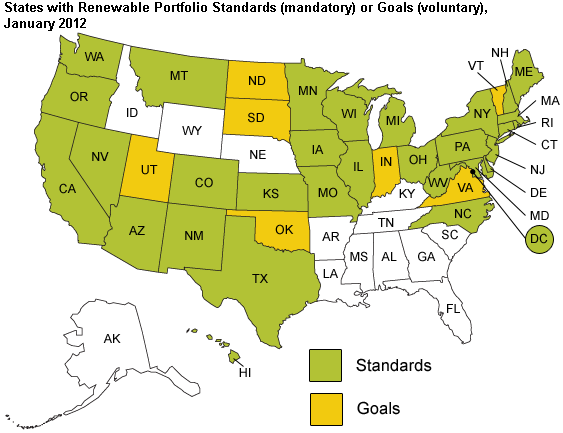
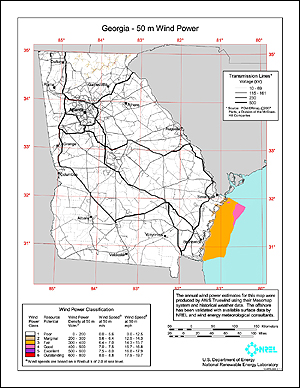
Everybody except for Georgia is jumping on the wind and solar bandwagon, but Georgia Power is side-lined in a nuclear jam like a horse-buggy manufacturer at the dawning of the Ford assembly line.
The white area on that map is for states that have no standards or goals for renewable energy.
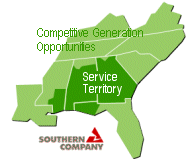
Remember Georgia Power is the biggest part of its parent, The Southern Company, and the nuclear units at Plant Vogtle (operating and planned) are actually owned by another offshoot of The Southern Company. According to Southern Company’s webpage, Megawatts and Markets,
Southern Company regulated regional electric utilities serve a 120,000-square-mile territory in Alabama, Florida, Georgia, and Mississippi. Our competitive generation business extends to markets in six southeastern states.
It’s interesting how similar the Southern Company’s markets are to the states in that white southeast no-renewable-energy-portfolio area!
On the eve of Southern Company (NYSE: SO) holding its annual meeting
of stockholders in Pine Mountain, GA., the nonprofit Green America
released a report today ranking the major U.S. power producer as
“the United States’ most irresponsible utility.”
Titled “Leadership We Can Live Without: The Real Corporate Social
Responsibility Report for Southern Company,” the Green America
analysis assigns letter grades to seven major U.S. utilities on four
fronts: reliance on coal; pollution; reliance on and expansion of
nuclear power; and lobbying expenditures. Southern came in dead last
with straight “F” grades in all four of the categories.
The PR and the report have a lot more detail, such as this:
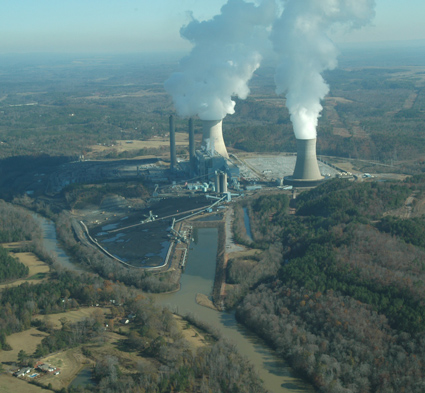
Clean Air Task Force data shows that Southern Company’s coal-fired
power plants cause 1,224 deaths, 1,710 heart attacks, 20,770 asthma
attacks, and 752 cases of chronic bronchitis per year. The total
annual cost of all of this damage is over $9 billion.
Hey, that’s more than the original projected cost of the new nukes!
Georgians, do you like trading your health for SO’s
coal plants
and its nuclear boondoggle?
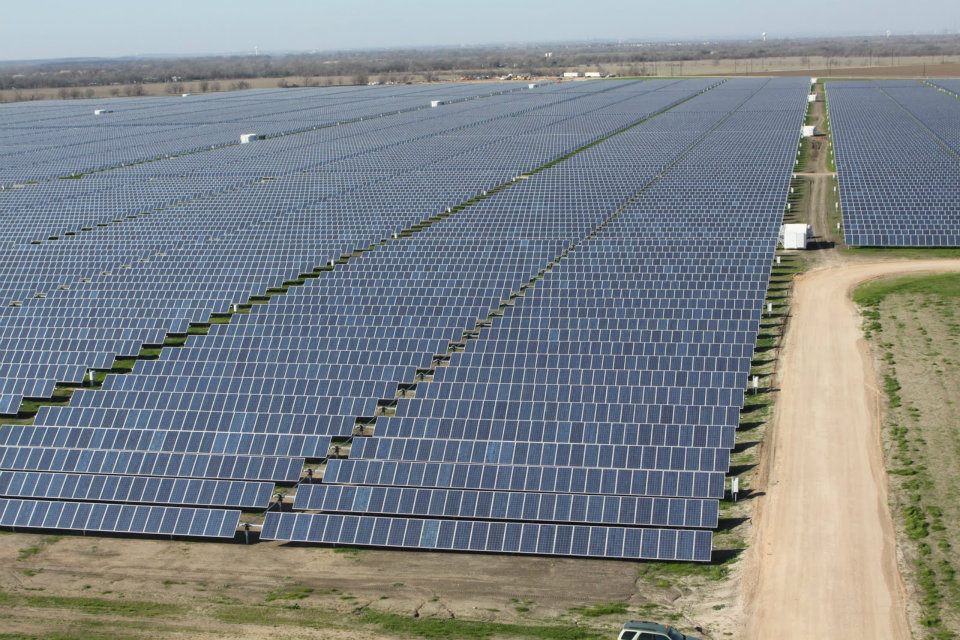
When the world's biggest oil producer plans to shift to solar energy, maybe it's time for the rest of the world to realize there's money in solar energy.
Ali Al Naimi, surprised the global solar stage with his grand announcement, “Saudi Arabia aspires to export as much solar energy in the future as it exports oil now.”
That was two years ago. This month Saudi Arabia held the fourth Saudi Solar Energy forum.
The summit turned out to be extremely successful, as by the end of the meeting, Saudi Arabia officially announced its ambitious solar energy strategy that plans to add 41GW to the national grid in 20 years through investments of $109B. The country currently produces just 3MW from solar. According to the plan, 25GW will be generated from solar thermal plants and 16GW from PV panels. The country aspires to generate a quarter of its total energy from the solar sector by 2032.
It seems the world's biggest oil exporter is planning for a future in which oil is much less important and the sun much more so.
And in that conference:
The companies that participated in the conference included First Solar (FSLR), Amonix, Areva Solar, Abengoa Solar, Novatec Solar, Siemens and Soitec Solar GmbH.
Not a U.S. company in that list. Of course, the U.S. doesn't need Saudi Arabia as a customer if we just get on with solar here at home. Georgia, for that matter, has two solar manufacturers Suniva of Norcross and MAGE SOLAR of Dublin) and more than 40 certified solar installers.
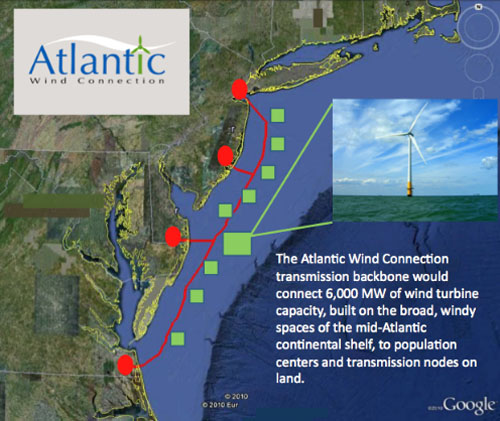
The Department of the Interior stated on Monday that there was “no overlapping competitive interest” for the areas where the $5-billion project would be constructed. This decision leads us to the next step in the process — environmental review of the Atlantic Wind Connection line.
The article notes that environmental review could take 18-24 months, with a projected power online date of end of 2017. Southern Company projects Vogtle Unit 3 online in 2016 and Unit 3 in 2017. And that’s before the cost overruns that have already started. I’m guessing Google will have its Atlantic wind project up and running before Southern Company has any new nukes online, if they’re ever online.
And remember, the Atlantic Wind Connection is privately funded:
Other than Google, companies funding the project include Good Energies and Japan’s Marubeni Corp.
The cost is about $5 billion for 6,000 MW of wind energy generation.
Meanwhile, Southern Company has already overrun its nuke cost estimate by almost $1 billion within a few weeks of NRC go-ahead. It won’t take long at that rate for the cost overruns to exceed $5 billion. That’s on top of the perhaps $8.3 billion base cost. That’s for two 1,100 MW reactors, for 2,200 MW total.
Comparing the Vogtle initial $913 million cost overrun to the capital costs of gas, wind, and solar plants show just how big these cost overruns can be. The Vogtle $913 million cost overrun by itself could have paid for approximately 1,000 megawatts of natural gas generation; 450 megawatts of wind power; and 330 megawatts of solar power.
Don’t forget that’s just the first cost overruns on those nukes. When the current Plant Vogtle nukes were built, there were supposed to be four at a cost of $660 million; only two were built, at a cost of $8.87 billion. That’s a cost overrun of 1300%. How much solar and wind could $8 billion buy?
Moreover, gas, wind, and solar generation could be up and running in 3-years or less from the first day to the last day of development, as opposed to the 10 years or more needed to build a nuclear plant.
A group of nine national environmental groups says that the two new nuclear reactors being built at Plant Vogtle (near Waynesboro in eastern Georgia) are over budget by up to $1 billion dollars. The opponents say Georgia Power’s share of the cost overruns is currently $400 million and that may cost ratepayers as well as taxpayers who are guranteeing loans in the billions of dollars.
The nine environmental groups, Friends of the Earth, Southern Alliance for Clean Energy, Blue Ridge Environmental Defense League, Center for a Sustainable Coast, Citizens Allied for Safe Energy, Georgia Women’s Action for New Directions, NC WARN, Nuclear Information and Resource Service, and Nuclear Watch South, are also suing:
On May 8th, 2012; at 6:00 PM, I (GEORGE BOSTON RHYNES)
was denied the right to address the Quitman-Brooks County School Board of Education. Please not that this was at a public meeting in the State of Georgia under our form of government.
May 14, 2012
George Boston Rhynes (229-251-8645) 5004 Oak Drive Valdsota, Georgia 31605
TO: Brooks County School Board of Education
 (229-263-7532) President Brad Shealy School Superintendent Debra H. Folsom Board Member Robert Lawrence Cunningham III Board Member Mr. Wayne Carroll Jr., Board Member Mr. Gerald Golden Board Member Mr. Joseph Luke Mitchell Board Member Ms. Dennis Monroe Board Member Mr. Frank Thomas PO Box 511 1081 Barwick Road Quitman, Georgia 31643
Moreover, my request was to speak before all members of the school board, parents, local press and others that attends such meetings. However, after three e-mails and several phone calls I was denied this right in the State of Georgia; as a Brooks County Family tax paying property owner.
I served my country for over 20 years and have been involved in civil and human righs since 1975 but have never seen such ill treatment of a United States Citizen wherein it is so diffuculy to address ELECTED and/ SELECTED officials within a state. I did not have this much trouble addressing a military school in Ramstein, Germany.
Again my family owns property in Brooks County (43 acreamust) as you will hear on the video below. However this did not matter to the Brooks County President Brad Shealy and those that get requests to address the school board in Quitman and Brooks County Georgia.