Tag Archives: LAKE

Big bet on solar power? –Sam Booher; Shale and Australia! SO CEO Thomas A. Fanning @ SO 2012-05-23

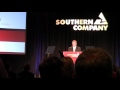
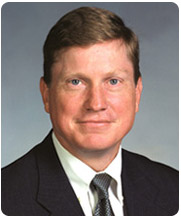
According to memory, Sam Booher congratulated Southern Company (SO) CEO Thomas A. Fanning on moving away from coal, and recommended big bold bets in solar power. Camera operator error prevented recording what Booher said. I did get video of CEO Fanning’s response, about shale and natural gas, plus Australia.

…the most reliable forms of energy. Today, with the revolution we have seen in the shale gas industry, that tends to be natural gas. And so what we are doing is we are transitioning away from coal towards natural gas. Combined with new environmental regulations that we will comply with.

Those would be the new environmental regulations about which SO Chief Operating Officer Anthony Topazi said last December:

“It’s physically impossible to build the controls, the generation, the transmission and the pipelines needed in three years.”

COO Topazi also projected:

“We will experience rolling blackouts or rationing power if we don’t have simply the time to comply.”

Since SO CEO Fanning didn’t say anything about rolling blackouts or rationing power, I guess SO managed to find a way to comply, just as other power companies said they could at the time. Maybe we shouldn’t pay too much attention to predictions of flickering power from SO.

Back to CEO Fanning:

From an energy standpoint, Southern Company is a little bit smaller, but similar to, the energy production profile of the nation of Australia. We are a great, big company from an energy production standpoint.

According to Forbes 18 March 2012, SO is the largest electric utility in the U.S. by retail sales and number 6 in the world. Back in 2006, Forbes ranked Germany’s E.ON number one in the world, and Japan’s TEPCO as number 6. What happened to E.ON and TEPCO? Continue reading

Exit strategy for when this big nuclear bet goes bad? –John S. Quarterman @ SO 2012-05-23

At Southern Company’s (SO) shareholder meeting, I enumerated some examples in the U.S., Japan, and Germany of nuclear gone bad, and pointed out Japan, Germany, and even Bulgaria had already or were getting out of nuclear, while Southern Company and Georgia continued to bet the farm on nuclear, and I asked what was SO’s exit strategy for when that bad bet goes bad? SO CEO Thomas A. Fanning said they had learned everything there was to learn from Fukushima, and besides Plant Vogtle is 100 miles inland where there are no earthquakes. He didn’t mention the same description applies to Chernobyl. He did say SO planned to make the U.S. nuclear industry the best in the world.

You kept using big bets and then bet the farm. Very interesting terminology.

Um, the title of SO’s corporate biography that SO was giving out in the lobby in paper, video, and audiobook formats is Big Bets: Decisions and Leaders That Shaped Southern Company. And ‘nuclear’s “bet-the-farm” risk’ is, as I mentioned, bond-rater Moody’s phrase.

He said the new Plant Vogtle units were planned for $14 billion and 10 years to build, and

…it is a big investment.

He said a company to do such a thing needed scale, financial integrity, and existing credibility of operations.

Scale seems to me a problem, since SO seems deadset on building mainframes in a networked-tablet world.

SO’s nuclear financial track record is that four nuclear plants were originally planend for Plant Vogtle at a cost of $660 million and only two were built at a cost of $8.87 billion. The new units at Plant Vogtle are already overbudget by almost a billion dollars. The Georgia Power bonds that SO CEO Fanning mentioned: aren’t they guaranteed by the $8.33 billion federal loan guarantee?

Regarding operations credibility, a year ago Vogtle Unit 1 shut down 2 days after the NRC gave Vogtle a clean bill of health. But the SO CEO says it’s all better now.

Here’s the video, followed by links to sources for the points I made:

Exit strategy for when this big nuclear bet goes bad? –John S. Quarterman
Shareholder Meeting, Southern Company (SO),
Callaway Gardens, Pine Mountain, Georgia, 23 May 2012.
Video by John S. Quarterman for Lowndes Area Knowledge Exchange (LAKE).

Here are the main points I was reading from, with links:

Continue reading

Salute for less coal; how about third-party solar? –Mark Woodall @ SO 2012-05-23

After saluting Southern Company (SO) for burning less coal, Mark Woodall said he was very disappointed to see Georgia Power fight so hard to prevent homeowners from using their own private property to generate and sell solar energy. He quoted SO CEO Thomas A. Fanning’s oft-repeated remark that Fanning is “bullish on solar”. Fanning proceeded to define “bullish” as pie in the sky bye and bye.

We remain very bullish on solar. When we think about renewables, I think renewables are exceedingly important to this nation’s future. My sense is until we see significant technology innovation, my sense is that that will probably very late in this decade or beyond that, we still are gonna get by far the lion’s share of electricity from central stations.

Then he said he was bullish on thin-film solar. Some time in the future or “one day” when Continue reading

Wind power and the Southern Company –Seth Gunning @ SO 2012-05-23

Seth Gunning from Atlanta spoke at the Southern Company (SO) meeting 23 May 2012 at Callaway Gardens; he was representing the Georgia Sierra Club with 97 shares. SO CEO Thomas A. Fanning graciously greeted him. Gunning brought up health effects of coal plants. Then he talked about two paths.

The way I see it, Southern Company sits at a crossroads. That one path Southern Company continues to drag its feet on the development of renewable energy economies in the southeast. The other path, Southern Company becomes a leader in creating jobs and economic development in clean energy in the south.

He thanked SO for recently partnering with Santee Cooper in the Palmetto Wind Project in South Carolina. It’s curious how there’s been no news whatever about that.

Then Gunning mentioned another wind project:

The state of Georgia is the only Atlantic state not currently working with the Department of Interior to streamline the permitting processes for offshore wind development.

He was referring to the Atlantic Offshore Wind Energy Consortium announced by DoI 8 June 2010. (Not to be confused with Google’s privately-funded Atlantic Wind Connection.) Gunning asked whether the Southern Company would advocate Continue reading

In Georgia, “competitive” is not for you!

Remember the Southern Company brags about “Our competitive generation business”. The important word there is “our”, as in the Southern Company and its subsidiary Georgia Power gets to compete, and you don’t. Unless you’re big enough.

According to the Georgia Public Service Commission:

Some retail competition has been present in Georgia since 1973 with the passage of the Georgia Territorial Electric Service Act. This Act enables customers with manufacturing or commercial loads of 900 kW or greater a one time choice in their electric supplier. It also provides eligible customers the opportunity to transfer from one electric supplier to another provided all parties agree.

This is apparently only one of twelve Georgia laws that impede a competitive solar power market. But this Territoriality Law alone might be enough of an impediment. Here’s a guide, and here’s the text of the Georgia Territorial Electric Service Act.

Because of that law, you can’t you put up solar panels on your own land and sell your power to somebody somewhere else. And you can’t get a company like SolarCity or Lower Rates for Customers to put up solar panels on your property and sell you the power ( or can you?). Unless you’re generating at least 900 KW; then maybe you can get selected businesses to switch to your power once. Except you probably still won’t qualify, because Continue reading

Shareholder Questions to Southern Company

Nuclear is our only emissionless technology, said Southern Company (SO) CEO Thomas A. Fanning. That would indicate that solar and wind have emissions. I assume he just mis-spoke in his otherwise masterful responses (often not answers) to shareholder questions.

Slides and sound for CEO Fanning’s main presentation are available on SO’s website. He indicated SO is unmatched in a combination of financial aspects, including dividends that have steadily increased year after year, and especially investment stability. He neglected to mention that much of those dividends are made possible by Georgia Power’s guaranteed profit margins. He did find time to oppose big government regulation, which is ironic, since Southern Company is a big beneficiary of Georgia’s numerous regulations benefitting Georgia Power. He also bragged about the Georgia legislature passing the “Energy Rate Increases to Finance Nuclear Power Plant Construction”.

During the Q&A session, I congratulated CEO Fanning on his 62% compensation raise last year, and noted that Georgia Power customers also got a raise, Continue reading

“Industrial”: Positive or Negative? Videos @ VLCIA 2012-04-17

Market study advisory panel forming up! Chairman Roy Copeland asked whether “Industrial” in VLCIA’s name is positive or negative for PR? Executive Director Andrea Schruijer made sure to announce a date change for a board meeting a month in advance. All that and much more!

Here are videos of the entire 17 April 2012 regular meeting of the Valdosta-Lowndes County Industrial Authority (VLCIA). Here’s the agenda.

VLCIA Executive Director Andrea Schruijer said they had shown contractor Market Street Services the area so they could go back and start working up data for a market study. In May an advisory panel of 10-13 individuals plus focus groups will meet with Market Street.

They went to the Industrial Asset Management Council (IAMC) spring forum in Austin, Texas, and they moved their May meeting a week later than usual.

New PR and Marketing person S. Meghan Duke gave an update on her area. Chairman Roy Copeland flustered her by asking whether the word “industrial” in VLCIA’s name reflected positively or negatively? She fell back on saying they were doing a survey towards a unique identity.

I’ll answer: as long as VLCIA includes as “industry” boondoggles like a health-threatening biomass plant and a job-destroying private prison, why yes, “industrial” reflects negatively on VLCIA. But a mere name change through a D.B.A. won’t fix that problem. Only a change in behavior will fix that problem. Changes such as doing some due diligence so they know when a private prison company is playing them along by saying they’re the primary site. Changes such as weighing the community’s health when considering potential jobs. And especially changes such as listening to people outside the VLCIA and Chamber bubble when others do useful and important research. The community can be an asset for VLCIA, providing research and contacts VLCIA either does not have the resources to do or might not think of to do, if VLCIA will listen to the community.

There’s more in the videos. Gretchen took these videos, as Chairman Roy Copeland welcomed guests, “even those with cameras.” Here’s a video playlist:

Videos
Regular Meeting, Valdosta-Lowndes County Industrial Authority (VLCIA),
Norman Bennett, Tom Call, Roy Copeland chairman, Mary Gooding, Jerry Jennett,
Tom Davis CPA, Allan Ricketts Project Manager,
S. Meghan Duke Public Relations & Marketing Manager, Lu Williams Operations Manager,
Valdosta, Lowndes County, Georgia, 17 April 2012.
Videos by Gretchen Quarterman for Lowndes Area Knowledge Exchange (LAKE).

-jsq

Videos @ GLPC 2012-02-27

Here are videos of the entire February meeting of the Greater Lowndes Planning Commission (GLPC). I would post their agenda, but they didn’t publish one.

They elect new officers annually. The previous chairman, Tommy Willis, handed over to the new chairman, Bill Slaughter. The recognized outgoing members John Bailey from Hahira and W.G. Walker from Dasher and former chairman Tommy Willis and introduced Ryan Warren as the new member from Dasher. (Who’s the new member from Hahira?)

See these two items previously posted:

Here’s a video playlist:

Regular Session, Greater Lowndes Planning Commission (GLPC),
Valdosta, Lowndes County, Georgia, 27 February 2012.
Videos by Gretchen Quarterman for Lowndes Area Knowledge Exchange (LAKE).

-jsq

Conservation at Lake Alapaha: REZ-2012-02 Dinkins @ GLPC 2012-02-27

How did conservation zoning get put on part of Robert Dinkins’ property at Lake Alapaha? County records conflict on that point. Was it important to keep that conservation zoning? Staff thought so, but the Planning Commission thought otherwise, and the Lowndes County Commission decided to agree.

The second county case in the 27 February 2012 Greater Lowndes Planning Commission (GLPC) meeting was REZ-2012-02 Dinkins, Southern Shore, 0264 007 A&B, ~97 ac., R-21 & CON to R-A, well/septic. They spent 8 1/2 minutes on it, mainly listening to the requester, Robert Dinkins, wonder how any part of the subject property was zoned for conservation. Staff recommended the conservation zoning remain. GLPC voted to recommend removing it.

REZ-2012-02 got 2:37 12 March 2012 Work Session of the Lowndes County Commission and 6:49 in its 13 March 2012 Regular Session. The County Commission voted to remove the conservation zoning. Here’s a previous post with more detail about that.

Here’s a video playlist of this rezoning item in all three meetings (GLPC, LCC Work Session, and LCC Regular Session):

Conservation at Lake Alapaha: REZ-2012-02 Dinkins
Regular Session, Greater Lowndes Planning Commission (GLPC), Valdosta, Lowndes County, Georgia, 27 February 2012.
Work Session, Lowndes County Commission (LCC), Valdosta, Lowndes County, Georgia, 12 March 2012.
Regular Session, Lowndes County Commission (LCC), Valdosta, Lowndes County, Georgia, 13 March 2012.
Videos by Gretchen Quarterman for Lowndes Area Knowledge Exchange (LAKE).

-jsq

Width, houses, and inheritance: REZ-2012-01 Whitehead/Black @ GLPC 2012-02-27

Housing, driveway width and possible change to the ULDC, conveyance to relatives, number of housing units, and other issues: the Planning Commission discussed all these and recommended a rezoning with a few conditions (limit of 2 houses). The County Commission zipped through making a decision.

The first county case in the 27 February 2012 Greater Lowndes Planning Commission (GLPC) meeting was REZ-2012-01 Whitehead/Black, 218-82 & 82A, ~7.1 ac., 2 lots, E-A/R-A to R-A, well/septic. They spent more than 27 minutes (1:09 + 3:54 + 6:02 + 1:21 + 1:40 + 2:56 + 2:56 + 0:59 + 6:16) on REZ-2012-01.

Compare that to the 5 minutes in the 12 March 2012 Work Session of the Lowndes County Commission and approximately 5 minutes in the 13 March 2012 Regular Session as the Lowndes County Commission approved the rezoning with the limitation on only 2 houses.

Time isn’t everything, and staff did visit the site and clarify some points and Commissioners did ask a few questions in the Work Session, but the Planning Commission spent much more time examining this case.

Here’s a video playlist of REZ-2012-02 in all three meetings (GLPC, LCC Work Session, and LCC Regular Session):

Width, houses, and inheritance: REZ-2012-01 Whitehead/Black
Regular Session, Greater Lowndes Planning Commission (GLPC), Valdosta, Lowndes County, Georgia, 27 February 2012.
Work Session, Lowndes County Commission (LCC), Valdosta, Lowndes County, Georgia, 12 March 2012.
Regular Session, Lowndes County Commission (LCC), Valdosta, Lowndes County, Georgia, 13 March 2012.
Videos by Gretchen Quarterman for Lowndes Area Knowledge Exchange (LAKE).

-jsq