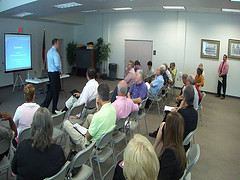
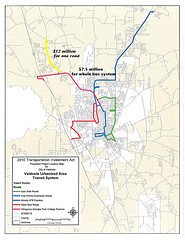
Not a special Local tax: it's a Regional tax –Nolen Cox T-SPLOST Public Meeting, Southern Georgia Regional Commission (SGRC), Corey Hull, Valdosta, Lowndes County, Georgia, 19 September 2011. Video by Gretchen Quarterman for Lowndes Area Knowledge Exchange (LAKE).
Virtually all empirical evidence for decades indicates that climate disruption, related ocean acidification, sea rise and global warming are not only happening, but consistently occurring at the highest range of modeled projections. Events which were projected within 100 years twenty years ago, and within 50 years 10 years ago, are happening now. Instead of fighting a delaying, rear-guard action against big, dynamic change in energy production, wouldn’t it be better for our company to set the standard for transformation? It seems we have the most to lose, and, therefore, the most to gain.
Unless there is some unexpected reversal in the climate change trends which have been occurring for decades, it seems inevitable that National Renewable Energy Portfolio Standards (RPS) will be legislated well before the end of this decade. Moody’s cited this likelihood in their recent credit downgrade of Southern Company. Since it seems highly unlikely that biomass and nuclear will be considered renewable energy sources under a RPS, where will Southern Company acquire mandated renewable energy — perhaps 20% or more of the total mix by 2020? And will the PSC allow us to load our full profits to rates for this energy on top of the big profits to the probable merchant suppliers, such as West Texas Wind?
I have heard reports that Santee Cooper in South Carolina and
Duke Energy in North Carolina are exploring the possibility of a joint venture to develop off-shore wind. Wouldn’t it be advantageous to ally with them in a joint venture? The Carolinas have a very long coast and very good wind resources, and a combined effort could reduce risk for all of us and significantly increase our combined political leverage. If we do not create some credible Georgia renewable energy resource, isn’t it possible that we will be forced to buy wind power from the Carolinas at an exorbitant rate within the next decade?
Between the likelihood of carbon pricing and a National Renewable Energy Standard, it seems almost certain that Southern Company’s extreme reliance on coal fired power generation will be significantly reduced, voluntarily or by fiat, this decade. Nuclear seems more unlikely and expensive a salvation than ever. Isn’t it time we changed course and embraced proven and rapidly improving solar and wind technology before we are forced into them by National mandate?
According to the information on your climate change Web site, Southern Company supports the target of an 80% reduction in carbon emissions by 2050. Can you tell us the approximate mix of nuclear, renewables, and efficiency that you envision to reach that goal?
The world’s worst nuclear disaster at Fukushima in Japan has had
economic effects on nuclear-owning power utilities.
What will happen to the Southern Company
as Georgia Power customers and U.S. taxpayers
get tired of paying for cost overruns
which are already almost a billion dollars?
The German government decided to abandon nuclear power after the
Fukushima nuclear disaster last year, closing eight plants
immediately and shutting down the remaining nine by 2022.
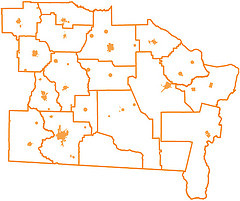
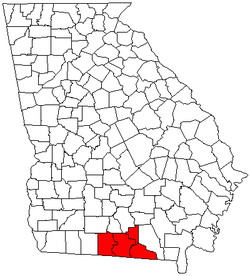
T-SPLOST regions are an intermediate level of government in which all the people in the region vote together, not by counties.
Gretchen Quarterman asked:
When the 18 counties vote, is it county by county, say Atkinson votes yes, and Lowndes votes no, and if there were 9 counties that voted yes and 9 counties that voted no, or is it the total of all the voters together, and then we say there were 400,000 voters and it’s a simple majority.
Corey Hull answered:
It’s a simple majority. It’s the latter of how you described it, it’s all the voters together.
How do we vote on T-SPLOST? T-SPLOST Public Meeting, Southern Georgia Regional Commission (SGRC), Corey Hull, Nolen Cox, Gretchen Quarterman, Valdosta, Lowndes County, Georgia, 19 September 2011. Video by Gretchen Quarterman for Lowndes Area Knowledge Exchange (LAKE).
The Vogtle $913 million cost overrun by itself could have paid for
approximately 1,000 megawatts of natural gas generation; 450 megawatts
of wind power; and 330 megawatts of solar power.
That’s not 20 gigawatts.
But the population of Germany is about 81 million,
while the population of Georgia is about 9.8 million people,
so the Georgia equivalent of 20 gigawatts would be about 2.4 gigawatts.
The federal government has guaranteed about $8.3 billion in loans
related to Plant Vogtle.
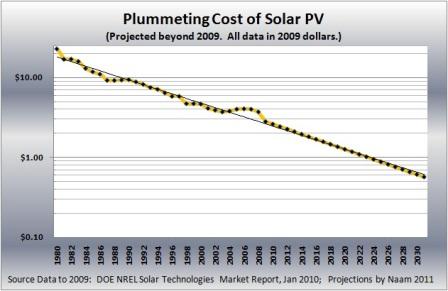
That $8.3 billion would pay for about 3 gigawatts of solar power.
That
big dish at Plant Vogtle?
That’s not just a nuclear containment vessel,
it’s a solar prevention wall.
Preventing jobs, energy independence, and profit through solar power in Georgia.
Plant Vogtle is why Georgia is not a leader in solar power today.
Lowndes County would be a T-SPLOST donor county: it would put more money into T-SPLOST than it would get back for projects.
Somebody (I think it was Robert Yost) asked whether Lowndes County would be a donor county for T-SPLOST. Corey Hull said yes, that was the case. Someone else noted:
Atkinson County that’s been coming over here spending our money all these years, gets a little of it back.
And the smaller counties get penalized a lot more if they vote against T-SPLOST, because they depend much more on LMIG.
So T-SPLOST among other downsides is a scheme to pit smaller counties against larger ones in the T-SPLOST region.
Lowndes County donor county T-SPLOST Public Meeting, Southern Georgia Regional Commission (SGRC), Corey Hull, Nolen Cox, Gretchen Quarterman, Valdosta, Lowndes County, Georgia, 19 September 2011. Video by Gretchen Quarterman for Lowndes Area Knowledge Exchange (LAKE).
German solar power plants produced a world record 22 gigawatts of electricity per hour—equal to 20 nuclear power stations at full capacity—through the midday hours on Friday and Saturday, the head of a renewable energy think tank said….
Norbert Allnoch, director of the Institute of the Renewable Energy Industry (IWR) in Muenster, said the 22 gigawatts of solar power per hour fed into the national grid on Saturday met nearly 50 percent of the nation's midday electricity needs….
The record-breaking amount of solar power shows one of the world's leading industrial nations was able to meet a third of its electricity needs on a work day, Friday, and nearly half on Saturday when factories and offices were closed.
Berlin is at more than 52 degrees north latitude. Even southern German city Munich is at 48 degrees north. That's a thousand miles north of where we sit here in south Georgia at 31 degrees north.
Germany has sun like Alaska, while Georgia has sun like the south of Spain.
"Never before anywhere has a country produced as much photovoltaic electricity," Allnoch told Reuters. "Germany came close to the 20 gigawatt (GW) mark a few times in recent weeks. But this was the first time we made it over."
A city of Cumming audio-visual recording policy sheet was available outside council chambers.
“Handheld audio and/or visual recording devices may be used from any location within the public seating area,” wrote Gerald Blackburn, city administrator. “No audio and/or visual recording device may be set up in the aisles.”
In a statement, Wal-Mart representative Maggie Sans wrote, “Previously, we expressed our concerns about ALEC’s decision to weigh in on issues that stray from its core mission ‘to advance the Jeffersonian principles of free markets…We feel that the divide between these activities and our purpose as a business has become too wide. To that end, we are suspending our membership in ALEC.”
Wal-Mart claimed that ALEC was no longer as interested in Jeffersonian free market principles as they were other partisan political issues. Two of those unnamed political issues are most certainly voter ID and stand your ground laws.
When even Wal-Mart complains that ALEC isn’t “free market” enough, Wal-Mart, which
Continue reading →