Tag Archives: Georgia

Industrial Authority next Tuesday @ VLCIA 2012-05-22

VLCIA has announced a meeting date change (to next Tuesday) in multiple places, and has already posted an agenda!

According to their facebook site and meetings webpage:

Notice: The Valdosta-Lowndes County Industrial Authority Regular Meeting has been rescheduled for the month of May. The meeting date will be Tuesday, May 22, 2011, 5:30 P.M. in the Industrial Authority Conference Room.

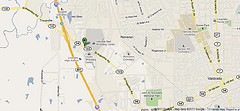
That’s at 2110 N. Patterson Street, Valdosta, GA.

Their facebook page has a new logo on it (shown on the right above). Also this snazzy cover image:

Both the new logo and the cover image are legible (unlike their old swoosh logo, still on their website, and seen to the right here). And the cover image has useful information, like what VLCIA is about and how to reach them!

However, I note that of those

3 THINGS TO KNOW ABOUT VALDOSTA BUSINESS
  1. Major Transportation Network
  2. Competitive Incentives
  3. Pro-Business Attitude

none of them is clean solar energy or fast Internet access. (Also, why are they SHOUTING?)

Here’s the agenda, which is back to their old content-free style. They don’t even say what the executive session is for. (Is it legal for them not to say?)

-jsq

Valdosta-Lowndes County Industrial Authority
Agenda
Tuesday, May 22, 2012 5:30 p.m.
Industrial Authority Conference Room
2110 N. Patterson Street
Continue reading

Powering North Carolina with wind, sun, and water

Here's some hard evidence of FERC Chairman Jon Wellinghoff's assertion back in 2009 that baseload is outdated, we don't need any new nukes or coal, because we can get all the new power we need from sun and wind. This study from North Carolina goes further: we don't need coal or nukes at all.

John Blackburn, Ph.D. wrote a report March 2010, Matching Utility Loads with Solar and Wind Power in North Carolina: Dealing with Intermittent Electricity Sources,

Takoma Park, Maryland, and Durham, North Carolina, March 4, 2010: Solar and wind power can supply the vast majority of North Carolina's electricity needs, according to a major report released today. Combined with generation from hydroelectric and other renewable sources, such as landfill gas, only six percent of electricity would have to be purchased from outside the system or produced at conventional plants.

Hourly Power Generation and Load for a sample day in July

"Even though the wind does not blow nor the sun shine all the time, careful management, readily available storage and other renewable sources, can produce nearly all the electricity North Carolinians consume," explained Dr. John Blackburn, the study's author. Dr. Blackburn is Professor Emeritus of Economics and former Chancellor at Duke University.

"Critics of renewable power point out that solar and wind sources are intermittent," Dr. Blackburn continued. "The truth is that solar and wind are complementary in North Carolina. Wind speeds are usually higher at night than in the daytime. They also blow faster in winter than summer. Solar generation, on the other hand, takes place in the daytime. Sunlight is only half as strong in winter as in summertime. Drawing wind power from different areas — the coast, mountains, the sounds or the ocean — reduces variations in generation. Using wind and solar in tandem is even more reliable. Together, they can generate three-fourths of the state's electricity. When hydroelectric and other renewable sources are added, the gap to be filled is surprisingly small. Only six percent of North Carolina's electricity would have to come from conventional power plants or from other systems."

Six percent is a small number. That means most coal plants could be shut down, and no nukes are needed.

Continue reading

Hospital Authority unaudited finances

If the hospital authority had a web site, I suppose this is the type of information that could be provided to the public so that they could know about the operations and financial health of the institution.

-gretchen

On South Georgia Medical Center letterhead 8 May 2012, CERTIFICATE OF CHIEF FINANCIAL OFFICER

I, Greg S. Hembree, the Chief Financial Officer of the Hospital Authority of Valdosta and Lowndes County, Georgia D/B/A South Georgia Medical Center, have reviewed the attached unaudited balance sheet, unaudited statement of revenues and expenses, and unaudited statement of cash flows for the six month period ending March 31, 2012, and to the best of my knowledge the statements present fairly the financial position, results of operations, and cash flows of the Authority.

Continue reading

Cook County schools furloughing teachers

Cook county schools have a budget shortfall problem, and they think they can solve it only by furloughing teachers. Remind me again why we're wasting $1 billion a year on prisons, including private prisons for the profit of private prison shareholders and executives (like CCA CEO Damon Hininger's $3 million a year) and we're furloughing teachers instead?

Greg Gullberg wrote for WCTV 10 May 2012, Teachers in Cook County Face Furloughs,

The Cook County School System is facing a $472,352 deficit. Superintendent Lance Heard tells Eyewitness News reporter Greg Gullberg that the only way out may be to initiate system-wide furlough days and cutting jobs.

"We've done everything we can to maintain the level of education for the students that we've always had and we think we've been able to do that," said Superintendent Heard.

Nothing is set in stone yet, but 488 teachers, staff and administrators, may be facing furlough days next school year. Superintendent Heard hopes to limit them to three to five per employee.

"I would like to say also that when we do take furlough days, they are always none instructional days. The students do not miss any school," said Superintendent Heard.

Yet. Keep on in this direction and the students will be missing school. As it is, they just get less-prepared teachers, for less-effective teaching. But this is not Supt. Heard's fault.

Do we in Georgia want to prepare students for jail, or to succeed in life? Prisons cost we the taxpayers lots of money. Successful young people help pay for everything. Maybe we should choose successful young people, starting with education.

-jsq

Map of Azalea City Trail: path of Saturday afternoon’s bike ride

Here’s a map of the Azalea City Trail, which is the path of (Saturday 12 May 2012) sponsored by Valdosta Bike Co-op.

Oddly, the City of Valdosta doesn’t seem to have such a map anywhere on its web pages, nor does the Valdosta-Lowndes County Parks and Recreation Authority (VLPRA).

-jsq

VHS Jazz Band @ Brown Bag Lunch Concert Series 2012-05-07

Gretchen went to Tuesday's Brown Bag Lunch and saw a lot of happy lunchers listening to the VHS Jazz Ensemble.

Here's a video playlist:

VHS Jazz Band @ Brown Bag Lunch Concert Series, Valdosta, Lowndes County, Georgia, 7 May 2012.
Videos by Gretchen Quarterman for Lowndes Area Knowledge Exchange (LAKE).

-jsq

FERC and energy demand response

Beyond a smart grid to mix and match the supply solar and wind to get rid of any need for new coal or nuclear plants, as FERC Chairman Jon Wellinghoff recommended three years ago, FERC also has plans to mix and match demand. Energy customers can volunteer to shut off their air conditioners or clothes dryers automatically if there’s not enough supply. This could facilitate adding solar power, by basically acknowledging that it may not always supply a fixed capacity.

Todd Griset wrote for law firm PretiFlaherty 23 April 2012, FERC seeks demand response standards,

Demand response, an innovative strategy to ensuring the integrity of electric grids, is growing in popularity, prompting federal regulators to consider standardizing how demand response performance is measured.

Managing an electric grid entails ensuring a constant balance between electric generation and customer demand for electricity. As customer demand rises, grid operators have traditionally called on more and more generating units. In most markets, grid operators dispatch the lowest-cost units first to keep overall costs down. As a result, generating units needed to meet peak demand tend to be more expensive than baseload generation. Many peaking units also emit more pollutants per unit of energy than baseload units.

In a demand response program, customers can volunteer to be available to reduce their load during times of peak demand. When done right, this reduction in customer demand can play much the same role as dispatching additional generation, but at a lower cost in dollars and environmental impacts. Energy efficiency resources can also play a similar role.

The U.S. Congress and the Federal Energy Regulatory Commission have both recognized that demand response can be a decentralized, crowd-sourced alternative to peaking power plants. Utilities and regional transmission organizations across the nation are implementing demand response programs.

Across the nation…. How about it, Georgia Power, and Georgia EMCs? How are your demand response programs coming?

-jsq

FERC Chairman: baseload outdated; no new nukes needed; go sun and wind

Power companies’ main stated objection to solar or wind is that they are not “capacity” or “baseload” generation because sometimes the sun does not shine and the wind does not blow. And those utilities are required by various state, regional Energy Regulatory Commissions right up to the Federal Energy Regulatory Commission (FERC) to supply capacity or baseload power. That’s their main excuse for coal and nuclear plants. Well, the Chairman of FERC thinks we may not need baseload, nor any new coal nor nuclear plants, either.

Noelle Straub and Peter Behr wrote for ScientificAmerican 22 April 2009, Will the U.S. Ever Need to Build Another Coal or Nuclear Power Plant? The new chairman of the Federal Energy Regulatory Commission doesn’t think so

No new nuclear or coal plants may ever be needed in the United States, the chairman of the Federal Energy Regulatory Commission said today.

“We may not need any, ever,” Jon Wellinghoff told reporters at a U.S. Energy Association forum.

So what will we need?

Continue reading

Videos @ LCC 2012 05 07

Here are videos of the entire approximately eight minute 7 May 2012 Work Session of the Lowndes County Commission. They vote in Regular Session tonight at 5:30PM. Here’s the agenda.

See other post about “5. Appointments – Lowndes County Development Authority”.

Two weeks ago they decided to hold a public hearing about abandoning part of the Right of Way of old US 41 South, but this time it’s on the agenda as a Resolution, and it appears part of the request has been withdrawn, and some people would be left landlocked with no access to a public road, so it seems the Resolution will be to table at least part of it to an undetermined future date. Yet the County Engineer seemed to reccomend going ahead with the rest of the abandonment. Where’s the public hearing?

Two rezonings had no comments. The third, just north of Hahira, got opposition at the Planning Commission; see the other post on that.

A developer wants, according to County Planner Jason Davenport, a letter from the Commission so it can more readily get tax credits from the federal government. He didn’t say what the tax credits would be for. For a concrete front yard? Or for solar on the roof? It will be interesting to see how the anti-grant Commissioners vote on this one, when it’s a developer who benefits.

It sounds like the county wants to award a contract to Continue reading

Rezoning density outside of Hahira @ LCC 2012 05 07

Two rezonings had no comments. The third, just north of Hahira, got opposition at the Planning Commission, which recommended a qualification, which County Planner Jason Davenport interpreted as trying to limit the density of development of the property.

At the Lowndes County Commission at its 7 May 2012 Work Session during the discussion on

7.c. REZ-2012-07 McNeal Property, McNeal Road E-A to R-A, Well & Septic, 25 acres

Crawford Powell, Commissioner for District 3, which is the south end of the county, asked a question, while Richard Raines, Commissioner for District 2, which is the north end of the county including Hahira, sat silent, although he did nod his head.

A neighbor sent a letter with details of opposition. I wonder what’s in it? If you want to know, you can submit an open records request to the county. Of course, with the three day time limit for the county to respond, the Commission will have already voted on it this evening before you find out what’s in the letter.

Here’s the video:

Rezoning density outside of Hahira
Work Session, Lowndes County Commission (LCC),
Valdosta, Lowndes County, Georgia, 7 May 2012.
Video by Gretchen Quarterman for Lowndes Area Knowledge Exchange (LAKE).

-jsq