Category Archives: Economy

Camera 2: Dr. Mark George about CUEE @ LCDP 2 May 2011

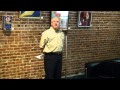
We have complaints that some people couldn’t understand what Dr. Mark George was saying in the previous post of his remarks at Monday’s Lowndes County Democratic Party meeting, so here’s another version from a different camera. Feedback, please.

He said the Chamber of Commerce said schools were not its issue. Dr. George pointed out that it was the Chamber and the real estate industry that largely produced the current situation by funelling people to the county schools.

He said the unification project started with a request from the Industrial Authority, who said it didn’t look good when potential industry saw there was a black school system and a white school system. (The timing of this is interesting, because it comes after Brad Lofton was hired as VLCIA Executive Director, and other people formerly associated with VLCIA say they were never asked by any potential industry how many school systems we have.)

Dr. George discussed many other interesting points, such as CUEE’s terminology drift from consolidation to integration to unification.

Here’s Part 1 of 2:


Camera 2: Dr. Mark George about CUEE @ LCDP 2 May 2011 Part 1 of 2:
Debate between proponents of school system unification (CUEE) and opponents,
at Lowndes County Democratic Party (LCDP), Gretchen Quarterman chair,
Videos by George Rhynes, Jim Parker, John S. Quarterman, and Gretchen Quarterman
for LAKE, the Lowndes Area Knowledge Exchange, Valdosta, Lowndes County, Georgia, 2 May 2011.

In this second video from camera 2, Dr. George noted that the Valdosta school system is internally segregated.

He said both he and Rev. Rose asked to have somebody put on the CUEE council, and that that didn’t happen.

There’s more; you can watch it for yourself. Here’s Part 2 of 2:


Camera 2: Dr. Mark George about CUEE @ LCDP 2 May 2011 Part 2 of 2:
Debate between proponents of school system unification (CUEE) and opponents,
at Lowndes County Democratic Party (LCDP), Gretchen Quarterman chair,
Videos by George Rhynes, Jim Parker, John S. Quarterman, and Gretchen Quarterman
for LAKE, the Lowndes Area Knowledge Exchange, Valdosta, Lowndes County, Georgia, 2 May 2011.

-jsq

Local businesses help the local economy

Here’s a long list of studies that show that:
Independent businesses have been found to generate between 60% and 300% more local economic activity that chain retail stores do.
Somebody remind me why VLCIA’s main efforts are on bringing in big chains?

Or why people are so fascinated with Olive Garden, for that matter?

Well, I suppose if you want lower wages, big box retailers are good for that.

Hm, so the ultimate big box would be a private prison: a literally captive audience paid for by captive tax dollars and hirable at the lowest possible wages.

-jsq

A real national strategy —Jim Dwyer

What say we make a real national security strategy, one based on energy independence and a sustainable economy?

Jim Dwyer write 3 May 2011 in the NY Times, A National Security Strategy That Doesn’t Focus on Threats

“Poorly fitted air conditioners cost New York City 130 to 180 million dollars a year in extra energy consumption,” one of the strategists, Capt. Wayne Porter of the Navy, said Tuesday. “They generate 370,525 extra tons of carbon dioxide.”

Suppose, he says, you fixed them. And then you got the 40 states that waste the most electricity to match the 10 most efficient. The likely benefits are no surprise — less foreign oil, cost savings, job creation, decreased pollution.

Now follow that thread to “A National Strategic Narrative,” a paper written by Captain Porter and Col. Mark Mykleby of the Marines, which calls on the United States to see that it cannot continue to engage the world primarily with military force, but must do so as a nation powered by the strength of its educational system, social policies, international development and diplomacy, and its commitment to sustainable practices in energy and agriculture.

“We must recognize that security means more than defense,” they write. After ending the 20th century as the world’s most powerful country, “we failed to recognize that dominance, like fossil fuel, is not a sustainable form of energy.”

An army without an economy defends nothing. Continue reading

Privatizing water —GA SB 122

Privatizing prisons is not enough; now Georgia wants to privatize water.

Aaron Gould Sheinin wrote in the AJC Monday 2 May 2011, Deal signs bill allowing public-private reservoirs

Partnerships between public authorities and private enterprise to build new reservoirs are now legal in Georgia under legislation Gov. Nathan Deal signed into law Monday.

Senate Bill 122 “is particularly useful at times such as these when budget cutbacks hinder our ability to invest in new infrastructure,” Deal said at a Georgia Chamber of Commerce luncheon in his honor. “This stretches public dollars by attracting partners to move forward with public works projects that will benefit the citizens of the state for generations.”

Lawmakers approved $46 million in bond money in the state budget that takes effect July 1 to help facilitate the construction of new reservoirs. Deal said he hopes to increase that to $300 million over the next several years.

“Increasing our water supply in terms of holding that supply is critical for meeting our future needs,” Deal said.

Yes, but trumping up a fake budget crisis by giving tax breaks to people who don’t need them and then using it to privatize public infrastructure for corporate profit at taxpayer expense is not the way to do it.

Wait, it gets even better: Continue reading

Dr. Mark George speaks against CUEE @ LCDP 2 May 2011

Update: See other post for videos from another camera with better sound.

Dr. Mark George pointed out that school consolidation didn’t solve some problems last time:

In 2011 our schools were more segregated racially than they were in 1968.
He questioned why people should believe that consolidation, even if called unification, would solve those same problems this time.

Continuing the debate between proponents and opponents of unification of the Valdosta and Lowndes County School Systems, organized by Gretchen Quarterman, chair of the The Lowndes County Democratic Party (LCDP). Here, speaking against, is Dr. Mark George.

Here’s Part 1 of 3: Continue reading

Rev. George Bennett speaks for CUEE @ LCDP 2 May 2011

Rev. George Bennett stated what he believes:
I’m on the CUEE board because I believe a unified school system can better serve children of our community, and particularly children in the city of Valdosta.

Gretchen Quarterman, chair of the The Lowndes County Democratic Party (LCDP), organized a debate between proponents and opponents of unification of the Valdosta and Lowndes County School Systems. Here, speaking for, is Dr. George Bennett, on the board of Community Unification for Educational Excellence (CUEE).

In the first video, Dr. Bennett talks about his history with the Valdosta schools. Here’s Part 1 of 3: Continue reading

Where was CUEE? —George Boston Rhynes

George Rhynes commented on Jon Parris’s comment. -jsq
I will be brief!

Where was CUEE and the people working to bring the two school systems together when local citizens were fighting for change, and seeking answers to the Hiring of Black Educators and the Federal Court Order being complied with that was filed decades ago? Where were they then?

And why can’t we find certain people in our community until the blind god seems to direct them from their hiding place from beneath the clay!

I have not seen these professionals take on

Continue reading

CCA profits from California private prisons

John Howard wrote in Capitol Weekly 28 January 2010, Private prison company finds gold in California:
In three years, a private-prison construction and management company, the Corrections Corporation of America, has seen the value of its contracts with the state soar from nearly $23 million in 2006 to about $700 million three months ago – all without competitive bidding. Even in a state accustomed to high-dollar contracts, the 31-fold increase over three years is dramatic.

During the same period, the company’s campaign donations rose exponentially, from $36,750 in 2006, of which $25,000 went to the state Republican Party, to $233,500 in 2007-08 and nearly $139,000 in 2009. The donations have gone to Democrats, Republicans and ballot measures. The company’s largest single contribution, $100,000, went to an unsuccessful budget-reform package pushed last year by Gov. Schwarzenegger.

CCA contributed to cutting funding for other services while getting more contracts for itself. Is that what we want in Georgia? Cut education funding while paying private prison companies? Is that what we want in Lowndes County?
Costs vary, but CCA receives about $63 per day per inmate, or about $23,000 annually.
That would pay for a lot of rehabilitation and education. How about we do that instead?

-jsq

Will school unification improve education? —CUEE

The real answer is in the first sentence after A: in this FAQ by CUEE:
Q: HOW WILL UNIFICATION OF OUR SCHOOL SYSTEMS IMPROVE EDUCATION?
A: School unification, by itself, will not improve the quality of education for our children.
Unfortunately, CUEE didn’t stop there. Their FAQ continues: Continue reading

Texas still susceptible to private prison boondoggle

Even though Texas has cancelled some prisons and closed at least one private prison, private prison companies continue to push to privatize Texas prison services.

Mike Ward wrote 30 April in the Austin American-Statesman, Lawmakers chafe as push continues to privatize prison health care

“There is a push on to change the system we have, a system that is cost-effective and is a national model, even before we know whether there will be any real savings,” said House Corrections Committee Chairman Jerry Madden, R-Richardson .

“I think it’s something we should look at, to see what the real facts are, but I don’t think we should be rushing to a decision right now about this,” Madden said. “Most of the Legislature, I believe, think(s) that a decision this big — whether the system should be privatized — is one that we should make, not some board or agency.”

The American-Statesman first reported the privatization efforts in March and that top aides to Gov. Rick Perry have been involved in some of the meetings with vendors and lobbyists.

More from the article: Continue reading