d. Consideration of an Ordinance to rezone 0.75 acres from
Single-Family Residential (R10) to Single-Family Residential
(R-6) as requested by Martha Rock, represented by Ken Garren
(File No. VA-2011-07). The property is located at 1 Brookwood
Circle. The Planning Commission did not review this request at
their March Regular Meeting because the case had been
withdrawn.
e.
Consideration of an Ordinance for a Conditional Use Permit for
a townhouse (SingleFamily Attached) development in a
Single-Family Residential (R-6) Zoning District as requested
by Martha Rock, represented by Ken Garren (File No.
CU-2011-02). The property is located at 1 Brookwood Circle.
The Planning Commission did not review this request at their
March Regular Meeting because the case had been withdrawn.
f. Consideration of a request to change the name of a portion of
Jackson Street Lane to Bivins Lane.
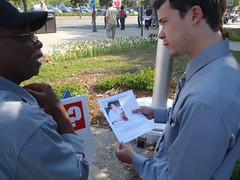
I’m pretty sure this is the picture Robert Hall showed the Valdosta City Council.
He was showing it to VDT reporter David Rodock outside before the meeting.
It’s not a pretty picture, which I think was part of his point.
He said he was also exposed to dioxin in Vietnam, and continues
to suffer several medical consequences.
Robert Hall on consequences of Dioxin @ VCC 7 April 2011
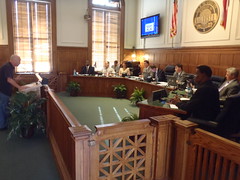
Regular monthly meeting of the Valdosta City Council (VCC),
Valdosta, Lowndes County, Georgia, 7 April 2011,
Videos by Gretchen Quarterman for LAKE, the Lowndes Area Knowledge Exchange.
5.c) Consideration of an Ordinance for Text Amendments to the Land Development
Regulations (LDR) for Section 106-1(C), Definitions, and Section 218-13 (TTT)
Temporary Use – Commercial Retail as requested by the City of Valdosta (File No. VA2011-04). The Planning Commission reviewed this request at their March Regular
Meeting and recommended approval (8-0 vote).
5.c) LDR changes @ VCC 7 April 2011 Part 1 of 2
Regular monthly meeting of the Valdosta City Council (VCC),
Valdosta, Lowndes County, Georgia, 7 April 2011,
Videos by Gretchen Quarterman for LAKE, the Lowndes Area Knowledge Exchange.
The mayor prefaced a comment that he’s read (apparently in this blog)
that he’s been criticized for not paying attention while people are speaking.
He clarified that he’s often taking notes.
Then Dr. Mark P. George spoke, wondering when people would get answers
to their more substantive questions.
I have an attorney.
These folks have an attorney.
He’s sitting right there.
Dr. Mark P. George @ VCC 7 April 2011 Part 1 of 3:
Regular monthly meeting of the Valdosta City Council (VCC),
Valdosta, Lowndes County, Georgia, 7 April 2011,
Videos by Gretchen Quarterman for LAKE, the Lowndes Area Knowledge Exchange.
Dr. George amplified the not paying attention comments
by adding in body language,
and saying he did appreciate taking notes.
He asked if the meeting is recorded.
Mayor Fretti answered yes.
Dr. George remarked:
It seems to me you are now cloaking the lack of response
in legalities.
…
Legality does not equal morality.
Council Sonny Vickers remarked that he
already told everyone he is for the biomass plant.
Dr. George recommended conversation,
following up on new information.
The mayor asked Dr. George to wrap up.
Dr. George responded:
Dr. Mark P. George @ VCC 7 April 2011 Part 2 of 3:
Regular monthly meeting of the Valdosta City Council (VCC),
Valdosta, Lowndes County, Georgia, 7 April 2011,
Videos by Gretchen Quarterman for LAKE, the Lowndes Area Knowledge Exchange.
More back and forth between Dr. George and the mayor
about how or whether or when he or somebody might answer
questions, followed by interchange between Dr. George
and the audience.
Dr. Mark P. George @ VCC 7 April 2011
Part 3 of 3:
Regular monthly meeting of the Valdosta City Council (VCC),
Valdosta, Lowndes County, Georgia, 7 April 2011,
Videos by Gretchen Quarterman for LAKE, the Lowndes Area Knowledge Exchange.
Regular monthly meeting of the Valdosta City Council (VCC),
Valdosta, Lowndes County, Georgia, 7 April 2011,
Videos by Gretchen Quarterman for LAKE, the Lowndes Area Knowledge Exchange.
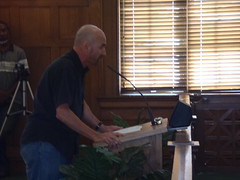
Roy Taylor spoke first at Citizens to be Heard,
Valdosta City Council, 7 April 2011.
He didn’t stay to hear the rest of the meeting, though.
Could he be one of the people
Scott Orenstein was referring to?
Here’s
the video.
Regular Meeting, Valdosta City Council, Lowndes County, Georgia, 7 April 2011
Videos by Gretchen Quarterman for LAKE, the Lowndes Area Knowledge Exchange.
PS: Sorry for not transcribing, Roy, but we have so many videos lately
that we’re going to have to rush a bunch of them out without that.
Mayor Fretti presented a check for $200 to Randall Jones,
who gets his name inscribed on a plaque inside
the front door of City Hall.
Jones is a maintenance supervisor at the water plant.
The mayor said he identified that the
January water outage
involved damage to switch gear and dealt with the problem.
Here’s
the video.
Regular Meeting, Lowndes County Commission, Lowndes County, Georgia, 12 April 2011
Videos by Gretchen Quarterman for LAKE, the Lowndes Area Knowledge Exchange.
How much should it cost for a citizen to get access to agendas
and minutes of a tax-funded board?
How does about $2 per meeting strike you?
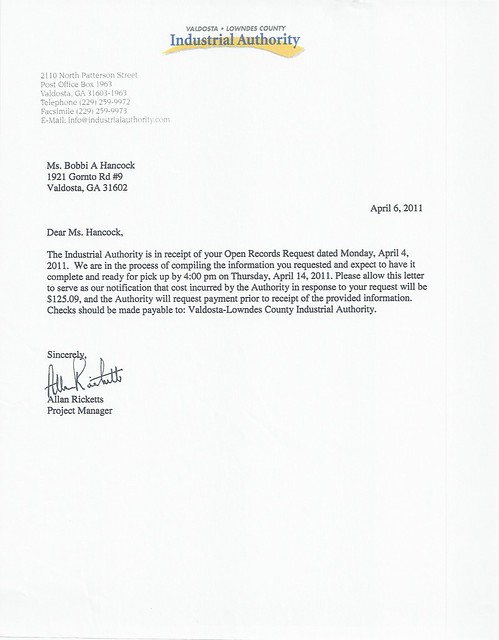
Bobbi Anne Hancock filed an open records request for the
agendas and minutes of all regularly scheduled and called
meetings of the
VLCIA letter asking $125.09 for copies of agendas and minutes
of the
Valdosta-Lowndes County Industrial Authority (VLCIA)
from 2006 to the present, and got this letter back:
So at 12 meetings per year for five years plus another 3 months,
that would be about 63 meetings, divided into $125.09 gets
about $1.99 per meeting.
Yesterday I wrote
that interactions about Valdosta Farm Days between the Lowndes Commmission
and the City of Valdosta
“could have been smoother if one or both of the parties had been proactive.”
The VDT reported that the County Commission wants to know
about Valdosta Farm Days,
and apparently there was a disconnect between the staff and the Commissioners.
Here’s how the Commission came to be informed, through interactions of citizens and staff.
First, an excerpt from the paper paper story by David Rodock,
“Farmers market proposal discussed by commission”,
Tuesday, April 12, 2011, page 3A (it’s not online):
Continue reading →
proactive: serving to prepare for, intervene in, or control an
expected occurrence or situation; anticipatory
Lowndes County Commission work session, 12 April 2011, Valdosta, Lowndes County, Georgia.
Videos by Gretchen Quarterman for LAKE, the Lowndes Area Knowledge Exchange.
While apparently supportive of the initiative, the process could
have
Continue reading →
 5. Public Hearings