Tom Kuettner and his goat products. Continue reading
Category Archives: Hahira
Parks and Rec. Appointment, Lowndes County, Georgia
Previously, the Valdosta City Council appointed City Council member
Robert Yost to the
Valdosta-Lowndes County Parks & Recreation Authority (VLPRA).
The Lowndes County Board of Commissioners debated appointing a Commissioner
to the VLPRA at their June 8 meeting:
They decided to appoint their chairman, Ashley Paulk, to the VLPRA. Chairman Paulk said he would serve, but as a private citizen. I wonder then what the point was of appointing him, rather than someone else.
When Valdosta appointed Yost, Ashley Paulk provided this statement to the VDT: Continue reading
Hahira City Council
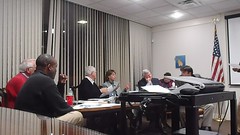
In the regular meeting, Hahira City Council, June 3,
Mr. Benjamin speaks up in Citizens Wishing to be Heard:
As you can see by the pan around the room, the meeting was pretty well attended. The average local government session around here gets maybe a couple of people who aren’t elected or staff. This one had probably half a dozen.
Each Council member, Ralph Clendenin (District 3), Allen Cain (District 2), Terry Benjamin (District 1), and Rose Adams (District 4), made a statment, followed by Jonathan Sumner (City Manager) and Wayne Bullard (Mayor).
Here’s a playlist. Videos by John S. Quarterman and Gretchen Quarterman for LAKE.
Hahira Elected Officials and Staff. Minutes of previous meetings and future schedule.
Hahira Teachers Learn Trees
About 25 teachers from Lowndes County schools were out at the Pine Grove Farm in Thursday identifying trees and looking at leaves.Maybe later they could even take the students out to the trees!It’s part of project learning tree, an environmental education program.
Renee Galloway says students don’t really get out of the classroom in language arts and reading, so she’s glad she’ll have new lessons to bring to her class.
“Hopefully, our teachers can take back the importance of the timber industry to Georgia’s economy to their classrooms,” said Joy Cowart, a Project Learning Tree facilitator.That’s one good lesson. Others might be the diversity of native forests and the economic and natural benefits of reforestation.
The last Hahira Pick-In
Here’s another view: Continue reading
Train in Hahira
Coming: Continue reading
Impervious cover increase, Lowndes County
Where’s all this change coming from and going to?
The dark green is labeled “Evergreen Forest” and decreased from 31.81% in 1991 to 26.47% in 2005. Meanwhile, the light pink labeled “Low Intensity Urban” went from 5.37% to 8.57%. Other changes include the red “High Intensity Urban” slice going from 1.15% to 1.98%. But the biggest change is piney woods being paved over for urban sprawl.
Could this have some effect on flooding?
-jsq
John S. Quarterman
Third Thursday, Hahira, GA
How many people can fit in a horse cart?
Don’t forget the children:
Let’s try to count them as they get out:
Cast: Walter Bird (driving), Sam (the horse), Nancy Evans Parr, Winfrey Murray Hendley, Wayne Bullard, Beverly Brown Underwood, Barbara Stratton, several children, and watching on the sidewalk, John S. Quarterman.
Third Thursday, 15 April 2010, Hahira, Lowndes County, Georgia.
Pictures by Gretchen Quarterman.
Comment on the Transportation Plan
One thing I noticed was that along Cat Creek Road they are proposing several intersection upgrades (at Hambrick Road, New Bethel Road, and Radar Site Road) which look like they would funnel still more traffic through Hambrick Road to Moody AFB. Hambrick Road and Cat Creek Road are not highways. State highways 122 and 129 (Bemiss Road) make a nice fast route from Hahira to Moody. A few improvements at Walker’s Crossing (where 122 and 129 intersect) would seem much more appropriate. The MPO could request for the state to do that.
Widening of Old US41N is on the list again as a county project, this time as far as Union Road.
Several new roads are proposed throughout the city and county as well as widening of many roads with additional travel or turn lanes.
You can look over the list of projects and you’ll probably find ones to comment on.
DoJ Rejects Lowndes County Redistricting
In denying the Lowndes County Commission the right to expand under the current proposed “superdistrict” plan, the DOJ stated in its opinion, “Our analysis of the evidence precludes a determination that the county has met its burden of showing that the proposed plan was not adopted, at least in part, with the purpose of making minority voters worse off.” In addition to stating that the plan was done deliberately to disenfranchise black voters, the letter of explanation that the DOJ sent to the county Tuesday regarding its denial of the petition states that the proposed plan was not in compliance with the Voting Rights Act regarding discrimination.Saying the county has not shown that it has not done something is not the same as saying the county deliberately did that thing.
The commission chairman seems to be forgetting his history:
Paulk said he is certain that the map met all of the criteria in the Voting Rights Act. The initiative was approved by the state’s General Assembly and voters approved the plan on Nov. 4, 2009.In denying the proposal, Paulk says the DOJ is denying the right of the people to vote on a plan of their choosing, noting that it passed overwhelmingly in the majority minority districts.
“We had a democracy when we drew those maps, not the socialist government we have now,” Paulk said.
The county districts currently in use were required in 1984 as part of a court settlement under that well-known socialist, Ronald Reagan.
That’s a good point about the plan passing overwhelmingly in the majority minority districts, but it also passed when nothing else was on the ballot for the county (everything else was for the various cities in the county), so few people outside Valdosta, Hahira, and Dasher voted on it. This problem was noted beforehand by state representative Ellis Black:
“My concern is about the inequity where it’s a special election in the unincorporated areas but it’s a regular city election,” Black said. “I’m concerned about the impact on the turn out as there will be a greater emphasis on city voters more so than the unincorporated voters.”The VDT quoted Ashley Paulk as saying he didn’t want to spend the money to hold a special election: “$40,880 minimum.” This from a county government that just spent $15 million for a bridge that few people use and $1.5 million to pave a road the majority of whose residents didn’t want paved. Is the will of the people in the unincorporated areas so unimportant? In any case, it looks like the county will now need to pay for developing another redistricting plan.
The VDT quotes Joe Pritchard, County Manager:
“We are satisfied that we did everything we possibly could to create a plan that met all of the criteria,” he said.If so, apparently all they could do was not enough. Also, the plan the county government proposed was not the only possible plan.
Back in 1997 a plan was proposed that would have put two commissioners in each of the two districts. The voters voted it down, and for that one the VDT wondered if the voters got it right, because the SPLOST tax was the big issue at the time, not commission expansion.
Another way would be to split the current districts lengthwise, creating two out of each of them. I don’t think that possibility was ever seriously entertained by the current commissioners. Why not is mysterious.
The DoJ was aware of the possibility of splitting at least the existing minority district, and said so:
Moreover, the evidence establishes that this retrogression was avoidable. Several alternatives exist that meet the county’s stated criteria and do not have a prohibited retrogressive effect. For example, it is possible to create an illustrative plan that follows the county’s 3-2 configuration, but which, unlike the county’s proposed plan, creates a second district in which census data show that the African American community would be able to elect a candidate of choice. The most recent data indicate that African Americans constitute 53 percent of the registered voters in this illustrative district. Although the county’s contention that the 2000 Census data understate this district’s current African American population percentage appears to be correct, it does not alter our conclusion, based on an analysis of voter registration data from October 2009, that the district would not afford black voters the ability to elect candidates of choice to office.That’s the paragraph in the DoJ letter immediately before the passage the VDT quoted. Neither the VDT nor the county government has chosen to put a copy of the DoJ letter on the web, but fortunately the DoJ did, so we don’t have to go by what we’re told to think; we can read the letter for ourselves.
The VDT article about redistricting history neglects to mention that another plan was put to a vote around 1983 that would have expanded the county commission to 9 members, if I recall the number correctly from the VDT article of that period I saw in the county museum. That plan was only narrowly defeated by the people of the county. Perhaps a similar plan, better prepared and presented, might fare better today.
Thomas County, with about half the population of Lowndes County, has eight commissioners.
Current commissioners are aware of that mid-1980s plan, and at least one of them objects to it because it would have created a district entirely within Valdosta, which is already represented by the Valdosta City Council. This makes me wonder if all the voters in the current county commission districts who happen to live inside Valdosta (or Hahira, or Remerton, or Dasher, or Lake Park) don’t count? That would be ironic, since they’re the ones who just voted for the plan these same commissioners favored.
The county government also did everything it thought it possibly could to create a new county waste disposal plan last year, but external reality intervened in that case, too. The county couldn’t get bids for its plan at the minimum it required. This was just as well, since there were strenuous objections to the county’s plan, voiced by hundreds of people at the meetings the county held not to get early input, rather to tell the people what the county government had decided.
The incoming chairman, Ashley Paulk, came up with a new, simpler plan that addressed most of the objections of the old waste disposal plan and that’s the one now working fine. The current waste plan was sort of an emergency solution arrived at without much external input.
Here’s a chance for the new chairman to once again demonstrate the adaptability of the county government. Given that circumstances have repeatedly indicated that the county government’s solution to a problem isn’t necessarily correct just because the county government believes it is, perhaps this time a transparent process for citizen participation could be used so that the people and the DoJ could be convinced that a solution is correct.