Category Archives: Water

Beliefs are good, but facts are better –John S. Quarterman @ VLCIA, 15 March 2011

First I praised the completion of the Wiregrass Solar LLC plant in Valdosta. Then I complimented Brad Lofton on finding his new job and hoped he’d be happy in Myrtle Beach. Then I praised the VDT for its editorial recommending using this opportunity to consult the councils of the various municipalities and the County Commission, and in particular that one way to produce unity in the community as G. Norman Bennett had previously advocated, would be to find out what the community wants VLCIA to do.
I understand the point about beliefs. But it’s not all about just the beliefs of just the people on the board. It’s also about things like is there enough water, and do we want businesses that soak up a lot of water, like Ben Copeland said at the Lake Park Chamber of Commerce. Beliefs are good, but facts are better. Thank you.


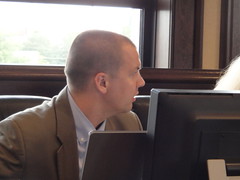
John S. Quarterman at the
regular monthly meeting, Valdosta-Lowndes County Industrial Authority (VLCIA)
Norman Bennett, Roy Copeland, Tom Call, Mary Gooding, Jerry Jennett chairman,
J. Stephen Gupton attorney, Brad Lofton Executive Director, Allan Ricketts Program Manager,
15 March 2011.
Video by David Rodock for LAKE, the Lowndes Area Knowledge Exchange.

-jsq

“Parameters on the types of industry” –VDT Editorial

And what about all that land?

In addition to a news story about Brad Lofton moving on up to Myrtle Beach, the Valdosta Daily Times also had an editorial yesterday (14 March), Lofton’s leaving a void in which they make some good points, including:

While the search is on for a new director, now is the time for the city, county and industrial authority board to come together to make some decisions about the organization and what the community leadership needs and wants it to be.
Here are a few modest suggestions along those lines, including considerations such as water.

More from the VDT: Continue reading

The politics of climate change denial

Why do some people deny the overwhelming science of climate change in a time when the evidence and analysis is so thorough and so conclusive that no reputable scientific organization in the world doubts any longer that humans are changing the climate of the whole planet for the worse: because it threatens their political and economic beliefs. Naomi Klein: Why Climate Change Is So Threatening to Right-Wing Ideologues:
And the reason is that climate change is now seen as an identity issue on the right. People are defining themselves, like they’re against abortion, they don’t believe in climate change. It’s part of who they are.
It’s like denying the earth goes around the sun. Why would they identify with such a silly thing? Because of what actually dealing with climate change would mean: Continue reading

The business of carbon trading in Georgia

Rich McKay wrote for the ajc, Carbon limits a boon for traders: Proposed emissions standards may galvanize business in Georgia.
The carbon-emitting companies pay the farmers to not cut down the trees or to plant new trees. The idea is that the trees, which gobble up carbon, will store up the carbon from the atmosphere and offset what the smokestacks spew.
Blake Sullivan, of the Macon-based Carbon Tree Bank, has 26,000 acres of forest in the state under contract for carbon banking.

“Georgia has an abundance of forests right here, and trees are like the lungs of the Earth,” he said. “They inhale carbon and exhale oxygen. We can be part of the solution right here in our own backyard.”

Why is this suddenly a business? Continue reading

The owl in Hahira: March 2011 LAKE meeting

The owl in Hahira:
Monthly LAKE Meeting
When: 5:30-6:45 PM, Tuesday 1 March 2011
Updated meeting location
Where: home of Thomas Ieracitano
414 East Main Street, Hahira
229-251-2462
That’s on US 122, just east of the Masonic Lodge.
Thomas says:
“Bring a lawn chair, laptop (I will have Mediacom wireless) and your own food and drink.”
If it rains or there are too many bugs or something, we will move to:
Down Home Pizza
103 South Webb Street, Hahira
229-794-1888

Help cover food, water, transportation, incarceration, solar energy, biomass, and regular local government meetings: you never know when news will be made!

Popular topics lately on the LAKE blog, On the LAKE Front, include Continue reading

Authority should listen to other sources –John S. Quarterman

This op-ed by me appeared in the VDT today, 24 Feb 2011. On 15 Feb 2011 I spoke directly to the VLCIA board about the main points and the next day I sent them the longer version, Why “jobs, jobs, jobs” isn’t good enough for the public good and the general welfare, which includes links to videos of the relevant speeches and to VLCIA’s charter. -jsq
Everyone wants jobs for those who need them and jobs for young people so they don’t have to go somewhere else to find one. But what good is that if those jobs suck up all the water those people need to drink?

At the Lake Park Chamber of Commerce annual dinner Brad Lofton gave a speech which I liked, and I told him so afterwards, because it was mostly about real industry with real jobs that that the Valdosta-Lowndes County Industrial Authority (VLCIA) has brought into the area.

But it had a problem:

Continue reading

Uncontrolled growth and water problems

Daniel Mayer, November 2006
Maybe growth, growth, growth alone isn’t any better than jobs, jobs jobs alone, and water remains one of the main issues. Kay Harris wrote in the VDT 17 Feb 2011 that Aging infrastructure, growth, and other issues contribute to city’s sewer woes:
Valdosta Utilities Director Henry … Hicks addressed the sewage spills, saying they are caused by excess rain which overloads the Withlacoochee River Water Pollution Control Plant. He said growth along the river and throughout the regional watershed area has contributed to the amount of excess water running into the river.

“When you have all this growth and you create more impervious surface area (through paving and development), more and more water is running into the Withlacoochee. On average, the plant handles six million gallons a day and is equipped to accommodate twice that, but in recent rain events, we’ve gotten upwards of 15 million gallons extra in stormwater runoff and the system can’t handle that,” Hicks said.

Some of the comments on the VDT page are also interesting. Guest remarked: Continue reading

The mentality that exploits and destroys the natural environment –Wendell Berry

And now a word from Wendell Berry:
The mentality that exploits and destroys the natural environment is the same that abuses racial and economic minorities…. The mentality that destroys a watershed and then panics at the threat of flood is the same mentality that gives institutionalized insult to black people and then panics at the prospect of race riots.
Source: “Think Little” in A Continuous Harmony: Essays Cultural and Agricultural, by Wendell Berry, 1972. Forty years later, that mentality is still a problem.

-jsq

Environmental apartheid and envieronmental racism –Leigh Touchton, VCC, 10 Feb 2011

NAACP reiterates charges of environmental racism, despite claims from Brad Lofton, Executive Director of the Valdosta-Lowndes County Industrial Authority, that “all of a sudden we haven’t heard anymore about environmental racism.” Leigh Touchton, president of the local NAACP chapter, presents to the Valdosta City Council research published by Robert D. Bullard about environmental apartheid.


Regular meeting of the Valdosta City Council, 10 February 2011.
Video by Gretchen Quarterman for LAKE, the Lowndes Area Knowledge Exchange.
She posted the appended as a comment on the previous LAKE post about Robert D. Bullard’s report.

-jsq

Dear Mr. Quarterman:
Continue reading

Georgia forests worth more standing than incinerated

Sandi Martin writes in Southeast Farm Press:
A University of Georgia researcher has found that Georgia’s forestlands provide essential ecosystem services to the state worth an estimated $37 billion annually.

This is in addition to the value of timber, forest products and recreation. This is the first time these indirect benefits of Georgia’s private forests have been estimated.

That’s substantially more than the $28 billion annually from the conventional wood-products industry.

What are these ecosystem services? Continue reading