Category Archives: Nuclear

Neither wind nor solar power “need to be purchased by Halliburton”

Continuing to see what “the indigenous” think about solar power:

Today, a number of Native tribes, from the Lakota in the Dakotas to
the Iroquois Confederacy in New York to the Anishinaabeg in Wisconsin,
battle to preserve the environment for those who are yet to come. The
next seven generations, the Lakota say, depend upon it.

“Traditionally, we’re told that as we live in this world, we have
to be careful for the next seven generations,” says Loretta Cook. “I
don’t want my grandkids to be glowing and say, ‘We have all these
bad things happening to us because you didn’t say something about it.’

Part of this family and spiritual obligation to preserve

Continue reading

Energy reliability: let’s do the study for Georgia

Which energy source is really more reliable?
Nuclear, coal, or wind, water, and sun?


As Plant Vogtle and others

have just demonstrated,

nuclear power isn’t as reliable as we might have thought.
Mark Z. Jacobson says we can generate reliable power from
wind, water, and sunlight alone.
Will that work in Georgia?

Elsevier’s policy of charging for peer-reviewed articles from
scientific journals is controversial, and some people find $19.95
prohibitive to access Mark Z. Jacobson and Mark A. Delucchi’s

Providing all global energy with wind, water, and solar power, Part I: Technologies, energy resources, quantities and areas of infrastructure, and materials

from Energy Policy
Volume 39, Issue 3, March 2011, Pages 1154-1169.
Fortunately, the same authors wrote an earlier version for
Scientific American, 26 October 2009,

A Plan to Power 100 Percent of the Planet with Renewables:
Wind, water and solar technologies can provide 100 percent of the world’s
energy, eliminating all fossil fuels. Here’s how

A new infrastructure must provide energy on demand at least as reliably
as the existing infrastructure. WWS technologies generally suffer less
downtime than traditional sources. The average U.S. coal plant is offline
12.5 percent of the year for scheduled and unscheduled maintenance. Modern
wind turbines have a down time of less than 2 percent on land and less
than 5 percent at sea. Photovoltaic systems are also at less than 2
percent. Moreover, when an individual wind, solar or wave device is down,
only a small fraction of production is affected; when a coal, nuclear
or natural gas plant goes offline, a large chunk of generation is lost.

Continue reading

Nuclear reactor Vogtle 1 at August shut down

Nuclear really more reliable than wind or solar?
What’s with the unscheduled shutdowns?

Colin McClelland reported for Bloomberg 21 April 2011,

U.S. Nuclear Output Falls as Vogtle Reactor in Georgia Shuts


U.S. nuclear-power output remained near a 4½-year low for a fourth day
as the Vogtle 1 reactor in Georgia shut down unexpectedly, the Nuclear
Regulatory Commission said.

Power generation nationwide decreased 538 megawatts to 71,781 megawatts
from yesterday, or 71 percent of capacity, the smallest amount since
Oct. 22, 2006, according to an NRC report today and data compiled by
Bloomberg. Twenty-nine of the nation’s 104 reactors were offline.

Southern Co. (SO)’s 1,109-megawatt Vogtle 1 reactor automatically
tripped offline yesterday at 5:34 p.m. when it was at full power. The
cause is under investigation, the NRC said.

The shutdown was ironically two days after

an NRC public meeting “to discuss Plant Vogtle’s annual safety evaluation and assessment.”

That would be the same location where,
according to

Tice Brashear back in 18 March 2009
:

Continue reading

Nuclear (Stewart Brand) vs. renewable energy (Mark Z. Jacobson) at TED


Stewart Brand of Whole Earth Catalog fame is a long-time environmentalist
who in recent years decided nuclear was necessary.
(He also decided

no-till
was necessary, which was enough
to convince me he’s gone barmy.)
Here
at TED
he debates Mark Z. Jacobson,
whose new study says we can

power the world with wind, water, and sun.

I think Jacobson should reconsider including building more hydroelectric dams,
but his study does demonstrate that we don’t need nuclear or biomass.
But watch it and see what you think:

Here is my critique of Brand’s arguments:

Continue reading

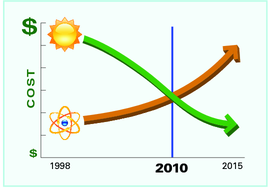
Solar Crosses Nuclear


John O. Blackburn and Sam Cunningham
write about

Solar and Nuclear Costs — The Historic Crossover:
Solar Energy is Now the Better Buy

Solar photovoltaic system costs have fallen steadily for decades. They are projected to fall even farther over the next 10 years. Meanwhile, projected costs for construction of new nuclear plants have risen steadily over the last decade, and they continue to rise. In the past year, the lines have crossed in North Carolina. Electricity from new solar installations is now cheaper than electricity from proposed new nuclear plants. This new development has profound implications for North Carolina’s energy and economic future. Each and every stakeholder in North Carolina’s energy sector — citizens, elected officials, solar power installers and manufacturers, and electric utilities — should recognize this watershed moment.

And North Carolina is north of Georgia, so Georgia should have more sun.

-jsq