It turns out tracking students can help all students if done properly.
CUEE’s
invited speaker Terry Jenkins
co-authored a paper
back in 1997 about
Detracking Troup County: Providing an Exemplary Curriculum for All Students.
He appeared to be saying de-tracking was an advantge of school consolidation.
Back then tracking was apparently considered a bad thing.
Recent research shows that actually tracking students can help all
levels of students.
So yet another supposed reason or benefit of consolidation turns out
not to be true.
Esther Duflo, Pascaline Dupas, and Michael Kremer wrote for American Economic Review, 101(5): 1739–74, DOI:10.1257/aer.101.5.1739,
Peer Effects, Teacher Incentives, and the Impact of Tracking: Evidence from a Randomized Evaluation in Kenya
To the extent that students benefit from high-achieving peers, tracking
will help strong students and hurt weak ones. However, all students may
benefit if tracking allows teachers to better tailor their instruction
level. Lower-achieving pupils are particularly likely to benefit from
tracking when teachers have incentives to teach to the top of the
distribution. We propose a simple model nesting these effects and test
its implications in a randomized tracking experiment conducted with
121 primary schools in Kenya. While the direct effect of high-achieving
peers is positive, tracking benefited lower-achieving pupils indirectly
by allowing teachers to teach to their level. (JEL I21, J45, O15)
The first sentence is the standard “diversity” argument that CUEE
keeps making.
The authors state it so as to poing out that their study finds
that it’s far from the whole story.
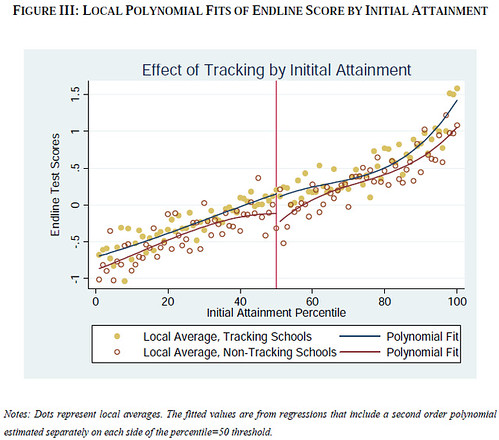
I find this part especially interesting: