Tag Archives: Health Department

Videos: Academy Drive septic tank citizen request, Glenn Road, Valencia Street, Kinderlou Clyattville Road Paving @ LCC Regular 2024-06-11

Citizen Patricia Scoby

doesn’t want to have to elevate her septic tank
.
However, the Board of Roads and Revenue, excuse me, the Lowndes County Commission
doesn’t have much say over that: that’s the Health Department.
But the Health Department should have taken into account the changed drainage such mounds cause.


[Collage @ LCC 11 June 2024]


Collage @ LCC 11 June 2024

The regular agenda breezed through unanimously at the 11-minute Regular Session.
Commissioner Demarcus Marshall was absent.

Commissioner Mark Wisenbaker did want to know what are the ingress and egress points for

5.a. REZ-2024-13 Carter, 6128 Glenn Road, 4.72ac, E-A to R-1, Well – Septic
.
No citizens spoke for or against in its Public Hearing.

For the

6.a. Valencia Street Quitclaim Deeds
,
Gretchen wondered, “Personally, I’m curious why the commission abandoned that little bit (one lot’s worth) of Valencia Street.”
The
board packet
for this latest Regular Session
included the

relevant excerpt

from the Minutes of the September 27, 2005, Regular Session.
Gretchen quoted it, but it also does not say why.
In the latest Regular Session, County Engineering Services Director Chad McLeod said the adjoining landowners
asked for the quitclaim deeds, but he did not say why the road was abandoned back in 2005.

FYI, the
Agenda Center
on lowndescounty.com only goes back to 2012.
If you want to see earlier minutes, you either have to file an open records request
or have already done so, as LAKE did years ago.

for

7.a. PI# 0016278 Kinderlou Clyattville Road Paving and Drainage Improvements
,
Chairman Bill Slaughter wanted to know if it was within the budget.
Answer: no, but TIA says it’s within the inflationary amount,
so TIA will cover the difference.

Below are links to each LAKE video of each agenda item,
with a few notes by Gretchen Quarterman,
followed by a LAKE video playlist.

See also the Continue reading
How to implement trash, health, and safety?

Disposal of solid waste (trash/garbage) is a matter of

community public health and safety

and providing such service

is the responsibilty of the local governing bodies.

How should trash health and safety responsibly be implemented?


We cannot be left in a situation where residents are either “forced
to buy” service from a provider, or have no option but to burn
their trash. The government can levy a tax, but they cannot say that
residents are forbidden to buy a service from an independent provider.

Such a ruling is

  • unfriendly to those who currently own, or want to
    start

    a waste collection business in our county
    ,
  • unfriendly to the
    residents who are counting on the government to follow
    the state-legislated goals to

    “protect the health
    safety, and well-being of its citizens and to protect
    and enhance the quality of its environment” ,

  • unfriendly to the environment as trash ends up on the side of the
    road or polluting the air by being burned and leaves us to
    face a new problem on a different day.

Residents in the unincorporated areas of the county who want curb side
collection, for the most part, already purchase it. Those of us using

the collection centers
do so because it is our preference.

The county
should (in my opinion) create a special tax district for waste disposal
(it already makes special lighting districts) and tax the residents
for the maintenance of the collection centers.

-gretchen

Who implements trash, health, and safety?

As we’ve seen, solid waste is a matter of public health, safety,
well-being, and the environment,

according to Georgia state law.

Whose responsibility is it to protect the environment
and the public health, safety, and well-being from solid waste?

Many health and safety issues are handled through the health department,

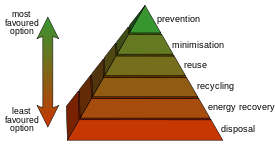
Diagram of the waste hierarchy


including the Georgia Department of Public Health,

and the

South Health District

(Ben Hill, Berrien, Brooks, Cook, Echols, Irwin, Lanier, Lowndes, Tift and Turner Counties).
Particularly, water quality (septic tanks, well water), food safety,
cleanliness of hotels, motels, restaurants, swimming pools and so on
are the responsibility of the local health department,
such as the

Lowndes County Health Department.

However, disposal of solid waste (trash/garbage) is handled by
the local municipality or governmental body (county).

The EPA has a variety of documents available about solid waste.

So does the state EPD, as enabled through Georgia Legislation:

Existing Rules and Corresponding Laws
.

So, where does this leave us?
See next post.

-gretchen