BirdLife International writes about
Bioenergy – a carbon accounting time bomb:
The first study, carried out by Joanneum Research, identifies a major
flaw in the way carbon savings from forest-derived biomass are calculated
in EU law as well as under UNFCCC and Kyoto Protocol mechanisms. It
concludes that harvesting trees for energy creates a ‘carbon debt’:
the carbon contained in the trees is emitted upfront while trees grow
back over many years. The true climate impact of so-called woody biomass
in the short to medium term can, as a result, be worse than the fossil
fuels it is designed to replace.
“The EU is taking out a sub-prime carbon mortgage that it may never be
able to pay back. Biomass policy needs to be fixed before this regulatory
failure leads to an ecological crisis that no bail out will ever fix”,
commented Ariel Brunner, Head of EU Policy at BirdLife International.
Hm, this seems to contradict VLCIA’s assertion that
the document they gave me proves their proposed wood
incinerator would be carbon neutral.
That document openly admits that biomass produces more CO2 than
coal, and calls for national or regional studies, which didn’t exist.
Nonetheless,
when I pointed that out (again) to VLCIA Executive Director
Brad Lofton,
he asserted that
“Carbon is absolutely not an issue with our plant.”
Hm, well, now there is a study, and it shows that burning woody
biomass is not carbon neutral.
And this excess production of CO2 isn’t limited to
burning whole trees.
Looking at the actual
study:
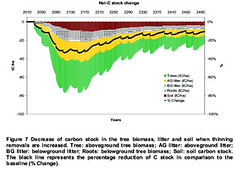
When residues are left on the forest floor, they gradually decompose. A
great deal of the carbon contained in their biomass is released over time
into the atmosphere and a small fraction of the carbon is transformed
into humus and soil carbon. When the residues are burnt as bioenergy,
the carbon that would have been oxidized over a longer time and carbon
that would have been stored in the soil is released immediately to the
atmosphere. This produces a short term decrease of the dead wood and
litter pools that is later translated into a decrease of soil carbon.
So it doesn’t really matter that VLCIA asserts that their proposed
plant will never burn whole trees.
The tops and limbs they want to burn produce the same problem.
The study also includes comparisons with CO2 saved by
biomass offsetting coal burning.
The catch for the proposed biomass incinerator in Lowndes County
is that it’s not offsetting anything: it’s in addition to the
coal burned at Plant Scherer.
We could offset some coal through efficiency and conservation,
plus solar power.
None of those things produce any emissions.
