Insurer won’t cover fracking losses

Does your insurance policy explicitly list fracking damages among the things it covers? If not, you’re probably not covered, and especially if your insurer is Nationwide. And if your drinking water catches on fire, that’s probably not even considered damage to your property. Remember, natural gas through fracking (plus nuclear) is what Southern Company and Georgia Power (and therefore all the smaller electric utilities in Georgia) are moving to instead of coal.

The River Reporter reported Wednesday, Nationwide insurance: no fracking way

National Casualty (Insurance) Company, part of the Nationwide group of insurance companies, has announced that hydraulic fracturing operations are prohibited in relation to properties it insures.

The company has determined that the exposures presented by hydraulic fracturing are too great to ignore. Risks involved with hydraulic fracturing are now prohibited for General Liability, Commercial Auto, Motor Truck Cargo, Auto Physical Damage and Public Auto (insurance) coverage. The company said it would not bind risks with this exposure, and any policies currently written with the exposure would be non-renewed (following state requirements).

Among the prohibited risks involved in fracking operations listed by the company are contractors involved in fracking operations, landowners whose land has been leased to lessees with fracking operations, frack sand and frack liquid haulers and site prep (dump trucks, bulldozers) or leasing of tanks.

On Thursday they posted (part of) Nationwide’s response:

Continue reading

GA PSC Forum videos online now

I hear somebody asked about Georgia Power's Construction Work in Progress (CWIP) stealth tax charge to customers for Southern Company's new nukes at Plant Vogtle. Maybe some of these candidates for the Public Service Commission could help get Georgia Power and SO to stop suppressing solar and wind in Georgia, maybe even to lead the way.

GIPL wrote today,

Thanks to everyone who came out to our Political Forum on the Georgia Public Service Commission. We had a great turnout, and learned a lot about the 2012 candidates for the PSC.

This is a statewide election, so please share this video far and wide with your friends. The primary election will be held on July 31, and the PSC will also be on the ballot in November.

Participants in last night's forum included (from left to right) Republican Matthew Reid and Democrat Steve Oppenheimer, who are both challenging incumbent Republican Commissioner Chuck Eaton in District 3, and Republican Pam Davidson and Libertarian David Staples, who are running against incumbent Republican Commissioner Stan Wise in District 5.

Beth Bond from Southeast Green moderated the media panel featuring Kristi Swartz from the Atlanta Journal Constitution, Walter Jones from Morris News Service, and Jonathan Shapiro from WABE.

Georgia Interfaith Power & Light hosted this forum. Co-hosts included 14 local environmental, religious, and advocacy organizations, including Southeast Green, Georgia WAND, GA Sierra Club, Civic League of Regional Atlanta, Glenn Memorial UMC Environmental Committee, GreenLaw, Southeast Energy Efficiency Alliance, Common Cause, League of Women Voters, Georgia Watch, Ryan Taylor Architects LLC, Sustainable Atlanta, Regional Council of Churches of Atlanta, Inc., Trinity Presbyterian Church Sustainability Committee, and the Southern Alliance for Clean Energy.

Here's the video:

-jsq

Sierra Club and Tea Party have produced Plan B for T-SPLOST

Yes, there is a Plan B for T-SPLOST. Two of them, actually, and they are in agreement on several major points.

David Pendered wrote for the Saporta Report yesterday, Called to produce their Plan B, groups detail their alternatives to proposed 1 percent transportation sales tax

Two organized opponents of the proposed 1 percent transportation sales tax said Thursday they are baffled by the allegation by tax advocates that the opponents have not offered an alternative to the tax.

The Sierra Club issued its alternative in writing in April, and members of the Atlanta Tea Party have voiced a consistent set of alternatives since October.

“We have common ground on this issue. There some things we don’t agree on, but we agree that this tax has got to be stopped,” said Debbie Dooley, a co-founder of the Atlanta Tea Party.

Both the Atlanta Tea Party and Sierra Club responded Thursday to a request from SaportaReport.com to provide their alternatives to the referendum. The request came after the campaign for the sales tax challenged them Wednesday to release their solution to relieve traffic congestion, in lieu of the transportation sales tax.

The article includes details of each of their responses, plus this handy list.

Continue reading

Solar already beats gas

Here’s an answer to the question of How long until solar beats gas?

Gayle Reaves wrote for fwweekly 11 July 2012, Serious about Solar,

Even on not-so-sunny days, solar still produces. David Power, deputy director of Public Citizen’s Texas office, said that back in February, when cold weather and power plant outages produced blackouts, CPS solar farm was on line and producing. “It was a pretty nasty day, cloudy, and there was a couple of inches of ice on the solar farm,” he said. “But they were still getting 30 to 35 percent of normal production out of it, even on the worst day you could imagine.”

Costs for solar panels have dropped dramatically in the last few years, although by some measures solar energy is still more expensive than that from gas-burning plants.

Power said that the comparisons that show solar to be more expensive are measuring the cost of building a solar plant compared to generating power from a fossil-fuel plant that may have been built and paid for decades ago. In marginal cost comparisons, he said, solar power comes out as costing either the same or less than building a new natural gas plant. “For that you have to get air quality permits and pay for fuel costs,” he said. “For the other, the sun shines, you get electricity, and you just have to wash it off once in a while if it doesn’t rain.”

So the answer is it’s already happened: solar beats gas now. So Southern Company’s fracking plan B makes no more sense than its nuclear Plan A.

-jsq

Wikileaks wins against VISA

Kim Zetter wrote today for Wired Threat Level, WikiLeaks Wins Icelandic Court Battle Against Visa for Blocking Donations

The Icelandic partner of Visa and MasterCard violated contract laws when it imposed a block against credit card donations to the secret-spilling site WikiLeaks, a district court there has ruled.

The Reykjavík District Court ruled that Valitor, which handles Visa and MasterCard payments in Iceland, was in the wrong when it prevented card holders from donating funds to the site. The court ruled that the block should be removed within 14 days or Valitor will be fined the equivalent of about $6,000 a day.

WikiLeaks spokesman Kristinn Hrafnsson told the Associated Press that it was “a small but very important step in fighting back against these powerful banks.” He said other lawsuits are ongoing in Denmark and Belgium.

The fine isn’t nearly big enough, and of course Valitor is appealing.

“This is a significant victory against Washington’s attempt to silence WikiLeaks,” WikiLeaks founder Julian Assange said in a statement about the win in Iceland. “We will not be silenced. Economic censorship is censorship. It is wrong. When it’s done outside of the rule of law it’s doubly wrong. One by one those involved in the attempted censorship of WikiLeaks will find themselves on the wrong side of history.”

They tried to silence Ben Franklin, too, for distributing some government communications that he got from an anonymous source.

“Those who would give up Essential Liberty
to purchase a little Temporary Safety,
deserve neither Liberty nor Safety.”
—Benjamin Franklin, An Historical Review of the Constitution and Government of Pennsylvania, 1759

History found old Ben to be on the right side. It will find the same about Julian Assange. Which side are you on?

-jsq

Georgia gets $2 billion under transportation bill

When Georgia gets $2 billion from the just-signed federal highway bill, why are federal Interstate 75 Exits 2 and 11 on our Region 11 T-SPLOST list?

Charles Edwards wrote for WABE 6 July 2012, Georgia gets $2 billion under transportation bill

The Georgia Department of Transportation will get infrastructure money under a U-S House resolution President Obama recently signed into law.

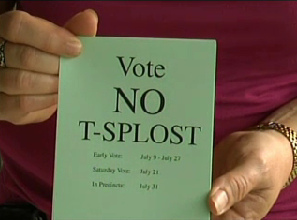
Yet more evidence that T-SPLOST is a poorly thought out inappropriate tax. We have through July 31st to vote it down.

-jsq

Duke and Progress to buy Santee-Cooper’s Summer nuke?

I erred in saying Duke owns nuclear Summer Station in North Carolina: it’s actually owned by SCANA and Santee Cooper. But I wasn’t as wrong as I thought. It looks like somebody’s been pressuring Duke and Progress, the two utilities currently maybe merging, to buy Summer.

John D. Runkle, attorney for NC WARN, hand-delivered a letter to Robert Gruber Executive Director Public Staff of the NC Utilities Commission on 18 June 2012, Re: INVESTIGATION — Duke-Progress Merger

In preparing comments on the Duke-Progress merger on behalf of the NC Waste Awareness and Reduction Network (NC WARN), we came across several reports that South Carolina officials, including the South Carolina Public Service Commission, were pressuring the utilities to purchase the State-owned Santee Cooper’s shares of the V.C. Summer Nuclear Generating Station.

Santee Cooper owns one-third of the present reactor and 45% of the proposed units 2 and 3. Based on the recent cost estimate of $9.8 billion, buying Santee Cooper’s share would add about $4.5 billion to the cost of the merger. But those are low-ball estimates; other nuclear units in the Southeast are projected to cost roughly twice as much. Realistically, purchasing Santee Cooper’s share would likely add much more to the cost of the merger.

We were unable to find any filings in either the South Carolina or North Carolina dockets regarding the V.C. Summer Station. If a purchase of nuclear units in South Carolina has been made a condition to the merger, it should be part of the public record, and not as some backroom negotiation.

I’d like to see that.

Even more I’d like to see this:

Continue reading

Live streaming of Public Service Commission Forum tonight

All candidates for the Georgia Public Service Commission at a forum tonight, 7-9PM 12 July 2012. GA PSC is the body that says Georgia Power can charge its customers for cost overruns for the new nukes at Plant Vogtle; the new nukes that will suck up even more water and are already sucking up lots of money through the stealth tax Construction Work in Progress (CWIP) charge on Georgia Power customer bills. GA PSC did require Georgia Power to buy 50 MW of solar, but that’s pennies compared to the dollars Georgia Power and Southern Company are shovelling into that pit by the Savannah River. Who will stand up and say enough nuclear is too much, and let’s get on with solar and wind?

Georgia Interfaith Power and Light blogged today, PSC Debate Tonight,

Tonight, GIPL is joining forces with 14 local organizations to host a Political Forum with this year’s candidates for the Public Service Commission.

We’re having technical difficulties with the live web stream. We hope it will be up and running tonight, but if not, the debate will be posted online this week. You can check this website tonight at 7pm for live web streaming, or watch our twitter feed @GeorgiaIPL for updates.

When: Thursday, July 12, 7 – 9 p.m.
Where:
Glenn Memorial UMC’s Auditorium/Sanctuary
1660 N. Decatur Road
Atlanta, GA 30307

All four challengers in the 2012 race have confirmed their attendance. Participants

Continue reading

Air is a public trust: Texas judge

The air is, after all, a bigger body than any body of water, and one that affects us all. A judge in Texas agreed that air should have the same legal protection as water.

Philip Bump wrote for Grist 10 July 2012, Texas judge rules that the atmosphere is protected under the public trust doctrine

Last May, a group of teenagers filed a series of lawsuits seeking to force the federal and state governments to take action on climate change. A key argument made in the lawsuits is that the atmosphere is a public trust — or, as described in one brief, that it is a “fundamental natural resource necessarily entrusted to the care of our federal government … for its preservation and protection as a common property interest.”

Yesterday, a state district court judge in Texas agreed.

Key issue from the plaintiffs' press release:

In deferring to the Texas Commission on Environmental Quality's (TCEQ) decision to deny the Plaintiffs' petition for rulemaking while other ongoing litigation over regulations ensues, the Judge concluded that the TCEQ's determination that the Public Trust Doctrine is exclusively limited to the conservation of water, was legally invalid. …

Which is not only good for air, but indicates that water already is legally a public trust.

-jsq


AP nuclear slant through omission

What's missing in AP's reporting and analysis of nuclear cost overruns?

AP published this Tuesday, News Guide: Nuclear industry facing cost pressures, perhaps as a companion to its story of the same day, Building costs increase at US nuclear sites. Like that story, the news guide is full of accurate and useful information about nuclear cost overruns, and even this good bit of analysis:

Q: Why do building costs matter to customers?

A: Because customers ultimately pay for the construction costs as part of their monthly power bills. The more a plant costs, the more customers will pay.

Yep, Georgia Power customers are already paying through that stealth tax, the construction work in progress (CWIP) charge for new nuke electricity they won't get for years if ever.

Yet something is missing. Can you spot it?

Hint:

Q: How does that compare with building coal- or gas-powered plants?

Good question, and AP correctly answers that nuclear plants are far pricier than coal or gas plants.

But are those three the only sources of energy? Where is the comparison to solar and wind power?

Well, maybe AP won't do it, but here it is already, Georgia Power deploys 1 MW solar; could have done 330 MW by now. Short version: for less than the amount of federal loan guarantees for Plant Vogtle, Southern Company could have built Georgia more solar energy production per capita than Germany, the world leader, has.

Why are we letting Georgia Power and the Southern Company pour our money down that pit near the Savannah River when they could be spending it to deploy solar and wind for more jobs, energy independence, and more profit for Georgia Power and SO? Oh, and clean air and plenty of clean water, too.

-jsq