
Movie actor Taro Yamamoto,
who broke a taboo when he spoke out about Fukushima,
and another when he was elected to the Japanese upper house in July,
yesterday broke an even bigger one when he personally presented a request
to Emperor Akihito about the health effects of the disaster
at nuclear Fukushima Dai-Ichi.
Some reaction in Japan was negative, because the Emperor supposedly
plays only a symbolic role.
However, Yamamoto’s request worked very well as PR,
getting massive worldwide publicity.

Here is a
petition to the Japanese Diet to support Taro Yamamoto’s action.
Let’s not forget that Plant Hatch on the Altamaha River is the
same design as Fukushima.
Here’s video from
Euronews, yesterday on YouTube,
Japanese politician breaks taboo by giving letter to Emperor about Fukishima fears,
The Emperor himself already spoke out a year ago:
As this earthquake and tsunami caused the nuclear power plant
accident, those living in areas designated as the danger zone lost
their homes and livelihoods and had to leave the places they used to
live. In order for them to live there again safely, we have to
overcome the problem of radioactive contamination, which is a
formidable task.

As Michael McAteer put it in The Atlantic 26 March 2012,
Japan in Uproar Over Censorship of Emperor’s Anti-Nuclear Speech:
Why did Japanese TV channels cut Emperor Akihito’s address on the one-year anniversary of the Fukushima crisis?
While this statement may seem more obvious than radical to
outsiders, underneath the Imperial-grade Japanese understatement
were two ideas that have become quietly explosive. First, he seemed
to suggest that the nuclear crisis is not over, a “formidable task”
yet to be overcome. This noticeably contradicts the government’s
official stance that Fukushima has achieved a cold shutdown and, for
all practical purposes, the crisis is over. Second, it implies that
it is not yet safe for people to return to areas stricken with high
levels of radiation, at least not before the “formidable task” is
“overcome.” This, again, contradicts the government’s position that
it is now safe for people to return to almost all areas and that
neither Tokyo Electric Power Company nor the national government are
obliged to assist in long term evacuations.It’s impossible to say for sure whether the emperor intended to
weigh in on two of the country’s most sensitive policy debates.
Either way, his words have struck Japan’s national conversation with
a weight that could only be delivered by the emperor himself.
The Emperor’s words were so sensitive that,
after the initial telecast and the first transcripts,
Japanese news completely failed to report
on that paragraph.
It’s not as if the Emperor, unworldly though he is supposed to be
in his position, does not know of what he speaks.
He is a biologist
with at least 38 peer-reviewed papers
including some in Science and Nature,
and is a world expert on certain kinds of fish.
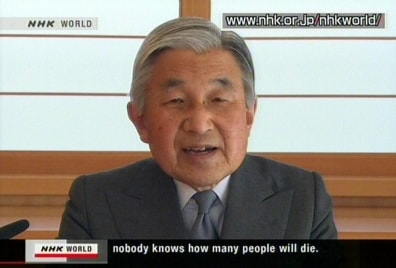
And that wasn’t even the first time.
Victoria Ward wrote for the Telegraph GMT 16 Mar 2011,
Japan’s Emperor Akihito expresses ‘deep concern’ over Fukushima nuclear plant crisis:
Japan’s reclusive Emperor Akihito has made an unprecedented public address in which he expressed deep concern about the escalating nuclear crisis.
In a rare televised appearance he described unfolding events at the
stricken Fukushima nuclear power plant as
“unpredictable” and acknowledged that the scale of the
crisis was “unprecedented”.“I hope from the bottom of my heart that the people will, hand in
hand, treat each other with compassion and overcome these difficult
times,” the emperor said solemnly.“The number of people killed is increasing day by day and we
do not know how many people have fallen victim.“I pray for the safety of as many people as possible. People are
being forced to evacuate in such severe conditions of bitter cold,
with shortages of water and fuel…
Perhaps someone required to be above the political fray
can see with his scientific mind that Fukushima is an ongoing
disaster that Japan is not handling at all well.
-jsq