
Only
160 miles from here,
the Crystal River nuclear reactor continues to run up a bad bill,
maybe as much as $5 billion,
and even other nuclear operators are reportedly starting to turn against it.
Should we wait for the new nukes on the Savannah River to run up a bill
that high before we cancel them?
Remember
back in May?
Florida is already experiencing a likely future for the new Plant
Vogtle nukes in Georgia: completion date pushed back, and customer
charges raised.
Yep, that’s the one.
And the bill keeps going up, as
Ivan Penn wrote for the Tampa Bay Times 30 December 2012,
Utilities nationwide could share the financial pain of the idled Crystal River nuclear plant,
The crippled Crystal River nuclear plant is now America’s headache.
The bill to fix it and pay for replacement power may top $5 billion.
The problem?The company that insures all 104 U.S. nuclear power plants has just
$3.6 billion on hand to pay for claims.Broken nuclear plants in California, Texas and Michigan will vie for
some of that money. But Crystal River alone represents such a
financial threat that the insurance company, Nuclear Electric
Insurance Ltd., may demand that its member utilities pony up more
money.
Is NEIL the guarantor on the bonds for the new nukes at Plant Vogtle?
I think Southern Company was smarter (for SO, not for us)
and
got Congress to guarantee those.
If so,
we the taxpayers will end up being on the hook
for Southern Company’s bad big bet.
Repairing the plant could cost as much as $3.5 billion for
construction work and $300 million a year for related costs such as
purchasing alternative electricity while Crystal River remains off
line. That could push the total cost above $5 billion.So far, NEIL has paid just under $300 million. The insurer stopped
paying after questions arose about how Progress Energy handled the
2009 replacement of old steam generators inside the nuclear plant’s
42-inch thick concrete containment wall. The Tampa Bay Times
documented how the wall cracked after Progress chose a
do-it-yourself approach to save about $15 million rather than use
the two companies that handled all similar projects in the nation.
An attempt to repair the crack and bring the plant back online
resulted in more cracks.Progress Energy wants NEIL to pay the bulk of the tab. The insurance
policy allows for a payment up to $2.25 billion for damage to the
plant, plus up to an extra $490 million for replacement power while
the plant is idled.Progress, however, argues that the cracks resulted from two separate
problems, which could increase the insurance payout to as much as
$5.4 billion.
Meanwhile,
Georgia Power customers are already paying
in advance on the boondoggle on the Savannah River,
and
Georgia Power can keep charging them even if it’s cancelled.
Even other nuclear operators, even Progress Energy’s new owner, Duke Energy,
are reportedly turning against bad nuclear bets:
The power companies are “going to want to make sure that Progress
— and now Duke — and NEIL are being responsible,”
Harding said. “I think NEIL is appropriately saying, ‘Make your
case, show this was an accident.’”Harding said even some Duke Energy employees have questioned whether
it was an accident or whether Progress was at fault and caused the
damage.“That’s the question I’ve heard from some of the folks at Duke.”
Crystal River already has an eight year delay scheduled.
One observer remarked:
“This is exactly what a fiasco looks like.”
Hey, we can do worse in Georgia!
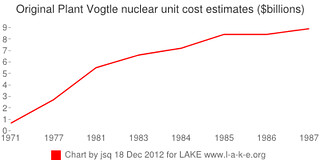
Last time Southern Company built nukes on the Savannah River they were
that late and even farther over budget.
Should we wait for SO’s new nukes to extend their
current 15 month delay to eight years and their current about $1 billion
cost overrun to $5 billion or even more?
Or should we go ahead and answer GA Public Service Commissioner
Doug Everett’s question from a couple of weeks ago:
“Which would you think would be best for the ratepayers of Georgia,
stop it now or continue with it?”

What do you think?
You can
contact the PSC, or the legislature, or Georgia Power, or Southern Company
directly and tell them what you think.
-jsq