In response to a very downbeat
diatribe by Bill McKibben in Rolling Stone on the occasion
of the U.N.’s Rio+20 conference being some sound and less fury accomplishing
not much about stopping climate change,
[Bill McKibben, Rolling Stone, 19 July 2012, “Global Warming’s Terrifying New Math: Three simple numbers that add up to global catastrophe – and that make clear who the real enemy is”]

Harvard student Chloe Maxmin
followed up McKibben’s problem statement with a plan for what to do:
divest from fossil fuel companies. [“In Honor of Kalamazoo: An Open Letter to Bill McKibben,” NextGenJournal, 25 July 2012, no longer online, referred to in a post the same day by Chloe Maxmin on First Here, Then Everywhere.]
Maxmin didn’t just wish, either,
she joined up with McKibben’s 350.org and helped organize
Harvard students to do something about it:
persuade Harvard to divest its shares of fossil fuel companies.
Students at the University of Georgia, or at Valdosta State University,
for that matter, could do the same.
Alli Welton wrote for 350.org 18 November 2012,
72% of Harvard Students Vote to Divest from Fossil Fuels,
Last Friday night, the Harvard College Undergraduate Council
announced that the student body had voted 72% in favor of Harvard
University divesting its $30.7 billion endowment from fossil fuels.Members of the Harvard chapter of Students for a Just and Stable
Future have been campaigning since September to divest Harvard’s
endowment from the top 200 publicly-traded fossil fuel corporations
that own the majority of the world’s oil, coal, and gas reserves.
Harvard actually already has divested its shares of one fossil fuel company
due to public pressure.
Stephen M. Marks and Lauren A.E. Schuker wrote for the Crimson 4 April 2005,
Harvard To Divest From PetroChina:
Decisions comes after months of pressure due to company’s links to Sudan
Harvard will sell its shares of PetroChina after months of pressure
regarding PetroChina’s alleged ties to ongoing genocide in the
Darfur region in Sudan, the University announced today….The announcement coincided with a student demonstration this
morning, where students—wearing black and carrying
signs—rallied for Harvard to divest its holdings in
PetroChina….University President Lawrence H. Summers, who asked for the ACSR for
a recommendation on the issue, said in a press release that while
Harvard does not usually divest, the circumstances surrounding
PetroChina merit an exception.“Divestment is not a step that Harvard takes lightly, but I
believe there is a compelling case for action in these special
circumstances, in light of the terrible situation unfolding in
Darfur and the leading role played by PetroChina’s parent company in
the Sudanese oil industry, which is so important to the Sudanese
regime,” Summers aid.
Yes, that Larry Summers, the architect of the 2009 global financial meltdown.
Even Larry Summers thought divestment was appropriate in the case of PetroChina.
Summers’ replacement after he was ejected by the faculty,
current Harvard President Drew Faust, still sounds the “circumstances”
alarm, countered by an op-ed in the Crimson, the student newspaper, 14 November 2012,
Vote to Divest,
At the Undergraduate Council and Harvard Graduate Council General
Meeting on October 21st, President Faust said that Harvard considers
divestment is considered: “Only in the most extreme of
circumstances.” DARA, an independent, non-profit organization,
recently released a report sponsored by 20 governments that shows
that the human death toll from climate change could exceed 100
million by 2030. Most of these deaths are the direct result of
burning fossil fuels. It is hard to imagine a circumstance much more
extreme. Moreover, climate change is an equity issue. Most of the
adverse effects of climate change disproportionately impact
developing countries, while the majority of greenhouse gas emissions
since the industrial revolution have come from industrialized
nations.
Summers and Faust no doubt know of an even bigger case of divestment
prompted by students,
starting as early as 1977, when then-president Derek Bok
sounded the “circumstances” alarm:
President Bok’s open letters, which called total divestiture
unjustifiable and a threat to Harvard’s academic freedom and
financial longevity, gave the Corporation the appearance of concern
and served to further anesthetize student opposition.
That’s the same Derek Bok who was brought in as interim president
after Summers was ejected, until Faust was selected.
But it turned out there were special circumstances, as evidenced by
a former student, Gay W. Seidman ’78, getting elected in 1986 by petition
to Harvard’s Board of Overseers on a pro-divestment platform.
Three years later, the pro-divestment movement got
South African Archbishop Desmond M. Tutu elected in 1989 to the Board of Overseers.

Back in the late 1970s when the divestment movement started on campus
at Harvard, who was reporting on it at and then president of the Crimson?
The
same Gay Seidman who later got elected to the Board of Overseers.
“I thought that [the anti-apartheid story] would be bigger
earlier [than most],” she explains. “This was really
going to matter.”
Can Chloe Maxmin duplicate that feat?
Maybe not the same way, since Harvard changed the rules to
make petition candidates harder to elect. So hard
even after being elected president of Harvard Law Review in 1990,
Barack Obama couldn’t get elected to the Board of Overseers in 1991.
Yes, he was running on a pro-divestment platform.
So was my classmate Steven Ballmer ’77, now CEO of Microsoft;
even he couldn’t get elected on a petition.
However, the pro-divestment movement was successful in the end.
Adam A. Sofen and Alan E. Wirzbicki wrote for the Crimson (unknown date),
A CONFLICTED RELATIONSHIP:
Harvard supported South Africa through
investments, but partially divested under protest.
They wrote
that Harvard actually adopted its first pro-divestment rules in
1978 under president “unjustifiable” Bok, and,
By 1985 these rules, which were reviewed periodically, called for
the University to use its proxy votes to urge companies operating in
South Africa to “take active steps to oppose apartheid.”It also forbade investing in banks that made loans to the South
African government and companies that provided “significant
quantities of an important good or service used in the direct
enforcement of apartheid.” The policy also promised a
divestment of stock in companies that refused to disclose the extent
of their operations in South Africa.
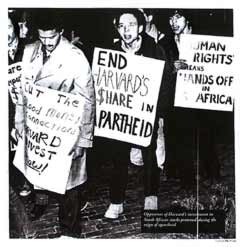
As we’ve seen, pro-divestment activists didn’t stop there.
And their work had something to do with the end of apartheid in South Africa
in 1993.
It wasn’t just that Harvard was among the first of many universities
to divest;
their divestment influenced many other organizations and people.
Students can have the same effect on stopping fossil fuel companies
from ruining the world through climate change.
Chloe Maxmin knows this history, as she wrote for 350.org:
Chloe Maxmin, a co-coordinator for Divest Harvard, said that the
election results show unprecedented student voice around divestment:
“In 1990, 52% of voting students supported complete divestment
from apartheid South Africa. Today 72% of voting students are
raising their voices for fossil divestment, telling Harvard to stop
investing in companies that are threatening our future.”Divest Harvard was the first student group in six years to
successfully qualify a referendum question for Harvard student
government elections, gaining hundreds of signatures beyond the 670
(10% of the undergraduate student body) necessary for qualification.
The passage of the referendum makes fossil fuel divestment the
official position of the Harvard College Undergraduate Council.
Can’t get a petition candidate elected to the Board of Overseer?
Get the student body to vote 72% on a petition referendum question.
Try to ignore that, Overseers!
And that’s not only more than the 52% apartheid pro-divestment vote
in 1990, it’s way faster: three months September to November,
compared to thirteen years from 1977 to 1990.

There is a nationwide college divestment campaign,
Divest for our future,
already involving 24 campuses.
The University of Georgia can join that list.
And that could start at one of UGA system’s big regional universities:
the Valdosta State University, with more students than
most of the colleges and universities already on the list.
Who will stand up against the fossil fuel companies?
-jsq