Tag Archives: Plant Vogtle

Putting conservation into conservatives —John S. Quarterman

My op-ed in the VDT today. -jsq

Gov. Deal
(WABE, 14 Nov 2012)
temporarily forgot that “conservative”
includes conserving something,


like

Theodore Roosevelt and national parks
,
or when

Franklin D. Roosevelt established the Okefenokee National Wildlife
Refuge
which also

administers Banks Lake,
when

Richard Nixon started the EPA,

and when

Jimmy Carter signed the Soil and Water Conservation Act.

If Gov. Deal wants to call conservation “liberal”, I’m happy to
be a liberal working for water for our state!


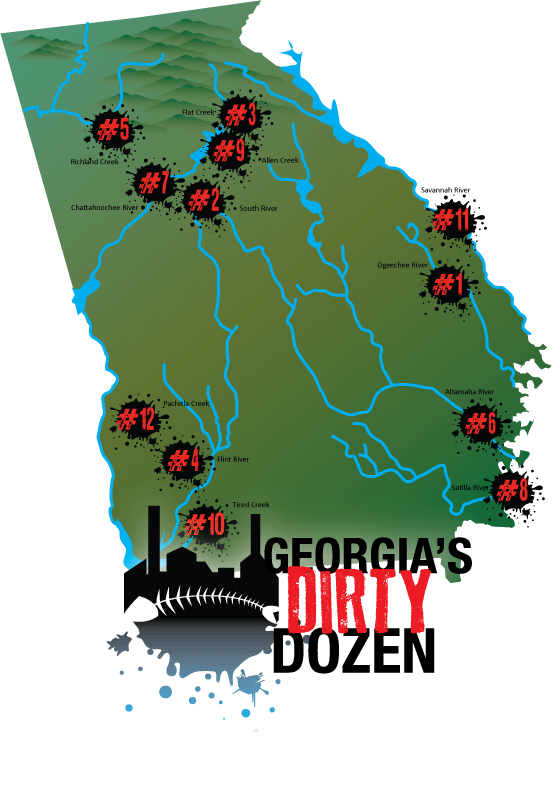
Georgia Water Coalition’s Dirty Dozen


listed the biggest boondoggle
of all as

#11: the nuclear reactors at Plant Vogtle

suck up more water from the Savannah River than all local agriculture and almost
as much as the city of Savannah.

If the new Plant Vogtle nukes

are ever completed,
all four will use more water than Savannah. In

2009 the legislature approved and Gov. Deal signed a law

letting Georgia
Power charge its customers in advance for building that boondoggle,
to the tune of

about $1.5 billion so far!

Let’s not forget

Continue reading

Florida Crystal River nuke down $5 billion?


Only
160 miles from here,
the Crystal River nuclear reactor continues to run up a bad bill,
maybe as much as $5 billion,
and even other nuclear operators are reportedly starting to turn against it.
Should we wait for the new nukes on the Savannah River to run up a bill
that high before we cancel them?

Remember

back in May?

Florida is already experiencing a likely future for the new Plant
Vogtle nukes in Georgia: completion date pushed back, and customer
charges raised.

Yep, that’s the one.
And the bill keeps going up, as
Ivan Penn wrote for the Tampa Bay Times 30 December 2012,

Utilities nationwide could share the financial pain of the idled Crystal River nuclear plant
,

The crippled Crystal River nuclear plant is now America’s headache.

The bill to fix it and pay for replacement power may top $5 billion.
The problem?

The company that insures all 104 U.S. nuclear power plants has just
$3.6 billion on hand to pay for claims.

Broken nuclear plants in California, Texas and Michigan will vie for
some of that money. But Crystal River alone represents such a
financial threat that the insurance company, Nuclear Electric
Insurance Ltd., may demand that its member utilities pony up more
money.

Is NEIL the guarantor on the bonds for the new nukes at Plant Vogtle?
I think Southern Company was smarter (for SO, not for us)
and

got Congress to guarantee those.

If so,

Continue reading

First ALEC, now Heartland Institute: losing sponsors

Heartland Institute, one of only two organizations to field a speaker

for
continuing Plant Vogtle delays and cost overruns

at this week's GA PSC hearing,
has been dropped by every pharmaceutical company.
When you're down to Heartland Institute and

renewable-energy-opposing

and

astroturf-funding
super-lobby group ALEC,
itself
rapidly losing members
(so bad
even Bank of America has dumped ALEC);
and when your public hearing speakers are 40 to 1 against continuing
with Southern Company and Georgia Power's nuclear boondoggle,
maybe it's time to end it.

Brad Johnson wrote for thinkprogress 19 December 2012,

Heeding Public Outrage, Pfizer Drops Climate Denial And Tobacco Front Group Heartland Institute
,

The pharmaceutical giant Pfizer (PFE) has confirmed that it will no
longer support the Heartland Institute, a political advocacy group
that questions the science of climate change and tobacco smoking.


Forecast the Facts, which is leading the

campaign calling on
corporations to drop Heartland,
was informed of the decision by
Pfizer's Corporate Secretary Matthew Lepore. Pfizer was a major
donor to Heartland, giving $45,000 in 2012 alone.

Pfizer's decision means that there are no longer any pharmaceutical
companies known to support the Heartland Institute.

Pfizer's last contribution to Heartland was in 2012. Pfizer's
decision follows a groundswell of public outrage over the corporate
support for the Heartland Institute's toxic behavior, including a
billboard campaign that equated believers in climate change with
serial killers such as the Unabomber. Over 150,000 people have
signed petitions to corporate leaders to drop Heartland. Pfizer is
the 21st company to end its support for Joseph Bast's organization,
joining its competitors Amgen (AMGN), Eli Lilly (LLY), Bayer
(BAYRY), and GlaxoSmithKline (GSK), as well as major companies like
General Motors (GM), State Farm, and PepsiCo (PEP).

That’s the best you’ve got for support, PSC, and you’re pretending continuing
to let Southern Company and Georgia Power run up a bill of $billions is in the
best interests of the people of Georgia?

-jsq

15 month delay for new Plant Vogtle nukes —state inspector at PSC


Southern Company's new nukes are delayed at least fifteen months,
at least a billion over budget and rising,
and not organized to meet safety filing requirements,
yet the Georgia PSC yesterday
let SO pass the buck to contractors and Georgia Power
continue charging customers for that boondoggle,
despite 40 to 1 opposition from attendees.

Ellen Reinhardt wrote for GPB News yesterday,

Plant Vogtle Construction Costs Rising
,

An independent auditor told utility regulators Plant Vogtle
construction will be delayed at least 15 months and go millions of
dollars over budget.

Nuclear engineer William Jacobs said poor construction material,
contractor mistakes and oversight delays will mean the Unit 3
reactor won't be ready until July of 2017.

That's 15 months later than planned.

Surprise!

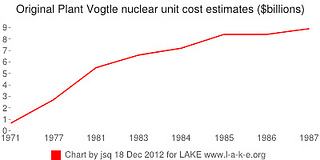
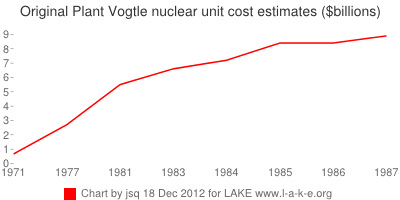
From $0.66 to $8.87 billion: original Plant Vogtle nuclear costs

Who could have expected that, given that back in the 1970s and
1980s

costs blew up 26 times the original estimate.

Back then SO complained about paperwork after Three Mile Island.
They're trying that same excuse now,
but even a former Commissioner-turned-lobbyist is incredulous,
as Kristi Swartz reported for the AJC yesterday,

Monitor: Paperwork problems a drag on Vogtle schedule
,

“It's taken eight months to handle paperwork
deficiencies?” asked Bobby Baker, a former PSC commissioner
who now represents Resource Supply Management, an energy consultant
that works with large commercial, institutional and industrial
electric customers.

A current Commissioner was almost as incredulous:

Continue reading

Original nuclear Plant Vogtle cost overruns

Why should we expect Southern Company to be any better at controlling
costs now than back in the 1970s and 1980s when its original
nukes on the Savannah River went massively over budget?
Massively as in 26 times as much per unit as originally projected.

Kristi Swartz wrote for the AJC 30 Jan 2012,

A financial look at Plant Vogtle nuclear projects
,


From $0.66 to $8.87 billion: original Plant Vogtle nuclear costs

When the two original nuclear units at Plant Vogtle were planned,
the total cost estimate was $660 million.

Yet, as

Jon Gertner reported for NYTimes 16 July 2006
,

The plant took almost 15 years to move from blueprints to being
operational. And by the time it began producing electricity in the
late 1980’s, its total cost, $8.87 billion, was so far overbudget
that Vogtle became yet another notorious example of the evils of
nuclear energy….

The grand plan was to have four reactors. Instead, it was scaled
back to two, Vogtle Unit 1 (finished in 1987) and Vogtle Unit 2
(1989).

That’s right, 4 nuclear units were planned for $660,000,000
fifteen (15) years later only 2 units were built,
for $8,870,000,000.
That’s more than $8 billion in cost overruns,
or more than 13 times the original cost estimate.
So per unit, that’s more than 26 times the original estimate,
or more than $4 billion per unit.

Swartz provided a handy table of cost estimates by year:

Continue reading

Renewables are Winning, Nukes are Dead, and Coal is Crashing


Somebody is willing to read the sunshine writing:

Renewables are Winning, Nukes are Dead and Coal is Crashing
, as
Kathleen Rogers and Danny Kennedy wrote for EcoWatch 14 Dec 2012.

As I wrote

back in April when formerly coal-plotting Cobb EMC went solar:

Coal is dead. Nuclear is going down.
Solar will eat the lunch of utilities that don’t start generating it.

Can Georgia Power and Southern Company (SO) read that handwriting on the wall?


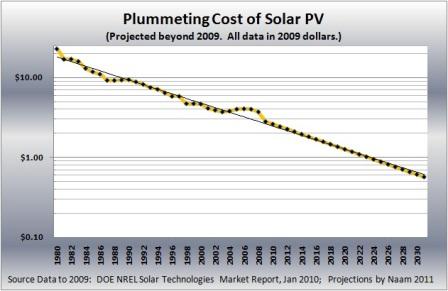
They can’t fight Moore’s Law, which has steadily brought the cost
of solar photovoltaic (PV) energy down for thirty years now, and
shows no signs of stopping.
This is the same Moore’s Law that has put a computer in your pocket
more powerful than a computer
that cost hundreds of thousands of dollars in 1982
and was used by an entire company.

Solar PV costs dropped 50% last year.

Already
all the new U.S. electric capacity installed this September
was solar and wind.

As this trend continues, solar will become so much more cost-effective
than any fossil or nuclear fuel power that nobody will be able to ignore it.

Rogers and Kennedy explained this phenomenon:

The seismic shift in how we all use cell phones and mobile technology to access the internet almost snuck up on the incumbent technologies and the monopolies that made money selling us landline telephones and a crappy service. Now, we’re all using apps on smartphones all of the time. So too, the shift to a scaled, solar-powered future built around the modular technology at the heart of solar power—the photovoltaic solar cell—will come as a surprise to many. We call it the solar ascent, and it is happening every day in a million ways.

Will SO and Georgia Power continue to prop up

that 1973 legal wall


that

inhibits solar financing in Georgia?

Companies and even economic development authorities are

starting to find ways around it,

and of course there’s

Georgia Solar Utilities (GaSU)
trying to

wedge into the law as a utility.

After Hurricane Sandy,

rooftop solar for grid outage independence

has suddenly hit the big time
(Austin Energy caught onto that back in 2003).
The

U.S. military got solar and renewable energy

back in Afghanistan and are now doing it bigtime everywhere.

SO and Georgia Power can try to ignore

Continue reading

Solar up 50% over last year in Germany


July in Germany

wasn’t a fluke:
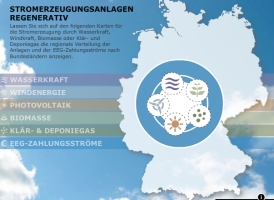
solar PV electricity production in Germany is up 50% over last year.
Maybe we hould consider a Feed-in Tariffs (FIT) in Georgia like that in Germany.
Unlike the Construction Work in Progress (CWIP) charge on Georgia Power
bills for nuclear power people won’t get for years, if ever, FIT charges
only apply after solar power is flowing.

Bloomberg Businessweek via AP 5 November 2012,

German solar power production up 50 pct on year
,


The German utilities’ industry association BDEW said Monday the
solar power output rose to 25,000 gigawatt hours in the January to
September period, from 16,500 gigawatt hours a year earlier.

It says solar power’s share in the country’s electricity production
rose to 6.1 percent from 4.1 percent. Wind power gained slightly to
8.6 percent from 8.0 percent. Biomass plants accounted for almost 6
percent.

It says all renewable energies combined accounted for about 26
percent of electricity production over the first nine months.

Germany decided last year to phase out nuclear power by 2022 and
replace it with renewable energies.


If you’re tired of Georgia Power and its parent Southern Company
pouring your customer and tax dollars down that nuclear pit near
the Savannah River, or if you’d just rather have solar or wind power,
you can send in your CWIP charge as a separate check, with a note on it.
Even if you’re not a Georgia Power customer, you can

contact them or Southern Company (or the GA PSC or the legislature)
about this.

-jsq

The power of going solar —John S. Quarterman


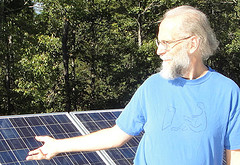
Solar panels on farm workshop --John S. Quarterman

My op-ed in the VDT today. Remember
to vote today or Tuesday.
-jsq

This spring,

the University at Buffalo
turned on 750 kilowatts of
solar electricity.

Rutgers U., in New Jersey,
installed 1.4
megawatts in 2009 and started on 8 MW this summer. Down here with a
lot more sun, how about solar panels on VSU parking lots?

There’s

plenty of private solar financing available.
Also in New
Jersey, a company installed 6 MW of solar on high school land and
leased the power to the school supplying most of its needs win-win.


You can go see a solar farm already working fine here,

200 kilowatts at Mud Creek Wastewater Plant.

Why not do the same


View Larger Map


at Lowndes High School,
where all the world on I-75 could see,

attracting business to our community?

Why not?

Continue reading

We can charge you even if it’s cancelled! —CWIPped Georgia Power


Steve Willis

An excellent article about the problems with Georgia Power’s
new nukes on the Savannah River gets at something you may not know:
they can charge you for them even if they’re cancelled!

Steve Willis wrote for the Georgia Sierran Oct./Nov./Dec. 2012 page 5,

Overruns, Uncertainty Plague Vogtle Expansion
,

If Southern Company abandons this
project, the CWIP law not only allows
Southern Company to keep all of the
CWIP payments legally extorted from
customers, but allows them to keep
CWIP fees in place or even increase them
until all their costs and profits have been
fully recovered. Due to the run-away
cost overruns, the CWIP charge on your
monthly bill is already more than three
times what Southern Company confidently
claimed it would be at this time
when they presented their case to “your”
Georgia legislature in 2009.

And that

2009 legislature

rubberstamped CWIP so it appears on your Georgia Power bill as

Nuclear Construction Cost Recovery Rider
.
Willis reminds us that the 2 nukes already at Plant Vogtle were projected
to be four nukes for $600 million and ended up being two for $9 billion.

Everyone has heard the saying “Fool me once, shame on you;
fool me twice, shame on me.” If the Vogtle expansion costs
balloon, as many analysts expect, it will cost

Continue reading

Georgia Power hikes prices for gas and nuclear, then complains about solar

Back in February,

Georgia Power's natural gas Plant McDonough

Georgia Power argued that a free market in solar power would cause
price increases.
Yet they already increased prices for natural gas and
for nuclear plants that won’t produce electricity for years, if ever,
and are already massively overbudget and behind schedule.
Why should we believe them about solar when it’s their archaic projects
they already
are deploying that already have increased customer prices?

In February,

Greg Roberts of Georgia Power argued,

Another reason is that the customers of Georgia Power, Georgia’s

Georgia Power is the snail in the way of solar power in Georgia

EMC’s and Municipal Electric Authority of Georgia are paying for the
poles and wires to transmit power, and the back-up generation to
cover the electricity needs when the sun isn’t shining. These costs
will have to be recovered from other customers not getting the
privileged deal from the developer, raising everyone else’s rates.

While there are already numerous federal and state tax and other
incentives for solar development in Georgia, it is still much more
costly than the service provided by utilities. But what if
third-party solar developers could get other electric customers in
Georgia to foot the bill? That would be the result of this
legislation.

It’s like asking Sally’s Café to pay the electric bill of Joe’s
Cafe across the street, thus allowing Joe to undercut Sally’s
prices.

Georgia Power well knows they could take a percentage of any power
transmitted through their lines, so that wires and poles and
backup generation argument is ludicrous.
And as far as subsidies, how about this one,

Georgia Power, Get the Facts, Investing in Georgia’s Energy Future:

Continue reading