Tag Archives: Plant Vogtle

From 15 to 19 months late: Plant Vogtle nukes

Surprise!
The already-billing but not-built new nukes at Plant Vogtle
are going to be even later and cost even more.
In December they were to be
15 months late;
now it’s 19 months late,
and the cost overrun expected is $740 million.
History is repeating itself from

the last time Southern Company
and Georgia Power built nukes on the Savannah River.

How about we pass

HB 267
to stop Georgia Power from charging that cost overrun to customers?

Kristi Swartz wrote for the AJC yesterday,

Vogtle nuclear project to take longer, cost more
,

Georgia Power’s Plant Vogtle nuclear expansion project will take
about 19 months longer to complete than originally expected and cost
about $740 million more than originally thought, the company said
Thursday.


Joseph A. “Buzz” Miller, Executive Vice President – Nuclear Development Southern Nuclear Operating Company

Georgia Power said its share of the estimated $14 billion project
will rise to $6.85 billion, up from $6.11 billion, because of
increased capital costs and additional financing costs. Customers,
who have been paying the financing costs since 2011, now will pay
them for a longer period of time.

And the amount Georgia Power customers have to pay
for

Construction Work in Progress (CWIP)
keeps
ratchetting up:

Continue reading

Want to finance solar? Call GA Sen. Jack Murphy today about SB 51


A Georgia Senate committee needs to take it up
a bill that would greatly ease financing
solar power for your housetop or business roof.
Sen. Jack Murphy is the chair, and you can contact him today.

GA SB 51,

The Georgia Cogeneration and Distributed Generation Act
,
was read to the Senate 16 January 2013
and referred to the Committee on

Regulated Industries and Utilities
.
Here’s contact information for the Chair of that Committee:

Continue reading

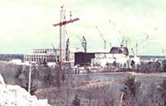
“It has to close because of the pocketbook.” —Kyle Jones on Maine Yankee nuclear power plant

Instead of demonstrating to influence legislators, sometimes it's better
to get elected and legislate: that's what Kyle Jones did in Maine,
and he closed the Maine Yankee nuke,
de-monopolized the state's electrical utilities,
and instituted a 30% renewable energy goal.
All this was helped by the nuclear industry's own incompetence.

Bangor Daily News, Page A2, 28 May 1997,

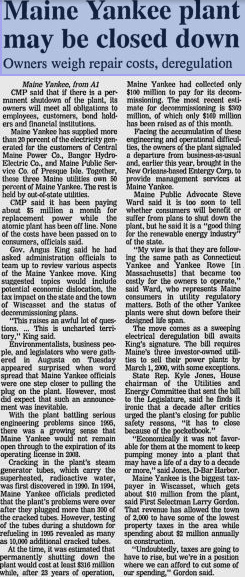
Maine Yankee plant may be closed down: Owners weigh repair costs, deregulation
,


Page 2A Bangor Daily News 28 May 1997

Cracking in the plant's steam generator tubes, which carry the superheated,
radioactive water, was first discovered in 1990.
In 1994, Main Yankee officials predicted that the plant's problems
were over after they plugged more than 300 of the cracked tubes.
However, testing of the tubes during a shutdown for refueling in 1995
revealed as many as 10,000 additional cracked tubes.

Sounds a lot like

San Onofre.

At the time, it was estimated that permanently shutting down
the plant would cost at least $316 million while,
after 23 years of operation, Maine Yankee had collected only
$100 million to pay for its decommissioning. The most recent
estimate for decommissioning is $369 million, of which
only $169 million has been raised as of this month.

Facing the accumulation of these engineering and operational difficulties,
the owners of the plant signaled a departure from business-as-usual
and, earlier this year, brought in the New Orleans-based Entergy Corp.
to provide management services at Maine Yankee.

Oh, my!
The same Entergy that's now

likely to close Vermont Yankee.

And Vermont Yankee wasn’t the first to follow this financial path to closure:

Continue reading

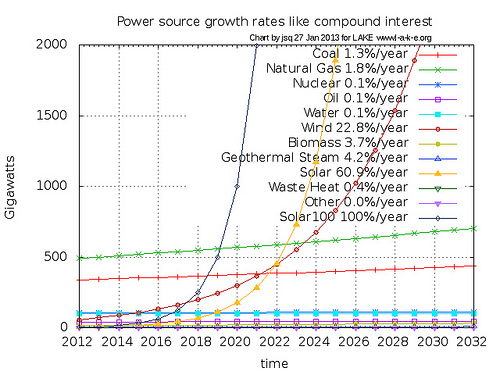
Power source growth rates like compound interest

What if instead of
projecting percentages
, we project gigawatts from
FERC’s December 2012 Installed Operating Generating Capacity table?
Solar and wind still win in less than a decade.


FERC 2012 power source gigawatts and growth rates projected 20 years

Ignore the fastest-growing curve for a moment; I added that.
All the other curves start with the December 2012 gigawatts
for each power source in the FERC table, and an annual compound
growth rate computed by comparing that installed operating capacity
to the capacity added in 2012 for that power source.
That compound annual growth rate for solar is 60.9% and for wind is 22.8%.
Nothing else comes close.

Solar passes coal in about 8 years, wind in about 9, and natural gas in
about

Continue reading

GA SB 51, The Georgia Cogeneration and Distributed Generation Act


Georgia Senator Buddy Carter
has introduced a Senate bill for the current
session of the legislature,

SB 51,
“The Georgia Cogeneration and Distributed Generation Act of 2001”.

It attempts to fix
Georgia’s special solar financing problem,
the antique 1973 Territorial Electric Service Act.

Why 2001?
Apparently Buddy Carter has been introducing it every year since then.
Last year

Georgia Power’s disinformation campaign

nuked it when it was

SB 401.

Has the legislature gotten tired of Georgia Power and its parent the Southern
Company being
way late and overbudget on those new nukes?

Does the legislature want Georgia citizens to get the savings and job
benefits of

the fastest growing energy source in the country?

Will
GaSU help
with SB 51, or only with GaSU’s attempt to become a solar
monopoly utility?
You can contact your legislators and tell them what you think.
Every one of them who

voted for Georgia Power’s stealth-tax rate hike for that nuke boondoggle

should vote for SB 51 to start getting Georgia on a clean path to jobs
and energy independence.

This bill is not perfect:
it counts

“generator fueled by biomass”

as

Continue reading

Failed concrete: the bane of nuclear reactors

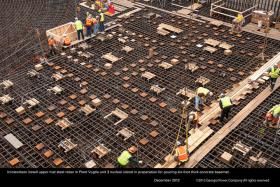
Let’s not forget the failed concrete on which

Plant Vogtle’s unprotected stranded reactor vessel
is supposed to sit.

A week before

the reactor vessel train wreck,
news stories
said concrete pouring was delayed due to “noncompliant rebar”.
Thomas Clements elaborated for the Aiken Leader 14 January 2013,

Vogtle AP1000 Nuclear Reactor Vessel Discovered Unprotected, Stranded in Savannah Port since December 15 Shipment Failure
,


Due to chronic delays in the pouring of “nuclear
concrete” for the basemat of the AP1000 units at Vogtle and VC
Summer, it remains unknown when or if any reactor vessels can
actually be placed into the excavated holes at the sites. A January
10 meeting of the NRC confirmed that another basemat-related
“license amendment request” (LAR) was soon to be filed
by SCE&G for its AP1000 project and that the target date for
granting of the LAR was March 18. It appears that the Vogtle project
has fallen behind the V.C. Summer project and no strategy for the
filing of a similar and necessary LAR by Southern Company is known.


Concrete, the long-time bane of

Seabrook Station

and also what’s keeping

Crystal River
shut down because nobody wants to pay the
billions of dollars it would take to fix it.


What say we call the whole thing off, like
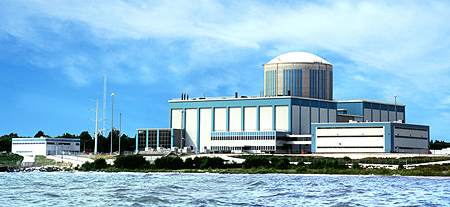
Dominion Power did with its existing

Kewaunee nuke
,
and
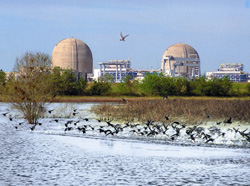
TEPCO and NRG did

with their plans for new South Texas nukes
.


Maybe it’s a sign that meanwhile

Google has invested a billion dollars in wind and solar
and gotten
2 gigawatts of power, almost as much as the 2.2 GW the two new Vogtle nukes
were supposed to produce, except Google’s solar and wind projects
are online on time, and for less than just the cost overruns at Vogtle.

The Georgia legislature is in session.
You can contact

your legislator or the PSC
today
about

toppling Southern Company’s three-legged nuclear regulatory-capture stool

and

fixing that 1973 Territoriality Law

so we can get on with solar and wind in Georgia,
for jobs and energy independence, and oh by the way clean air and
plenty of clean

water
.

-jsq

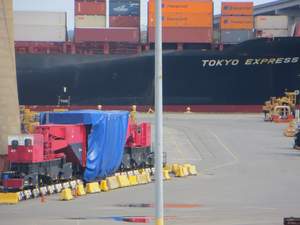
Vogtle reactor vessel sitting unprotected at Savannah port

What happened to Plant Vogtle’s new reactor vessel after

it was in a train wreck
a week ago?
It went back to Savannah port and sits there unprotected and unguarded.

Thomas Clements wrote for the Aiken Leader 14 January 2013,

Vogtle AP1000 Nuclear Reactor Vessel Discovered Unprotected, Stranded in Savannah Port since December 15 Shipment Failure
,


Tom Clements, Alliance for Nuclear Accountability

The reactor pressure vessel (RPV) for the chronically delayed Vogtle
AP1000 reactor construction project near Waynesboro, Georgia sits
stranded and seemingly unprotected in the port of Savannah. The
special railroad car carrying the 300-ton vessel had unknown
mechanical problems on December 15 on exiting the port. The NRC has
said that the vessel only got one-quarter mile before a sound was
heard and the car stopped. Plans by Westinghouse and Southern
Company to move the vessel are unknown. It is also unknown if the
railroad car can be repaired and used or if the railroad company
which owns the line is concerned that the rail car might break down
again on its line in an in accessible place. Meanwhile, the
apparently unguarded reactor might be subject to sabotage and sits
in apparent violation of NRC quality assurance and “administrative
control” regulations.

The article includes links to several more pictures
taken 13 January 2013 by Tom Clements of

Alliance for Nuclear Accountability,

such as this one with the bridge clearly visible:

Continue reading

The water is not lost. —Forrest H. Williams


Valdosta resident Forrest H. Williams replied in the VDT today to

my op-ed of 6 January.

His information seems a bit out of date.
For example, he cites

Progress Energy’s Crystal River nuke

as a good example, when it’s been

down since 2009

and is still

producing zero percent power
,
both according to the NRC.
Readers of this blog know that

the blog version of my op-ed

already links to sources for everything I said.
I may respond more later, but no doubt there are other people
who want to get involved in this discussion.
And I do thank Forrest H. Williams for airing the sort of disinformation
that is out there, so others can dispel it.

Oh, and saying water that is evaporated is not lost is like saying trees that are burned are not lost. Evaporated water is not available for agricultural or wildlife or drinking water use, and thus is indeed lost.

Continue reading

Google invests in wind and solar

While Southern Company and Georgia Power pour money
down that nuclear pit by the Savannah River and Progress Energy can’t
afford to fix its Crystal River nuke, Google’s
wind and solar projects are already online on time,
all for less than the cost overruns so far at Vogtle
or the fix-it price at Crystal River.

David Goldman wrote for CNN Money 10 January 2013,

Google invests $200 million in Texas wind farm
,


“We look for projects like Spinning Spur because, in addition to
creating more renewable energy and strengthening the local economy,
they also make for smart investments,” Kojo Ako-Asare, Google’s
senior manager of corporate finance, said in a

blog post
.

Ako-Asare added that wind farms offer “attractive returns relative
to the risks.”

Which is the opposite of nuclear’s

huge risks
relative to the

apparently negative returns.

So how much wind and solar energy does Google generate?

Continue reading

Vogtle nuclear reactor train wreck

Ever wondered what a nuclear reactor vessel looks like?
Here’s one that’s literally a train wreck,
on its way to Plant Vogtle on the Savannah River.

Rob Pavey wrote for the Augusta Chronicle 10 January 2013,

Vogtle reactor vessel slips between Savannah, Burke County
,


A 300-ton reactor vessel bound for Plant Vogtle was stranded briefly
in south Georgia this week after a malfunction with the specially
designed rail car moving the nuclear component from Savannah to
Burke County. Workers examine a rail car that was transporting a
300-ton reactor vessel from the Port of Savannah to the Plant Vogtle
nuclear site in Burke County. A misalignment between the cargo
platform and the rail car caused the component to be returned to
Savannah.

“The platform that contained the RV (reactor vessel) during
transport became misaligned with the Schnabel railcar, so the
railcar stopped immediately,” said Georgia Power Co. spokesman
Mark Williams. “The platform and car were re-aligned the same
day and safely returned to the port.”

The Schnabel railcar, which features extra axles that help
distribute and support the weight of heavy objects, did not break,
he said. Georgia Power would not divulge the location of the
incident.

I wonder what the locals think.
We’d ask them, if we knew where they were.

Well, that’s the only mishap so far, right?

Continue reading