Tag Archives: Coal

Overwhelming majority of Americans want clean water and renewable energy –poll


A
new poll
says 94% want new energy balanced with clean air and water, 86% want to shift from coal and nuclear to wind and water power, and 79% are concerned about shale gas fracking affecting water quality.

A few excerpts from the PR

Water is High Priority for Bipartisan Majority of Americans
,
10 January 2013,

  • 92 percent of Americans think “U.S. energy planning and
    decision making” should be based on “a comprehensive
    understanding of what our national water resources are”
    — a national water roadmap that Congress asked for, but which
    was never produced. The national water roadmap attracts the support
    of 92 percent of Republicans, 89 percent of Independents, and 94
    percent of Democrats.
  • 86 percent of Americans want leadership on shifting from coal and
    nuclear energy to wind and solar. Support for this approach exists
    across party lines, including 72 percent of Republicans, 83 percent
    of Independents, and 97 percent of Democrats.
  • 86 percent of Americans “support more studies of the health
    and environmental consequences of the chemicals” used in
    fracking. Supporters of this approach include 81 percent of
    Republicans, 84 percent of Independents, and 89 percent of
    Democrats.
  • Three quarters of Americans have heard of fracking, with 51 percent
    saying they are very or somewhat familiar with it. 79 percent of
    Americans are concerned about fracking “as it relates to water
    quality.”

What is to be done?

Continue reading

The water is not lost. —Forrest H. Williams


Valdosta resident Forrest H. Williams replied in the VDT today to

my op-ed of 6 January.

His information seems a bit out of date.
For example, he cites

Progress Energy’s Crystal River nuke

as a good example, when it’s been

down since 2009

and is still

producing zero percent power
,
both according to the NRC.
Readers of this blog know that

the blog version of my op-ed

already links to sources for everything I said.
I may respond more later, but no doubt there are other people
who want to get involved in this discussion.
And I do thank Forrest H. Williams for airing the sort of disinformation
that is out there, so others can dispel it.

Oh, and saying water that is evaporated is not lost is like saying trees that are burned are not lost. Evaporated water is not available for agricultural or wildlife or drinking water use, and thus is indeed lost.

Continue reading

Help Sierra Club send a message to Georgia Power CEO Bowers


Georgia Sierra Club’s Beyond Coal campaign probably contributed to

Georgia Power’s recent decision
to shut down some coal plants.
Now Sierra Club offers a petition to ask Georgia Power CEO Paul Bowers
to go farther, and replace those coal plants with solar offshore wind power
for jobs and health for Georgia.


Dirty Coal is Out, Help Usher Clean Energy In!

Georgia Power recently announced their plans to retire three of
their oldest and dirtiest coal fired power plants.


Now, we must send
a clear message to Georgia Power’s leadership that we want to keep
Georgia Jobs by investing in homegrown clean energy and energy
efficiency to power our homes and businesses.

Send a message to Georgia Power CEO Paul Bowers telling him to
replace dirty coal with investments in homegrown clean energy and
energy efficiency that can produce thousands of lasting Georgia
jobs.

It’s a petition; details here.

Seth Gunning
explained why

in Sierra Club PR:

Continue reading

Nukes economically hard to justify —GE CEO Immelt

The CEO of General Electric,
the company that designed the reactors

at Fukushima and Hatch 1 and 2,

said nukes are economically hard to justify.
And that was back in July, before
the first new nukes permitted in 30 years,
at Plant Vogtle on the Savannah River,

slipped 15 months.

What’s winning? Shale gas, temporarily, but that’s just a bump
in the road on the way to wind and solar power.

Pilita Clark wrote for Financial Times 30 July 2012,

Nuclear ‘hard to justify’, says GE chief
,


Nuclear power is so expensive compared with other forms of energy
that it has become “really hard” to justify, according
to the chief executive of General Electric, one of the world’s
largest suppliers of atomic equipment.

“It’s really a gas and wind world today,” said Jeff
Immelt, referring to two sources of electricity he said most
countries are shifting towards as natural gas becomes
“permanently cheap”.

“When I talk to the guys who run the oil companies they say
look, they’re finding more gas all the time. It’s just hard to
justify nuclear, really hard. Gas is so cheap and at some point,
really, economics rule,” Mr Immelt told the Financial Times in
an interview in London at the weekend. “So I think some
combination of gas, and either wind or solar … that’s where we see
most countries around the world going.”


GE CEO Immelt may also want to talk to GE’s own research director

Continue reading

Putting conservation into conservatives —John S. Quarterman

My op-ed in the VDT today. -jsq

Gov. Deal
(WABE, 14 Nov 2012)
temporarily forgot that “conservative”
includes conserving something,


like

Theodore Roosevelt and national parks
,
or when

Franklin D. Roosevelt established the Okefenokee National Wildlife
Refuge
which also

administers Banks Lake,
when

Richard Nixon started the EPA,

and when

Jimmy Carter signed the Soil and Water Conservation Act.

If Gov. Deal wants to call conservation “liberal”, I’m happy to
be a liberal working for water for our state!


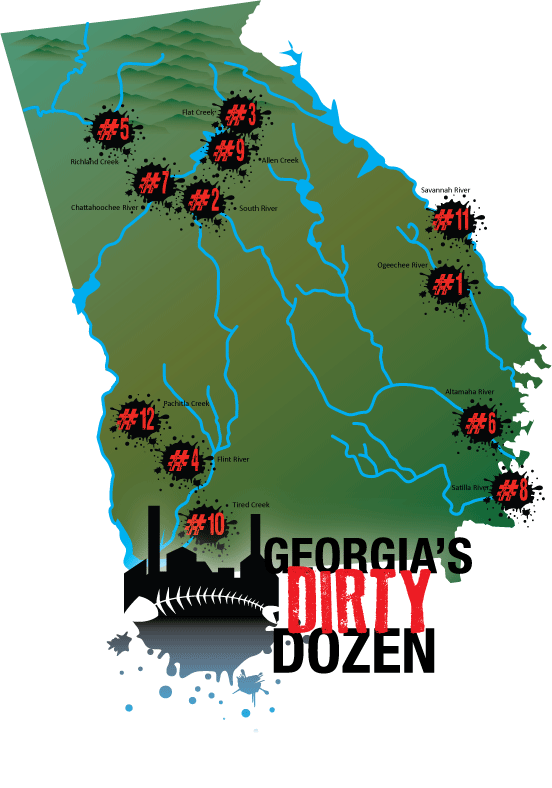
Georgia Water Coalition’s Dirty Dozen


listed the biggest boondoggle
of all as

#11: the nuclear reactors at Plant Vogtle

suck up more water from the Savannah River than all local agriculture and almost
as much as the city of Savannah.

If the new Plant Vogtle nukes

are ever completed,
all four will use more water than Savannah. In

2009 the legislature approved and Gov. Deal signed a law

letting Georgia
Power charge its customers in advance for building that boondoggle,
to the tune of

about $1.5 billion so far!

Let’s not forget

Continue reading

Carbon bubble? Solar and wind erode coal, gas, and biomass credit quality —Moody’s


In Europe it’s already happening: solar and wind are causing
bond-rater Moody’s to warn of downgrades of energy companies
that depend on heat from burning coal, gas, or biomass.
Moody’s earlier even warned the Bank of England
of a potential carbon bubble developing.
If combustion energy plants are affected like this,
the credit effects will be even bigger on even-more-expensive
nuclear plants, which Moody’s called a

bet-the-farm risk
way back in 2009.

James Murray wrote for businessGreen 6 Nov 2012,

Moody’s: Renewables boom poses credit risk for coal and gas power plants:
Credit ratings agency warns increases in renewable power have had ‘a
profound negative impact’ on the competitiveness of thermal
generation companies
,

“Large increases in renewables have had a profound negative impact
on power prices and the competitiveness of thermal generation
companies in Europe,” said Scott Phillips, an assistant vice
president and analyst at Moody’s Infrastructure Finance Group, in a
statement.

“What were once considered stable companies have seen their business
models severely disrupted and we expect steadily rising levels of
renewable energy output to further affect European utilities’
creditworthiness.”

And not just rising, rising increasingly

Continue reading

Fake fracking reports: professor and institute head quit, other institute disbanded

From Austin to Buffalo, fake science for fracking is increasingly being exposed,

Frack U

with academic consequences: lead professor resigns,
institute head quits, another institute disbanded.
The image on the right (Frack U) is not a reputation any university wants to see.
At least academia takes conflicts of interest seriously;
now if government and the voters would do the same….
Or energy companies.
Remember, shale gas (plus nuclear) is what Georgia Power and
Southern Company are shifting to from coal,
while shading us from the finances that would enable solar power
for jobs and energy independence in south Georgia.

Terrence Henry
wrote for NPR 6 December 2012,

Review of UT Fracking Study Finds Failure to Disclose Conflict of Interest (Updated)

The original report by UT Austin’s Energy Institute,


‘Fact-Based Regulation for Environmental Protection in the Shale Gas
Development,’
was released early this year, and claimed that there
was no link between fracking and water contamination. But this
summer, the

Public Accountability Initiative
, a watchdog group,
reported that the head of the study, UT professor Chip Groat, had
been sitting on the board of a drilling company the entire time. His
compensation totaled over $1.5 million over the last five years.
That prompted the University to announce an independent review of
the study a month later, which was released today.

The review finds many problems with the original study, chief among
them that Groat did not disclose what it calls a “clear
conflict of interest,” which “severely diminished”
the study. The study was originally commissioned as a way to correct
what it called “controversies” over fracking because of
media reports, but ironically ended up as a lightning rod itself for
failing to disclose conflicts of interest and for lacking scientific
rigor.

Unrepentant
as recently as July,
Professor Groat resigned in November.
Plus this:

Raymond Orbach of UT’s Energy Institute has resigned after the group
became engulfed in controversy over a study of fracking.

And elsewhere even more drastic results have ensued:

Continue reading

Renewables are Winning, Nukes are Dead, and Coal is Crashing


Somebody is willing to read the sunshine writing:

Renewables are Winning, Nukes are Dead and Coal is Crashing
, as
Kathleen Rogers and Danny Kennedy wrote for EcoWatch 14 Dec 2012.

As I wrote

back in April when formerly coal-plotting Cobb EMC went solar:

Coal is dead. Nuclear is going down.
Solar will eat the lunch of utilities that don’t start generating it.

Can Georgia Power and Southern Company (SO) read that handwriting on the wall?


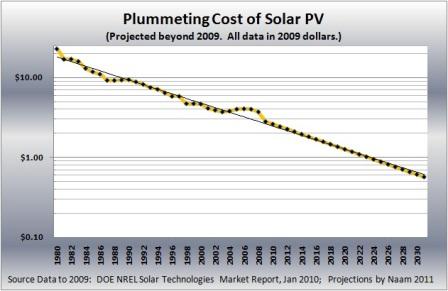
They can’t fight Moore’s Law, which has steadily brought the cost
of solar photovoltaic (PV) energy down for thirty years now, and
shows no signs of stopping.
This is the same Moore’s Law that has put a computer in your pocket
more powerful than a computer
that cost hundreds of thousands of dollars in 1982
and was used by an entire company.

Solar PV costs dropped 50% last year.

Already
all the new U.S. electric capacity installed this September
was solar and wind.

As this trend continues, solar will become so much more cost-effective
than any fossil or nuclear fuel power that nobody will be able to ignore it.

Rogers and Kennedy explained this phenomenon:

The seismic shift in how we all use cell phones and mobile technology to access the internet almost snuck up on the incumbent technologies and the monopolies that made money selling us landline telephones and a crappy service. Now, we’re all using apps on smartphones all of the time. So too, the shift to a scaled, solar-powered future built around the modular technology at the heart of solar power—the photovoltaic solar cell—will come as a surprise to many. We call it the solar ascent, and it is happening every day in a million ways.

Will SO and Georgia Power continue to prop up

that 1973 legal wall


that

inhibits solar financing in Georgia?

Companies and even economic development authorities are

starting to find ways around it,

and of course there’s

Georgia Solar Utilities (GaSU)
trying to

wedge into the law as a utility.

After Hurricane Sandy,

rooftop solar for grid outage independence

has suddenly hit the big time
(Austin Energy caught onto that back in 2003).
The

U.S. military got solar and renewable energy

back in Afghanistan and are now doing it bigtime everywhere.

SO and Georgia Power can try to ignore

Continue reading

New biomass plant near Dublin, GA: what it’s really about

Not really about jobs, and not about feeding electricity into the grid:
the new biomass plant near Dublin, GA is about saving that company money on electricity: but at what cost to the state and to local residents?


Mike Stucka wrote for Macon.com 6 December 2012,

Deal announces $95 million biomass power plant for Laurens County
,

A new biomass power plant announced Thursday is expected to bring
hundreds of related jobs and a direct $95 million investment.

A statement from the office of Gov. Nathan Deal said the plant
itself will bring 35 permanent jobs to Laurens County.

Compare 35 permanent jobs for $95 million to

MAGE SOLAR’s 350 jobs for $30 million
.
That’s about $2,700,000 per job for this deal,
vs. $85,714 per job for MAGE SOLAR.
Which would make MAGE SOLAR’s facility more than 30 times more effective
at producing permanent jobs.

OK, but what’s this one supposed to do?

Continue reading

How to stop climate change: divest from fossil fuel companies

In response to a very downbeat

diatribe by Bill McKibben in Rolling Stone on the occasion
of the U.N.’s Rio+20 conference
being some sound and less fury accomplishing
not much about stopping climate change,
[Bill McKibben, Rolling Stone, 19 July 2012, “Global Warming’s Terrifying New Math: Three simple numbers that add up to global catastrophe – and that make clear who the real enemy is”]


Chloe Maxmin, Divest Harvard

Harvard student Chloe Maxmin

followed up McKibben’s problem statement with a plan for what to do:

divest from fossil fuel companies. [“In Honor of Kalamazoo: An Open Letter to Bill McKibben,” NextGenJournal, 25 July 2012, no longer online, referred to in a post the same day by Chloe Maxmin on First Here, Then Everywhere.]

Maxmin didn’t just wish, either,
she joined up with McKibben’s 350.org and helped organize
Harvard students to do something about it:
persuade Harvard to divest its shares of fossil fuel companies.
Students at the University of Georgia, or at Valdosta State University,
for that matter, could do the same.

Alli Welton wrote for 350.org 18 November 2012,

72% of Harvard Students Vote to Divest from Fossil Fuels
,

Last Friday night, the Harvard College Undergraduate Council
announced that the student body had voted 72% in favor of Harvard
University divesting its $30.7 billion endowment from fossil fuels.

Members of the Harvard chapter of Students for a Just and Stable
Future have been campaigning since September to divest Harvard’s
endowment from the top 200 publicly-traded fossil fuel corporations
that own the majority of the world’s oil, coal, and gas reserves.

Harvard actually already has divested its shares of one fossil fuel company
due to public pressure.

Continue reading