Tag Archives: Coal

$1.88 billion and more on Kemper Coal to be charged to Mississippi Power customers


Risks at

Southern Company’s Kemper Coal plant in Mississippi
?
Push those costs onto the public, of course!
Southern Company and its subsidiary Mississippi Power
got the MS Public Service Commissioners to approve super-CWIP
(Construction Work in Progress)
for Kemper Coal: automatic rate increases for MS Power customers for years.
Just like Southern Company and its biggest subsidiary Georgia Power
got the Georgia legislature to approve Super-CWIP for the new nukes
at Plant Vogtle back in 2009.
And both CWIP projects are already over budget.
How about we cancel those boondoggles and build solar and wind instead?

AP reported 13 December 2012,

After spending $1.88 billion, Southern Co. still faces risks on plant in Kemper County
,

Continue reading

Let the Sun Shine: Fact versus Fiction —Michael G. Noll

LTE in the VDT today. I’ve added a few links. -jsq


Fox News recently claimed that “solar won’t work in America because
it’s not as sunny as Germany”. Such statements are common for a
network that has long lost its credibility. Unfortunately too many
take such gibberish at face value. Thus columns like

“environmentalism or obstructionism?”
are not
surprising, but in the end it’s the facts that matter:

  • Global warming is real. For years we have been experiencing record
    heat waves, droughts, wild fires, etc., and while seawater levels
    are rising, storms like hurricane Sandy become major threats

    to low lying areas along coast lines
    .
  • The main culprit for global warming are greenhouse gases like
    carbon dioxide, resulting from the burning of fossil fuels,
    especially coal and oil.
  • While China overall emits more than we do, the US leads in per
    capita emissions. The average US citizen produces three times more
    carbon dioxide than the average Chinese citizen.

Continue reading

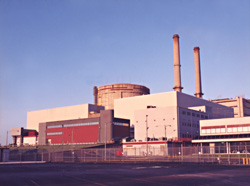
Duke Energy is closing Crystal River nuclear reactor


Finally!
The reactor
only 160 miles from here

that

nobody wanted to pay to fix

is closing for good: Duke is closing Crystal River.
After Kewaunee and Crystal River closing, which one is next?
San Onofre?
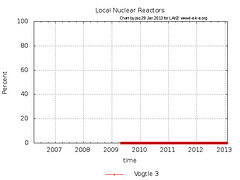
The never-opened Vogtle 3 and 4?

Ivan Penn wrote for Tampa Bay Times today,

Duke Energy announces closing of Crystal River nuclear power plant
,

Duke Energy announced early Tuesday it will permanently close the
Crystal River nuclear plant that has been shut down since late 2009.


The company said it is reviewing alternatives, including building a
new natural gas plant, to replace the power produced by the nuclear
facility.

Duke's four coal-fired plants will remain in service at the same
Citrus County complex where the nuclear plant, known as CR3, is
located.


How about they build
offshore wind farms
and solar farms
instead, like

TEPCO is doing near Fukushima
?
Those can be built on time and on budget, use no fuel, and cause no pollution.
And how about

rooftop solar for jobs
and energy independence?

There's more in

the article,

including this:

Continue reading

Denmark beats Georgia Power’s 20 year plan


As

anticipated,

Georgia Power released
that

20-year energy plan Thursday,

because they have file one every three years with the PSC.
It includes far less solar power than tiny little far-north-of-here
Denmark is busily deploying.


The good news:
Georgia Power is closing a bunch of coal plants.
And this plan makes a nod towards
"demand response programs, energy efficiency programs, pricing
tariffs and other activities".

The bad news:
they're replacing those coal plants with natural gas, and of course
"two new state-of-the-art nuclear facilities at Plant Vogtle";
you know, the two

Georgia Power has been charging customers for since 2009
while they deliver no electricity.

Georgia Power
can't even seem to deliver the reactor containment vessels.

But what about renewable energy?

Continue reading

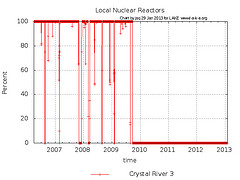
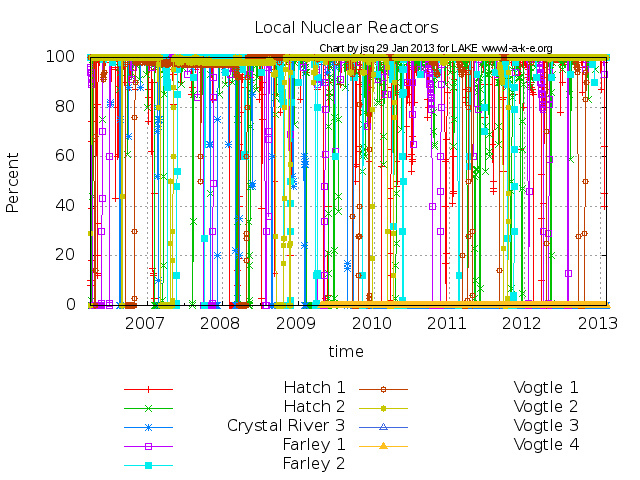
NRC Power Reactor Status Reports Graphed

Do you know how many outages nuclear reactors near here have had?
Probably not, because that’s usually not in the news,
and you have to dig into day by day NRC reactor status reports
to find out.
It turns out nuclear power is 0/7 instead of 24/7 on many a day.

Looking at all nine
nuclear reactors within 200 miles of here,
the graph drips downtime like tears.


Reactors within 200 miles

The available data on NRC’s website and graphed here goes back to 31 March 2006,
through 29 January 2013.
Let’s look at each of our closest reactors one by one. Hatch 1 on the Altamaha River,
in addition to its recent

40% power on 21 January and 87% on 5 January
,
has had quite a few outages:

Continue reading

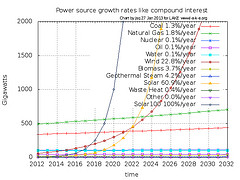
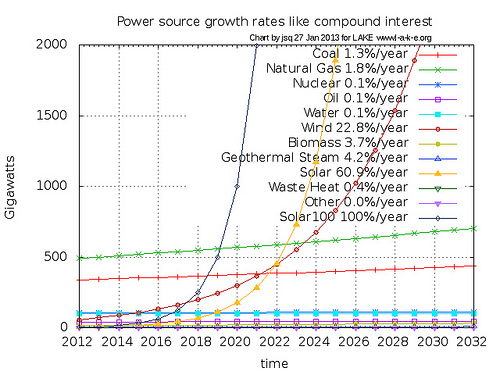
Power source growth rates like compound interest

What if instead of
projecting percentages
, we project gigawatts from
FERC’s December 2012 Installed Operating Generating Capacity table?
Solar and wind still win in less than a decade.


FERC 2012 power source gigawatts and growth rates projected 20 years

Ignore the fastest-growing curve for a moment; I added that.
All the other curves start with the December 2012 gigawatts
for each power source in the FERC table, and an annual compound
growth rate computed by comparing that installed operating capacity
to the capacity added in 2012 for that power source.
That compound annual growth rate for solar is 60.9% and for wind is 22.8%.
Nothing else comes close.

Solar passes coal in about 8 years, wind in about 9, and natural gas in
about

Continue reading

Georgia Power to announce 20-year plan Thursday

What will Georgia Power announce for a 20 year energy plan Thursday?
Will they (1) just double down on their rate-hike boondoggles for

nuclear
and

gas
,
or (2) they could flip like

Austin Energy in 2003
and

Cobb EMC in 2012

and suddenly go solar?
The wording here looks like it’s going to be the former.
That they even feel compelled to announce some sort of formal plan instead of just

shovelling disinformation out another 50 years

indicates they’re feeling

the pressure to change direction

to real sustainable energy: wind and solar power.

Matt Shedd wrote for WUGATV today,

Georgia Power To Release Energy Plan
,

Georgia Power is set to release a 20-year energy plan on Thursday


which will outline a way for the company and the state to be less
reliant on coal power. The AJC reports that just 5 years ago, the
company’s reliance on coal was at 70 percent.

That number has now dropped to 47 percent. These changes are coming
in the wake of Georgia Power’s parent, the Southern Co., being
pushed by environmental rules to rely less on coal. Georgia Power
won approval to buy electricity produced by natural gas from its
sister company Southern Power, which may be part of the company’s
future plans.

Thomas A. Fanning, CEO of Georgia Power’s parent The Southern Company (SO),
has been touting 70% to 35% reduction in coal since at least

May 2012 at the SO shareholder meeting.

Fanning continues to

emphasize nuclear, gas, and “clean coal”

instead of real sustainable energy, namely wind and solar power.
He also continues to assert electricity demand will increase,
while

ignoring conservation and efficiency,
which for Georgia
could remove all need for new energy,
enabling solar and wind to shut down more coal and gas plants,
as well as nukes.

So, get out the popcorn and take your bets.
Will it be (1) or will it be (2)?
I’m betting this time it will be (1), but sooner or later it will be (2),
and even Georgia Power, and yes, even Southern Company,
will stop digging in their heels and get on the solar
train to profits, jobs, energy independence, and oh, by the way, clean
air and plenty of clean water.

-jsq

Solar energy growth like compound interest

Some nuclear backers only want to look at the
next table in that FERC report,

Office of Energy Projects
Energy Infrastructure Update
For December 2012
,
which shows solar energy as 0.34% of total U.S. energy production,
and then they stop thinking.
But what about

that 30% increase in solar power deployed
between 2011 and 2012?

Think of it like compound interest.

Total Installed Operating Generating Capacity
Installed Capacity (GW) % of Total Capacity % Growth 2011-2012
Coal 337.71 29.17% 1.3%
Natural Gas 491.82 42.48% 1.8%
Nuclear 107.01 9.24% 0.1%
Oil 41.32 3.57% 0.1%
Water 98.12 8.47% 0.1%
Wind 57.53 4.97% 22.8%
Biomass 15.00 1.30% 3.7%
Geothermal Steam 3.70 0.32% 4.2%
Solar 3.90 0.34% 60.9%
Waste Heat 0.69 0.06% 0.4%
Other 1.04 0.09% 0.0%
Total 1,157.86 100.00% 23.3%

Source: Data derived from Ventyx Global LLC, Velocity Suite.

Growth rates computed by jsq for LAKE www.l-a-k-e.org 24 January 2013.

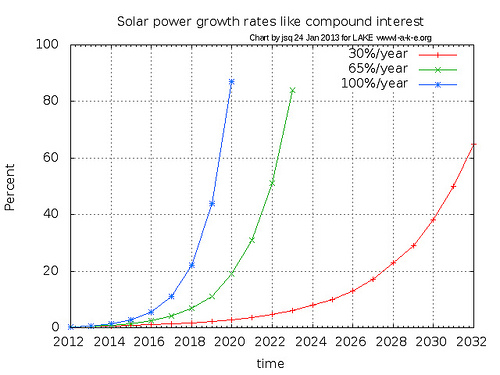
Let’s look what happens if we assume 30% growth in solar power deployed per year:


Solar power growth rates like compound interest

At 30% annual growth,
we’re up to solar as 50% of all generation
within

Continue reading

New U.S. energy in 2012 —FERC


What new energy sources are being deployed the fastest in the U.S.?
According to FERC, the Federal Energy Regulatory Commission,
it’s not what you may think.
The big winners are coal, wind, and solar.

According to the report

Office of Energy Projects
Energy Infrastructure Update
For December 2012
,
Coal, while accounting for only 17% of new capacity in 2012,
unfortunately increased by 133% over new capacity installed in 2011.
Natural gas did account for the second most new installed capacity in 2012,
33%, but the amount in megawatts installed actually decreased by 20%
from 2011.

The most new capacity installed in 2012?
Wind, at 40%, with a 56% increase over new installations in 2011.
That’s right, wind beat natural gas 40% to 33% in total new capacity in 2012,
and whomped gas in increase in new capacity in 2011, by 56% to -20%.

While solar only accounted for 5.59% of new capacity in 2012,
that was an increase of 30% over new capacity in 2011,
which is way more than gas and after only coal and wind.

New Generation In-Service (New Build and Expansion)
December 2012 January – December 2012 Cumulative January – December 2011 Cumulative Percent of Total New 2012 Percent Increase 2011- 2012
Primary Fuel Type No. of Units Installed Capacity (MW) No. of Units Installed Capacity (MW) No. of Units Installed Capacity (MW)
Coal 4 1,434 8 4,510 15 1,932 17.1% 133%
Natural Gas 6 2,306 94 8,746 108 11,020 33.1% -20.6%
Nuclear 0 0 1 125 0 0 0.474% -%
Oil 0 0 19 49 66 136 0.186% -64%
Water 2 4 13 99 41 94 0.375% 5.32%
Wind 45 3,095 164 10,689 146 6,844 40.5% 56.2%
Biomass 5 91 100 543 131 446 2.06% 21.7%
Geo- thermal Steam 2 9 13 149 9 56 0.565% 166%
Solar 16 77 240 1,476 354 1,131 5.59% 30.5%
Waste Heat 0 0 1 3 2 136 0.0114% -97.8%
Other 2 0 5 0 11 0 0% -%
Total 82 7,016 658 26,387 883 21,795 100% 21.1%

Source: Data derived from Ventyx Global LLC, Velocity Suite.

Last two columns added by jsq for LAKE www.l-a-k-e.org 24 January 2013.

Biomass unfortunately accounted for

Continue reading

China, etc., mining uranium in Niger and Mali

A commenter on
Mali: a French War for Uranium
suggested that if "that zone" (presumably
the Sahara in Mali and Niger)
were such an El Dorado the U.S. and the Chinese would have long been interested.
Actually, it turns out numerous countries are involved, especially along
the
Uranium Highway in the Uranium Province in Niger.
Not the Americans so much, but definitely the Chinese.


According to

World Information Service on Energy Uranium Project
,
in

Mali
, it's the Canadians (Cascade Resources Ltd.,
Northern Canadian Uranium Inc., Rockgate Capital Corp.) and
the Australians (Oklo Uranium Ltd).:

The following companies are performing uranium prospection and/or exploration in Mali:


Cascade Resources Ltd. ,
Northern Canadian Uranium Inc. ,
Rockgate Capital Corp. ,
Oklo Uranium Ltd


Faléa uranium/silver project

> View deposit info
Opposition to uranium mining in Faléa: Association des ressortissants et
amis de la Commune de Faléa (ARACF)

Pre-Feasibility study on Faléa mine project started:


On Nov. 15, 2012, Rockgate Capital Corp. announced the commencement of a Pre-Feasibility study on its Faléa U-Ag-Cu project in south-west Mali. Rockgate has engaged the services of the DRA Group of Johannesburg, South Africa to complete the study.

Environmental and social baseline studies commissioned on Faléa mine project:
On April 26, 2010, Rockgate Capital Corp. announced that it has commissioned environmental and social baseline studies on the Faléa Project, Mali.

Apparently Niger has more recoverable Uranium than either the U.S. or Canada;
more than Kazakhstan; more than any country except Australia.


In Niger
, it's Russia, Korea, India, and here are a few notes
about Chinese involvement:


Areva ready to give Chinese access to Imouraren uranium mine:

French nuclear giant Areva is ready to open up to a Chinese partner the

Continue reading