Tag Archives: Coal

GaSU wins at GA PSC, but will GaSU help all of us win in the legislature?

GA PSC Stan Wise’s 2009 nuclear CWIP lobbying points eerily matched Southern Company’s,
but suddenly he’s got separation-of-powers religion about Georgia Solar Utilities (GaSU).
The PSC recommended GaSU’s utility bid anyway.
When the legislature takes that up in a month or so, will GaSU CEO Robert Green,
unlike SO or Georgia Power or Stan Wise, help the rest of us little people
fix the 1973 Territoriality law so we can sell our solar electricity
on a free market?

Dave Williams wrote for the Atlanta Business Chronicle yesterday,

Georgia Public Service Commission moves ahead on solar energy
,


Georgia Power logo

The Georgia Public Service Commission approved a plan by Georgia
Power Co. Tuesday to acquire an additional 210 megawatts of solar
generating capacity, more than tripling its investment in solar
energy.


GA PSC PR about 20 November 2012 decisions

But a sharply divided PSC also gave a potential competitor to
Georgia Power its blessing to appeal to the General Assembly to
amend a 39-year-old law that gives the Atlanta-based utility the
exclusive right to continue serving existing customers.

Under Georgia Power’s Advanced Solar Initiative, the company will
buy solar power produced by both large “utility-scale”
solar farms and from smaller projects operated by residential and
commercial property owners.


Right, that’s actually

only 10 Megawatts from “smaller projects”,

maintaining Georgia Power’s monopoly while throwing throwing
a bone to the rest of us.

While the PSC supported Georgia Power’s plan unanimously, a
subsequent motion by McDonald encouraging other solar utilities
interested in serving Georgia to pursue their plans with the
legislature passed by the narrow margin of 3-2.

Georgia Solar Utilities Inc., a company launched in Macon, Ga.,
earlier this year, filed an application with the PSC in September
for authority to generate solar energy in Georgia on a utility
scale.

The two Nay votes were from the two recently-reelected PSC members,
apparently now thoroughly in the pocket of the incumbent utilities.
Here’s one of them now:


Continue reading

Help the military stop climate change through sustainable renewable energy

In memory of Armistice Day, the eleventh hour of the eleventh day of the
eleventh month, when World War I ended,
let’s help the military get us off of oil
and to deal with climate change so fewer people will die in wars.

John M. Broder wrote for NYTimes 9 November 2012,

Climate Change Report Outlines Perils for U.S. Military
,

Climate change is accelerating, and it will place unparalleled strains on


American military and intelligence agencies in coming years
by causing ever more disruptive events around the globe,
the nation’s top scientific research group said in a
report
issued Friday.

The group, the National
Research Council
, says in a study commissioned by the
C.I.A. and other intelligence agencies that
clusters of apparently unrelated events exacerbated by a warming climate
will create more frequent but unpredictable crises in water supplies,
food markets, energy supply chains and public health systems.


Hurricane Sandy provided a foretaste
of what can be expected more often in the near future, the report’s
lead author, John D. Steinbruner, said in an interview.

“This is the sort of thing we were talking about,” said
Mr. Steinbruner, a longtime authority on national security. “You
can debate the specific contribution of global warming to that storm. But
we’re saying climate extremes are going to be more frequent, and
this was an example of what they could mean. We’re also saying it
could get a whole lot worse than that.”

Climate-driven crises could lead to internal instability or international
conflict and might force the United States to provide humanitarian
assistance or, in some cases, military force to protect vital energy,
economic or other interests, the study said.


This is in addition to the even more obvious
connection between war and U.S. dependence on foreign oil

which the veterans in Operation Free want to fix

by helping us shift to clean renewable energy.

“In Iraq… the lines would stretch up to ten miles long under
the hot sun, under constant risk of attack by extremists. I realized
then just how vulnerable it makes any country to be dependent on
oil, especially the United States, which uses nearly a quarter of
the world’s supply.”

We also heard last year from

Col. Dan Nolan (U.S. Army ret.) that the Marines in Afghanistan
realized

Continue reading

Georgia Power raising rates


Georgia Power is raising rates
in January, despite its recent announcement that it would lower
rates because of lower fuel bills.
Why raising?
Mostly the new nukes and for a new natural gas plant.
And 16% of the rise is for energy efficiency.
Does that seem like the right proportion to you?

Kristi Swartz wrote for the AJC 1 Nov 2012,

Georgia Power bills to increase
,

The average Georgia Power bill will increase about 44 cents a month
starting in January, not decrease as many might have expected when
the company announced last month its fuel costs had dropped.

The utility, which serves 2.4 million customers, notified state
regulators in October that it would be applying for a residential
rate reduction because the amount it pays for fuel has fallen 7
percent, saving $122 million. The utility cannot profit from lower
fuel costs and must pass those savings on to customers.

So why are customer rates going up?

About $1.05 of the typical residential bill will go toward paying
for a new natural gas unit at Plant McDonough-Atkinson in Smyrna.
That increase already was approved as part of a three-tiered rate
hike set in 2010.

Yep, that’s that

set-in-2010 and keep-rising-’till-2013 natural gas
rate hike

that Georgia Power got away with while complaining about
any potential solar subsidies.
The one
AJC complained would be “on autopilot”:

Continue reading

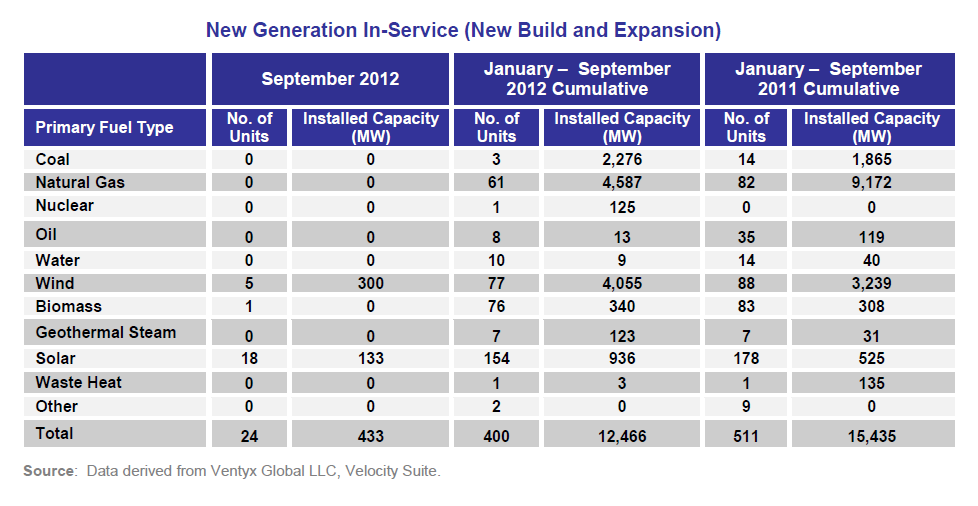
Wind and solar were all the new U.S. electric generation in September 2012

Wind and sun provided all the new electric power generation
deployed in September 2012.
As Moore’s Law continues to decrease solar prices, solar
power gets deployed still more rapidly,
and wind also gets installed on time and on budget.
Meanwhile, nuclear takes a

three-legged nuclear regulatory-capture stool

and hardly any new reactors get finished anyway.


Stephen Lacey wrote for TP Climate Progress 24 October 2012,

Wind And Solar Make Up 100% Of New U.S. Electricity Capacity In September
,

September was tied for the

hottest of any September
on record
globally. It was also a very hot month for renewable energy in the
U.S. According

to figures
from the Federal Energy Regulatory
Commission, wind and solar accounted for all new electricity
capacity added to America’s grid in September.

New wind is up 25% Jan-Sep 2012 over the same period last year,
and new solar is up 78%.
For comparison, new coal is

Continue reading

What Georgia Power is afraid of: GaSU and Dr. Smith; and you

So what is Georgia Power afraid of

that made their CEO Paul Bowers double down on old-style baseload?

Competition, that’s what!
What could be more scary in the power-monopoly state of the

1973 Territorial Electric Service Act?


GaSU sun

On one side, Georgia Power faces

GaSU and its 80 or 90 MW solar plant proposal.

Walter C. Jones wrote for OnlineAthens 24 September 2012,

Proposed solar company could stir up Georgia’s utility structure
,

A proposal from a start-up business promises to lower electricity
rates by rebating profits to customers if given a chance to compete
as Georgia Power Co.’s “mirror image.”


GaSU fb profile image

To proceed with its long-range plan of developing 2 gigawatts of
solar power, the start-up, Georgia Solar Utilities Inc., wants to
start by building an 80-megawatt “solar farm” near
Milledgeville as soon as it gets a green light from the Georgia
Public Service Commission. GaSU filed its request last week, and as
of Monday, it’s still too fresh for public evaluation.

So radical is the proposal that spokespersons for Georgia Power and
the Georgia Solar Energy Association said they still were evaluating
it and could not comment.

Groups that normally advocate for customers also are staying quiet.

GaSU executives recognize such a big change won’t come easily.

Continue reading

Georgia Power’s Bowers pushes solar misinformation out the next fifty years

Paul Bowers, CEO of Georgia Power, doubled down on baseload nuclear,
coal, and natural gas for the next fifty years.
What’s he scared of?

Nick Coltrain wrote for OnlineAthens yesterday,

Renewable push not in the cards for Ga. Power
,


Georgia Power CEO Paul Bowers in Georgia Trend, November 2011

“Renewable (energy sources are) going to have a sliver,”
Bowers said of fuels to create electricity. “Is it going to be
2 or 4 percent? That’s yet to be determined. Economics will drive
that. But you always remember (that renewable energy is) an
intermittent resource. It’s not one you can depend on 100 percent of
the time.”

One time you can depend on it is hot summer days when everybody is
air conditioning, which is why

Roger Duncan of Austin Energy in 2003


Austin Energy flipped in one year

from spouting such nonsense to deploying the most aggressive solar rooftop
rebate program in the country.
Austin Energy did the math and found those rebates would cost
about the same as a coal plant and would generate as much energy.
And when it is needed most, unlike the fossilized baseload grid,
which
left millions without power in the U.S. in June

and

hundreds of millions without power in India in July.

Bowers knows better than the nonsense he just spouted;
as recently as

November 2011 he told Georgia Trend,

Continue reading

A billion people on solar: India


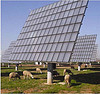
Figure 6: Solar Sheep (Concentrix Solar PV concentrator plant)

Two professors in India have done the math and found that
there’s plenty of available land in India (much of it on rooftops)
to power its billion people on solar energy alone.
And solar uses less water than nuclear or coal, also as we already knew for the U.S.

Today in The Hindu,

India can meet energy needs sans N-power: Study
,

According to their study, 4.1 per cent of the total uncultivable and

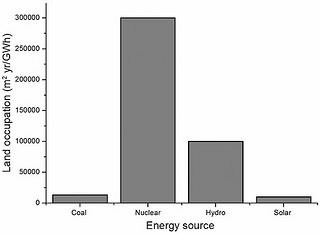
Figure 3: 1GWh Land area per energy source

waste land area in India is enough to meet the projected annual
demand of 3,400 terawatt-hour (TWh) by 2070 by solar energy alone (1
terawatt-hour per year equals 114 megawatts). The land area required
will be further reduced to 3.1 per cent “if we bring the other
potential renewable energy sources of India into picture”,
they claim. They conclude that land availability is not a limiting
constraint for the solar source as believed. According to their
study, 4.1 per cent of the total uncultivable and waste land area in
India is enough to meet the projected annual demand of 3,400
terawatt-hour (TWh) by 2070 by solar energy alone (1 terawatt-hour
per year equals 114 megawatts). The land area required will be
further reduced to 3.1 per cent “if we bring the other
potential renewable energy sources of India into picture”,
they claim. They conclude that land availability is not a limiting
constraint for the solar source as believed.

The graph above shows land occupation needed to generate 1 gigawatt hour (1GWh)
for each of coal, nuclear, hydroelectric, and solar.
It is Figure 3 from the actual study,

Is land really a constraint for the utilitzation of solar energy in India?

by H. Mitavachan and J. Srinivasan, Current Science, Vol. 103, No. 2, pp. 163-168, 25 July 2012.
More from the Hindu article, with graphs from the journal article:

Continue reading

Southern Company’s three-legged nuclear regulatory-capture stool


The

failed EDF nuke project at Calvert Cliffs in Maryland

makes it clearer why Southern Company (SO) was the first company
to get a nuclear permit in 30 years:
it was the only one big enough and monopolistic enough to pull it off.
Even then it’s such a

bet-the-farm risk

that even

“great, big company”

SO only dared
to deploy its

great big huge scale
equipment
with the regulatory capture triple-whammy
of
a stealth tax on Georgia Power bills,
PSC approval of cost overruns,
and
an $8.33 billion federal loan guarantee:


  1. a legislated

    stealth tax in the form of

    a rate hike on Georgia Power customers
    for
    power they won’t get for years if ever.
    If you’re a Georgia Power customer,
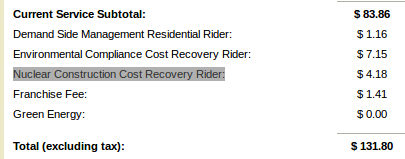
    look on your bill for Nuclear Construct Cost Recovery Rider.
    You’ll find it adds about 5% on top of your Current Service Subtotal.
    Georgia is one of only a handful of states where such a
    Construction Work in Progress (CWIP) charge is legal

    thanks to our regulatory-captured legislature.

    Doubling down on bad energy bets,
    Southern Company is also

    trying to use CWIP to build a coal plant in Mississippi.


  2. A captive Public Service Commission that

    rubber-stamps costs
    for Plant Vogtle.
    In case there was any doubt as to the PSC’s role in legitimizing those new nukes,
    the very next day Fitch reaffirmed Southern Company’s bond ratings.

    Southern Company’s regulated utility subsidiaries derive predictable
    cash flows from low-risk utility businesses, enjoy relatively
    favorable regulatory framework in their service territories, and
    exhibit limited commodity price risks due to the ability to recover
    fuel and purchased power through separate cost trackers.

    Translation: Georgia Power customers subsidize SO’s bonds
    and SO shareholders’ stock dividends.
    The PSC also approved
    cost overruns being
    passed on to Georgia Power customers,
    and those nukes are already over

    $400 or $900 million
    , depending on who you ask.
    What do you expect when

    4 out of 5 Public Service Commissioners
    apparently took 70% of their campaign contributions from utilities
    they regulate or their employees or their law firms,

    and the fifth commissioner took about 20% from such sources?
    Hm, there’s an election going on right now!


  3. An

    $8.33 billion federal loan guarantee.

    Even that’s not good enough for SO and Georgia Power: SO is
    asking for less down payment.

And what if even one of that three-legged regulatory capture stool’s legs
went away?

Continue reading

Bill Moyers on ALEC

Bill Moyers takes on ALEC.

Posted yesterday On Bill Moyers’ website,

‘United States of ALEC’ Video Previews

This week, Moyers & Company (check local listings) presents


“United States of ALEC,” a report on the most
influential corporate-funded political force most of America has
never heard of — ALEC, the American Legislative Exchange
Council. A national consortium of state politicians and powerful
corporations, ALEC presents itself as a “nonpartisan
public-private partnership”. But behind that mantra lies a
vast network of corporate lobbying and political action aimed to
increase corporate profits at public expense without public
knowledge.

He said more

on Huffington Post Wednesday,

Continue reading

Georgia Power inches towards more solar, trailing New Jersey

If you’re quick, you may be able to sell solar from your roof
to Georgia Power.
If the PSC approves a pending request.
If you get in before that new quota gets filled.
And if you’re a Georgia Power customer.
The rest of us?
Not until the
1973 Georgia Electric Territorial Act
is changed.
Until then, Georgia will continue to lag way behind New Jersey in solar power.


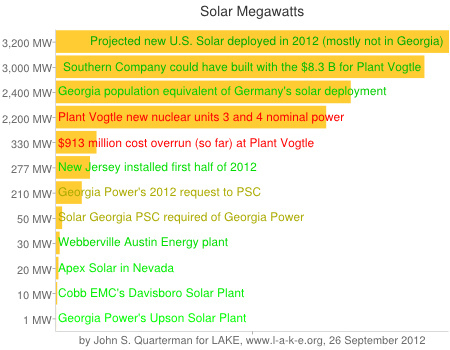
210 MW is more than 50 MW but way less than 3,000 MW

Walter C. Jones wrote for the Augusta Chronicle today,

Georgia Power plans to triple solar power use
,

Georgia Power filed Wednesday seeking permission from state
regulators to more than triple the amount of solar power it uses to
generate electricity for its 2.4 million customers by swapping it
for what was already planned from other renewable sources.

What “other renewable sources”?

The Georgia Power plan won’t affect rates because it is based on
paying the solar providers what it would have paid the biomass
provider, 13 cents per kilowatt hour, which is already figured into
customer’s rates.

OK, that’s good, because it means biomass is well and truly
dead in Georgia.
But it also means Georgia Power isn’t very serious about solar,
if all it’s doing is fiddling with accounting for the small amount
of power biomass might have produced and not going for the real
numbers solar can produce.
OK, how many solar megawatts?

Continue reading