Category Archives: Coal

Putting conservation into conservatives —John S. Quarterman

My op-ed in the VDT today. -jsq

Gov. Deal
(WABE, 14 Nov 2012)
temporarily forgot that “conservative”
includes conserving something,


like

Theodore Roosevelt and national parks
,
or when

Franklin D. Roosevelt established the Okefenokee National Wildlife
Refuge
which also

administers Banks Lake,
when

Richard Nixon started the EPA,

and when

Jimmy Carter signed the Soil and Water Conservation Act.

If Gov. Deal wants to call conservation “liberal”, I’m happy to
be a liberal working for water for our state!


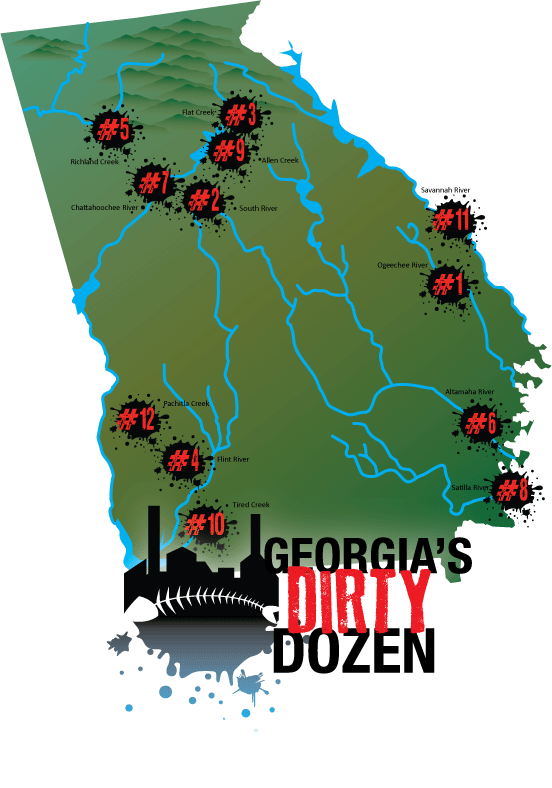
Georgia Water Coalition’s Dirty Dozen


listed the biggest boondoggle
of all as

#11: the nuclear reactors at Plant Vogtle

suck up more water from the Savannah River than all local agriculture and almost
as much as the city of Savannah.

If the new Plant Vogtle nukes

are ever completed,
all four will use more water than Savannah. In

2009 the legislature approved and Gov. Deal signed a law

letting Georgia
Power charge its customers in advance for building that boondoggle,
to the tune of

about $1.5 billion so far!

Let’s not forget

Continue reading

Carbon bubble? Solar and wind erode coal, gas, and biomass credit quality —Moody’s


In Europe it’s already happening: solar and wind are causing
bond-rater Moody’s to warn of downgrades of energy companies
that depend on heat from burning coal, gas, or biomass.
Moody’s earlier even warned the Bank of England
of a potential carbon bubble developing.
If combustion energy plants are affected like this,
the credit effects will be even bigger on even-more-expensive
nuclear plants, which Moody’s called a

bet-the-farm risk
way back in 2009.

James Murray wrote for businessGreen 6 Nov 2012,

Moody’s: Renewables boom poses credit risk for coal and gas power plants:
Credit ratings agency warns increases in renewable power have had ‘a
profound negative impact’ on the competitiveness of thermal
generation companies
,

“Large increases in renewables have had a profound negative impact
on power prices and the competitiveness of thermal generation
companies in Europe,” said Scott Phillips, an assistant vice
president and analyst at Moody’s Infrastructure Finance Group, in a
statement.

“What were once considered stable companies have seen their business
models severely disrupted and we expect steadily rising levels of
renewable energy output to further affect European utilities’
creditworthiness.”

And not just rising, rising increasingly

Continue reading

What is Moore’s Law for solar power?

Many people are unfamiliar with Moore’s Law, and

how it affects solar power.

Moore’s Law doesn’t occur
in many technologies or industries,
but it’s there in solar photovoltaic (PV).
For those of us whose whole working lives have been
affected by Moore’s Law, seeing it turn up in another field
is like a flashing neon sign pointing to the future.
A future of distributed solar power sunrise
over the crumbling industrial relics of coal, nuclear, and natural gas plants.
A future with much less control by monopoly utilities,
which is why they fight it.
If they even see it coming; Bill Gates didn’t, back in the day,
but Jeff Bezos of Amazon did.
They both surfed that tide,
and Moore’s Law made both of them among the richest humans on the planet
while changing the world for all of us.
Steve Jobs even used it to put a computer in your pocket
more powerful than big companies could buy a few decades ago.
What does Moore’s Law for solar power mean for electric power?

This chart shows the telltale symptom of Moore’s Law in solar electricity:
65% compound annual growth rate in solar power plants
deployed for the past 5 years:


Source:
Solar Power Graphs to Make You Smile

by Zachary Shahan for CleanTechnica 10 June 2011.

As SunPower’s Dinwoodie puts it:

That 17 GW installed in 2010 is the equivalent of 17 nuclear power
plants — manufactured, shipped and installed in one year. It
can take decades just to install a nuclear plant. Think about that.
I heard Bill Gates recently call solar “cute.” Well,
that’s 17 GW of “cute” adding up at an astonishing pace.


Bill Gates should recall that Moore’s Law made formerly “cute” PCs with his
“cute” operating system Windows expand into every company in the world
and made him the second richest human on the planet.
Growth of computer software markets,

like for the U.S. as shown in the graph on the right,

is a symptom of the original Moore’s Law.
Software runs on hardware, and these hardware market curves
are driven more directly by Moore’s Law:

Continue reading

Fake fracking reports: professor and institute head quit, other institute disbanded

From Austin to Buffalo, fake science for fracking is increasingly being exposed,

Frack U

with academic consequences: lead professor resigns,
institute head quits, another institute disbanded.
The image on the right (Frack U) is not a reputation any university wants to see.
At least academia takes conflicts of interest seriously;
now if government and the voters would do the same….
Or energy companies.
Remember, shale gas (plus nuclear) is what Georgia Power and
Southern Company are shifting to from coal,
while shading us from the finances that would enable solar power
for jobs and energy independence in south Georgia.

Terrence Henry
wrote for NPR 6 December 2012,

Review of UT Fracking Study Finds Failure to Disclose Conflict of Interest (Updated)

The original report by UT Austin’s Energy Institute,


‘Fact-Based Regulation for Environmental Protection in the Shale Gas
Development,’
was released early this year, and claimed that there
was no link between fracking and water contamination. But this
summer, the

Public Accountability Initiative
, a watchdog group,
reported that the head of the study, UT professor Chip Groat, had
been sitting on the board of a drilling company the entire time. His
compensation totaled over $1.5 million over the last five years.
That prompted the University to announce an independent review of
the study a month later, which was released today.

The review finds many problems with the original study, chief among
them that Groat did not disclose what it calls a “clear
conflict of interest,” which “severely diminished”
the study. The study was originally commissioned as a way to correct
what it called “controversies” over fracking because of
media reports, but ironically ended up as a lightning rod itself for
failing to disclose conflicts of interest and for lacking scientific
rigor.

Unrepentant
as recently as July,
Professor Groat resigned in November.
Plus this:

Raymond Orbach of UT’s Energy Institute has resigned after the group
became engulfed in controversy over a study of fracking.

And elsewhere even more drastic results have ensued:

Continue reading

Renewables are Winning, Nukes are Dead, and Coal is Crashing


Somebody is willing to read the sunshine writing:

Renewables are Winning, Nukes are Dead and Coal is Crashing
, as
Kathleen Rogers and Danny Kennedy wrote for EcoWatch 14 Dec 2012.

As I wrote

back in April when formerly coal-plotting Cobb EMC went solar:

Coal is dead. Nuclear is going down.
Solar will eat the lunch of utilities that don’t start generating it.

Can Georgia Power and Southern Company (SO) read that handwriting on the wall?


They can’t fight Moore’s Law, which has steadily brought the cost
of solar photovoltaic (PV) energy down for thirty years now, and
shows no signs of stopping.
This is the same Moore’s Law that has put a computer in your pocket
more powerful than a computer
that cost hundreds of thousands of dollars in 1982
and was used by an entire company.

Solar PV costs dropped 50% last year.

Already
all the new U.S. electric capacity installed this September
was solar and wind.

As this trend continues, solar will become so much more cost-effective
than any fossil or nuclear fuel power that nobody will be able to ignore it.

Rogers and Kennedy explained this phenomenon:

The seismic shift in how we all use cell phones and mobile technology to access the internet almost snuck up on the incumbent technologies and the monopolies that made money selling us landline telephones and a crappy service. Now, we’re all using apps on smartphones all of the time. So too, the shift to a scaled, solar-powered future built around the modular technology at the heart of solar power—the photovoltaic solar cell—will come as a surprise to many. We call it the solar ascent, and it is happening every day in a million ways.

Will SO and Georgia Power continue to prop up

that 1973 legal wall


that

inhibits solar financing in Georgia?

Companies and even economic development authorities are

starting to find ways around it,

and of course there’s

Georgia Solar Utilities (GaSU)
trying to

wedge into the law as a utility.

After Hurricane Sandy,

rooftop solar for grid outage independence

has suddenly hit the big time
(Austin Energy caught onto that back in 2003).
The

U.S. military got solar and renewable energy

back in Afghanistan and are now doing it bigtime everywhere.

SO and Georgia Power can try to ignore

Continue reading

New biomass plant near Dublin, GA: what it’s really about

Not really about jobs, and not about feeding electricity into the grid:
the new biomass plant near Dublin, GA is about saving that company money on electricity: but at what cost to the state and to local residents?


Mike Stucka wrote for Macon.com 6 December 2012,

Deal announces $95 million biomass power plant for Laurens County
,

A new biomass power plant announced Thursday is expected to bring
hundreds of related jobs and a direct $95 million investment.

A statement from the office of Gov. Nathan Deal said the plant
itself will bring 35 permanent jobs to Laurens County.

Compare 35 permanent jobs for $95 million to

MAGE SOLAR’s 350 jobs for $30 million
.
That’s about $2,700,000 per job for this deal,
vs. $85,714 per job for MAGE SOLAR.
Which would make MAGE SOLAR’s facility more than 30 times more effective
at producing permanent jobs.

OK, but what’s this one supposed to do?

Continue reading

How to stop climate change: divest from fossil fuel companies

In response to a very downbeat

diatribe by Bill McKibben in Rolling Stone on the occasion
of the U.N.’s Rio+20 conference
being some sound and less fury accomplishing
not much about stopping climate change,
[Bill McKibben, Rolling Stone, 19 July 2012, “Global Warming’s Terrifying New Math: Three simple numbers that add up to global catastrophe – and that make clear who the real enemy is”]


Chloe Maxmin, Divest Harvard

Harvard student Chloe Maxmin

followed up McKibben’s problem statement with a plan for what to do:

divest from fossil fuel companies. [“In Honor of Kalamazoo: An Open Letter to Bill McKibben,” NextGenJournal, 25 July 2012, no longer online, referred to in a post the same day by Chloe Maxmin on First Here, Then Everywhere.]

Maxmin didn’t just wish, either,
she joined up with McKibben’s 350.org and helped organize
Harvard students to do something about it:
persuade Harvard to divest its shares of fossil fuel companies.
Students at the University of Georgia, or at Valdosta State University,
for that matter, could do the same.

Alli Welton wrote for 350.org 18 November 2012,

72% of Harvard Students Vote to Divest from Fossil Fuels
,

Last Friday night, the Harvard College Undergraduate Council
announced that the student body had voted 72% in favor of Harvard
University divesting its $30.7 billion endowment from fossil fuels.

Members of the Harvard chapter of Students for a Just and Stable
Future have been campaigning since September to divest Harvard’s
endowment from the top 200 publicly-traded fossil fuel corporations
that own the majority of the world’s oil, coal, and gas reserves.

Harvard actually already has divested its shares of one fossil fuel company
due to public pressure.

Continue reading

GaSU wins at GA PSC, but will GaSU help all of us win in the legislature?

GA PSC Stan Wise’s 2009 nuclear CWIP lobbying points eerily matched Southern Company’s,
but suddenly he’s got separation-of-powers religion about Georgia Solar Utilities (GaSU).
The PSC recommended GaSU’s utility bid anyway.
When the legislature takes that up in a month or so, will GaSU CEO Robert Green,
unlike SO or Georgia Power or Stan Wise, help the rest of us little people
fix the 1973 Territoriality law so we can sell our solar electricity
on a free market?

Dave Williams wrote for the Atlanta Business Chronicle yesterday,

Georgia Public Service Commission moves ahead on solar energy
,


Georgia Power logo

The Georgia Public Service Commission approved a plan by Georgia
Power Co. Tuesday to acquire an additional 210 megawatts of solar
generating capacity, more than tripling its investment in solar
energy.


GA PSC PR about 20 November 2012 decisions

But a sharply divided PSC also gave a potential competitor to
Georgia Power its blessing to appeal to the General Assembly to
amend a 39-year-old law that gives the Atlanta-based utility the
exclusive right to continue serving existing customers.

Under Georgia Power’s Advanced Solar Initiative, the company will
buy solar power produced by both large “utility-scale”
solar farms and from smaller projects operated by residential and
commercial property owners.

Right, that’s actually

only 10 Megawatts from “smaller projects”,

maintaining Georgia Power’s monopoly while throwing throwing
a bone to the rest of us.

While the PSC supported Georgia Power’s plan unanimously, a
subsequent motion by McDonald encouraging other solar utilities
interested in serving Georgia to pursue their plans with the
legislature passed by the narrow margin of 3-2.

Georgia Solar Utilities Inc., a company launched in Macon, Ga.,
earlier this year, filed an application with the PSC in September
for authority to generate solar energy in Georgia on a utility
scale.

The two Nay votes were from the two recently-reelected PSC members,
apparently now thoroughly in the pocket of the incumbent utilities.
Here’s one of them now:

Continue reading

Help the military stop climate change through sustainable renewable energy

In memory of Armistice Day, the eleventh hour of the eleventh day of the
eleventh month, when World War I ended,
let’s help the military get us off of oil
and to deal with climate change so fewer people will die in wars.

John M. Broder wrote for NYTimes 9 November 2012,

Climate Change Report Outlines Perils for U.S. Military
,

Climate change is accelerating, and it will place unparalleled strains on


American military and intelligence agencies in coming years
by causing ever more disruptive events around the globe,
the nation’s top scientific research group said in a
report
issued Friday.

The group, the National
Research Council
, says in a study commissioned by the
C.I.A. and other intelligence agencies that
clusters of apparently unrelated events exacerbated by a warming climate
will create more frequent but unpredictable crises in water supplies,
food markets, energy supply chains and public health systems.



Hurricane Sandy provided a foretaste
of what can be expected more often in the near future, the report’s
lead author, John D. Steinbruner, said in an interview.

“This is the sort of thing we were talking about,” said
Mr. Steinbruner, a longtime authority on national security. “You
can debate the specific contribution of global warming to that storm. But
we’re saying climate extremes are going to be more frequent, and
this was an example of what they could mean. We’re also saying it
could get a whole lot worse than that.”

Climate-driven crises could lead to internal instability or international
conflict and might force the United States to provide humanitarian
assistance or, in some cases, military force to protect vital energy,
economic or other interests, the study said.



This is in addition to the even more obvious
connection between war and U.S. dependence on foreign oil

which the veterans in Operation Free want to fix

by helping us shift to clean renewable energy.

“In Iraq… the lines would stretch up to ten miles long under
the hot sun, under constant risk of attack by extremists. I realized
then just how vulnerable it makes any country to be dependent on
oil, especially the United States, which uses nearly a quarter of
the world’s supply.”

We also heard last year from

Col. Dan Nolan (U.S. Army ret.) that the Marines in Afghanistan
realized

Continue reading